


Money Research Collective’s editorial team solely created this content. Opinions are their own, but compensation and in-depth research determine where and how companies may appear. Many featured companies advertise with us. How we make money.
Americans Are About to Drop Billions Betting on the 2026 World Cup
By Pete Grieve MONEY RESEARCH COLLECTIVE
Do Americans finally like soccer? Or do they just love gambling? (Maybe both.)

As the U.S., Canada and Mexico prepare to host the 2026 FIFA World Cup, millions of people are getting in on the action with wagers on the matches, goals and eventual champion. If the latest predictions are right, the betting figures will smash records.
New forecasts project that soccer fans will bet nearly $3 billion in the U.S. through online sportsbooks, while billions more could be traded on prediction market platforms.
Must Read
- Warren Buffett on Market Volatility — and 3 Ways You Can Take Advantage
- Experts are Bullish on Gold — Here's How to Get In
H2 Gambling Capital, a market intelligence provider, predicts $2.9 billion will be wagered with U.S. sportsbooks. That’s only a fraction of the $60 billion that could be bet globally, representing a 71% increase over the 2022 World Cup in Qatar. (H2’s U.S. estimate covers “legal sportsbooks only, excluding dot-com sites,” says Ed Birkin, the firm’s managing director.)
Eilers & Krejcik Gaming released a separate forecast, with a base case of $2.82 billion in U.S. online wagers for the 2026 World Cup. This estimate assumes that the U.S. men’s national team (USMNT) reaches the Round of 32 or the Round of 16, where the Americans would bow out.
Sports betting on the 2026 World Cup could triple 2022 levels
This summer, the World Cup expands into a new format with 48 teams, up from 32 in the past. The change means more games (104 vs. 64), more action and more betting. Combine the expansion with the explosive growth of app-based sports betting and the rise of prediction markets, and it’s a perfect storm for this to be one of the biggest moments ever for sports gambling.
Eilers & Krejcik Gaming forecasts worst-case and best-case scenarios ranging from $2.32 billion and $4.33 billion in total U.S. wagers, with more betting expected in the event of a deeper USMNT run. However, the team has not advanced to the quarterfinals since 2002.
As a reference point, Eilers & Krejcik Gaming projected $1.62 billion in bets for the Super Bowl in February and estimated $900 million to $1 billion in bets for the last World Cup.
About 70% of the World Cup bets will be wagered on two platforms: DraftKings (accounting for $1.02 billion) and FanDuel ($945 million), the firm said in its forecast.
Where People Are Investing Right Now
- Robinhood lets you trade stocks and ETFs 24 hours a day, 7 days a week
- CIT Bank: Earn up to 4.10% with a high-yield savings account
- American Hartford Gold: Explore different gold IRA options and protect your wealth
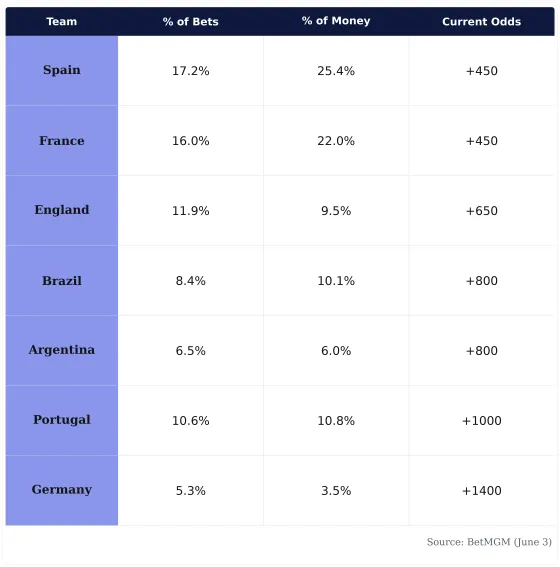
World Cup winner odds for 2026
So far, the most betting action on the tournament winner is behind Spain and France, and to a lesser extent, England, Brazil and Portugal, according to BetMGM.
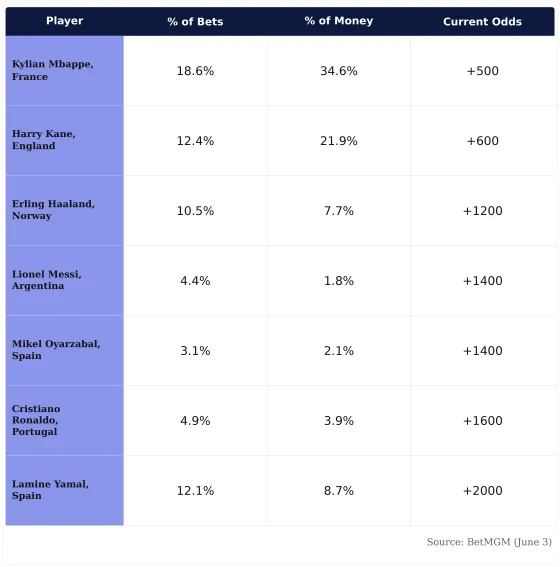
Leading goalscorer odds
Who will score the most goals and win the “Golden Boot” in the 2026 World Cup? The most bets have come in on France’s Kylian Mbappe, England’s Harry Kane, Norway’s Erling Haaland, Portugal’s Cristiano Ronaldo and Spain’s Lamine Yamal.
Can you bet on World Cup prediction markets?
Prediction market platforms have exploded onto the scene since the last World Cup, largely due to the Trump administration granting them permission to operate nationwide. Users 18 and older can essentially sports-bet on these sites by purchasing “yes” or “no” contracts on sports-related event markets, which resolve to a value of $1 per contract if the pick is correct.
Analysts say prediction market volume cannot be compared head-to-head with sports-betting figures. One reason for this is that a trade on a prediction market counts toward volume on both the buy and sell sides of a trade. Also, traders are constantly buying and selling contracts, meaning the volume numbers that are reported end up being larger than the actual money at stake on the games.
The trends still show clear growth. DeFi Rate, a research and analytics website covering prediction markets, estimated Monday that American customers will trade $2.5 billion on prediction market platforms for the World Cup, with Kalshi projected to see $1.47 billion of that volume.
“The key driver will be the individual matchups — they account for roughly 80% of the projected volume, and our data shows most of the action will happen on game day,” Cheryle Shepstone, director of content at DeFi Rate, said in a news release.
Future-looking bets on prediction markets are also popular, offering users the ability to cash out their trades as the tournament progresses.
DeFi Rate projected $253 million in Kalshi volume on the World Cup winner market. That would comfortably beat the comparable market for the winner of the 2026 March Madness tournament, which had an estimated $169 million of volume.
Must Read
- Warren Buffett on Market Volatility — and 3 Ways You Can Take Advantage
- Experts are Bullish on Gold — Here's How to Get In
Pete Grieve is a New York-based reporter who covers personal finance news. At Money, Pete reports stories that affect Americans’ wallets on topics including insurance, autos, housing, credit cards, retirement and taxes. He studied political science and photography at the University of Chicago, where he was editor-in-chief of The Chicago Maroon, the student newspaper. Pete began his career as a professional journalist in 2019. Prior to joining Money, he was a health reporter for Spectrum News based in Columbus, Ohio, where he wrote digital stories and appeared on TV to provide coverage to a statewide audience. He has also written for the San Francisco Chronicle, the Chicago Sun-Times and CNN Politics. Pete received extensive journalism training through Report for America, a nonprofit organization that places reporters in newsrooms to cover underreported issues and communities, and has attended journalism conferences from organizations including Investigative Reporters and Editors (IRE) and the Society for Advancing Business Editing and Writing. He has discussed his reporting in interviews with outlets including the Columbia Journalism Review, This Morning With Gordon Deal and WBEZ (Chicago's NPR station). He’s been a panelist at the Chicago Headline Club’s FOIA Fest and he received the Institute on Political Journalism’s $2,500 Award for Excellence in Collegiate Reporting in 2017. An essay he wrote for Grey City magazine was later published in a 2020 book, Remembering J. Z. Smith: A Career and its Consequence.