


Money Research Collective’s editorial team solely created this content. Opinions are their own, but compensation and in-depth research determine where and how companies may appear. Many featured companies advertise with us. How we make money.
Here’s How Long It Has Been Since You Could Pay for College With a Minimum Wage Job
By Adam Hardy MONEY RESEARCH COLLECTIVE
Until 2001, you could fully pay for college tuition, room and board with any full-time job in the U.S., according to a Money analysis of federal wage and education data. That’s no longer the case.

In the year 2000, millions of people exhaled as computer systems avoided a Y2K meltdown. The first permanent crew arrived at the International Space Station. A pound of ground beef cost under $1.50.
It was also the final year that you could fully pay for college tuition, room and board with any full-time job in the U.S., according to a Money analysis of federal wage and education data. The minimum wage in 2000 was $5.15, and the cost of attending a public, four-year college — a budget line item that includes housing and food — was $8,653.
Must Read
- 10 Smart Ways Seniors Are Earning Extra Money
- Your Social Security Number Isn’t 'Suspended' — That Phone Call Is Probably a Scam
- Silver Is Up 70% Since This Time Last Year — and These Gold IRA Companies are Handing Out Up to $25,000 of It
Today, the picture looks much different. The minimum wage has been frozen at $7.25 for over 17 years, the longest period without an increase in U.S. history. Meanwhile, college costs have risen to an estimated $24,868 in 2026, for an increase of 187% since 2000.
Increasingly, Americans are catching on — and sounding off. According to a recent Pew survey, 82% of adults said it’s harder for young people to pay for college than it was for their parents. That is a big jump from 2021, when 71% said the same.
The data backs them up. Money analyzed trends in wages and college costs over the past 36 years, finding that it took as little as 31 hours of work a week in the ’90s to fully pay for college, room and board, even after accounting for federal payroll and income taxes for a single filer.
Today, it requires a workweek of 71 hours.
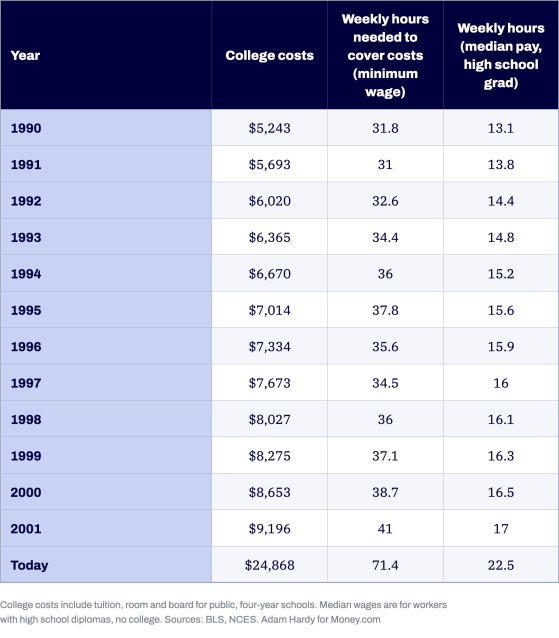
Paying for college with a minimum wage job? That’s so ’90s
Money’s analysis starts in 1990, when the average cost to attend a four-year college ran $5,243. The net minimum wage was $6,601 per year, meaning any job available to a student — from shopping-cart wrangler to burger flipper — could pay for a bachelor’s degree, food and on-campus housing with the equivalent of 31.8 hours of work per week.
That used to be the norm. A landmark study from Georgetown University found that more than 7 in 10 college students worked in the ’90s, for an average of about 30 hours a week.
Throughout the rest of the decade, the weekly hours needed to afford college fluctuated from 31 to 39. It wasn’t until 2001 that a typical full-time minimum wage job could no longer pay for college (assuming the entire paycheck went toward college costs), requiring a work week of at least 41 hours.
In subsequent years, the gap ballooned as minimum wage increases became rarer and college tuition hikes became steeper.
Must Read
- Retirees Are Doing These 10 Things to Add to Their Monthly Income
- Your Social Security Number Isn’t 'Suspended' — That Phone Call Is Probably a Scam
- Warren Buffett on Market Volatility — and 3 Ways You Can Take Advantage
Today, working 30 to 40 hours per week at minimum wage rarely puts a dent in college costs. And experts advise against working more than that, as it can negatively affect grades and ability to graduate on time.
There is a silver lining. Few Americans in 2026 earn the federal minimum wage. Most states set their own minimum wages far above $7.25, usually ranging from $10 to upwards of $18.40 in Washington, D.C.
To help account for large differences in state minimum wages, Money also looked at how the typical earnings for a high school graduate stack up against college costs.
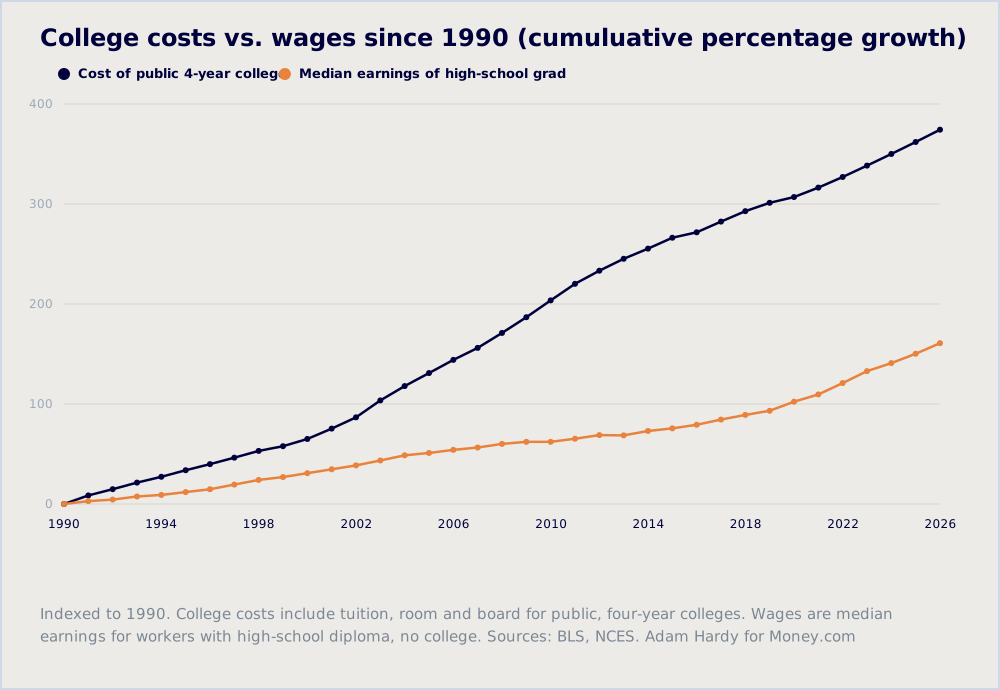
In 1990, typical annual pay for a high school grad after taxes was $16,013.19, while college costs were under $5,300. That year, just 13 hours of work per week at median pay could cover tuition, room and board.
The typical take-home pay these days for a high school grad is much higher at $44,252.74. But so are college costs. To cover $24,868 for college tuition, room and board requires a workweek of about 23 hours earning median pay.
That workweek is longer than in the 90s, yes, but it’s still noticeably shorter than the 70-plus hours it would take on today’s federal minimum wage.
And that affordability gap appears to be shrinking. Since the pandemic, college costs have remained stagnant, while typical wages — especially for high-school grads — have risen.
It is no doubt more challenging for students to work their way through college today than in previous generations, but that doesn’t mean the trend is set is stone.
Adam Hardy is Money's lead data journalist. He writes news and feature stories aimed at helping everyday people manage their finances. He joined Money full-time in 2021 but has covered personal finance and economic topics since 2018. Previously, he worked for Forbes Advisor, The Penny Hoarder and Creative Loafing. In addition to those outlets, Adam’s work has been featured in a variety of local, national and international publications, including the Asia Times, Business Insider, Las Vegas Review-Journal, Yahoo! Finance, Nasdaq and several others. Adam graduated with a bachelor’s degree from the University of South Florida, where he studied magazine journalism and sociology. As a first-generation college graduate from a low-income, single-parent household, Adam understands firsthand the financial barriers that plague low-income Americans. His reporting aims to illuminate these issues. Since joining Money, Adam has already written over 500 articles, including a cover story on financial surveillance, a profile of Director Rohit Chopra of the Consumer Financial Protection Bureau and an investigation into flexible spending accounts, which found that workers forfeit billions of dollars annually through the workplace plans. He has also led data analysis on several of Money’s marquee rankings, including Best Hospitals, Best Credit Cards, Best Places to Live and others. In 2025, Adam was named a Goldschmidt Data Journalism Fellow by the Society for Advancing Business Editing and Writing (SABEW). As part of the fellowship, he received hands-on training from SABEW, the U.S. Census, U.S. Federal Reserve Bank, Bureau of Labor Statistics and other federal government agencies in Washington, D.C. Adam also holds a multimedia storytelling certificate from Poynter’s News University and a data journalism certificate from the Investigative Reporters and Editors at the University of Missouri. In 2017, he received an English teaching certification from the University of Cambridge, which he utilized during his time in Seoul, South Korea. There, he taught students of all ages, from 5 to 65, and worked with North Korean refugees who were resettling in the area. Now, Adam lives in St. Petersburg, Florida, with his pup Bambi. He is a card-carrying shuffleboard club member.