


Money Research Collective’s editorial team solely created this content. Opinions are their own, but compensation and in-depth research determine where and how companies may appear. Many featured companies advertise with us. How we make money.
Gas Prices Rose 40% Since the Iran War Began. They Won’t Fall Nearly as Fast
By Adam Hardy MONEY RESEARCH COLLECTIVE
The ceasefire offers hope, but oil damage and risk premiums may keep gas prices elevated.

At the eleventh hour, the Pakistani government helped broker a two-week ceasefire in the Iran war.
The temporary agreement among the U.S., Israel and Iran was announced Tuesday just minutes before President Donald Trump’s deadline for Iran to reopen the Strait of Hormuz, a crucial waterway for the world’s oil supply. Earlier Tuesday, the president threatened to destroy Iran’s “whole civilization” if it did not reopen the strait and allow trade to continue.
The conflict has choked off between 10% and 20% of the world’s oil supply, sending fuel prices surging all around the globe. In the weeks since the U.S. and Israel attacked oil-rich Iran, U.S. drivers have been faced with some of the highest gas prices on record.
The average price for a gallon of regular gas reached $4.16 on Wednesday, according to AAA’s price tracker, marking an increase of over 20% from last month. Historic price data from the U.S. Energy Information Administration shows that gas prices reached current levels only once before: when Russia invaded Ukraine in 2022, which resulted in an all-time high of $5 per gallon, on average.
Analysts are hopeful the ceasefire could lead to an end to the Iran war — but that doesn’t mean gas prices will meaningfully fall overnight.
“Even if the conflict ended, energy infrastructure has been destroyed or damaged, and it takes time to repair. So we still could see a supply disruption occurring for weeks and months,” Andrew Lipow, president of energy consulting firm Lipow Oil Associates, tells Money.
Why gas prices ‘go up like a rocket and fall like a feather’
For much of February, average gas prices hovered around $2.90 a gallon. Within days of the U.S.’s and Israel’s attacks on Iran, the national average broke $3 a gallon, and about a month later, $4 a gallon.
While the price hikes are jolting for drivers, they commonly follow major supply shocks to the oil markets.
“This goes to the old adage that gas prices go up like a rocket and fall like a feather,” Mark Zandi, chief economist at Moody’s Analytics, previously told Money.
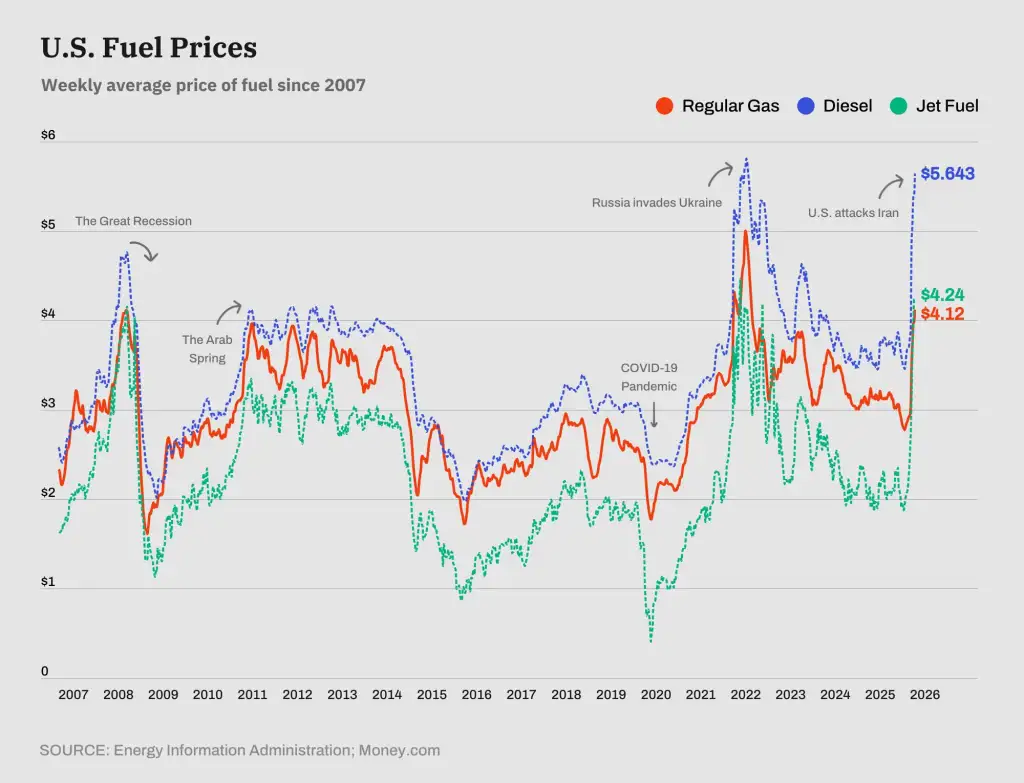
For instance, when Russia invaded Ukraine in February 2022, the cost of a gallon of gas shot up from about $3.60 to $4.20 in one month, an increase of nearly 17%. Prices continued to climb throughout the year until they peaked above $5 a gallon in June. It wasn’t until November that prices reached pre-war levels again.
In this case, Russia was the aggressor and the major oil exporter. The supply disruption was largely due to sanctions and political backlash against Russia. Still, gas prices went haywire as a result.
There is one major exception to the “fall like a feather” adage: recessions. During the past two major U.S. recessions, gas prices fell sharply. Lipow says high oil prices spur an economic contraction, and that’s one case were he would expect gas prices to plummet. Barring a recession, he doesn’t anticipate a gallon of gas falling below $3 a gallon anytime soon.
Analysts are expecting gas prices to linger because of the widespread destruction of Iranian oil infrastructure, warning that it will take considerable time to get oil supplies back to pre-war levels.
If the ceasefire holds — and if Iran is able to rebuild — that still does not guarantee oil and gas prices will return to what they were. There’s new risk in trading in the region that experts say can’t be ignored. The conflict and closure of the strait have introduced a “sizable risk premium” in oil prices that Zandi says will last months, if not years.
The increased risk potentially leads to fewer oil tankers willing to brave the strait, and higher insurance costs if or when they do. That translates to elevated oil prices for the foreseeable future.
“The market is going to remember,” says Patrick De Haan, head of petroleum analysis at GasBuddy. “And markets can have a little PTSD.”

More from Money:
Is This 2008 All Over Again? Fears of a Financial Crash Grow Among Investors
13 Everyday Items Getting More Expensive Because of the Iran War
New USPS Fuel Surcharge Will Make Mailing Packages More Expensive Through 2027
Adam Hardy is Money's lead data journalist. He writes news and feature stories aimed at helping everyday people manage their finances. He joined Money full-time in 2021 but has covered personal finance and economic topics since 2018. Previously, he worked for Forbes Advisor, The Penny Hoarder and Creative Loafing. In addition to those outlets, Adam’s work has been featured in a variety of local, national and international publications, including the Asia Times, Business Insider, Las Vegas Review-Journal, Yahoo! Finance, Nasdaq and several others. Adam graduated with a bachelor’s degree from the University of South Florida, where he studied magazine journalism and sociology. As a first-generation college graduate from a low-income, single-parent household, Adam understands firsthand the financial barriers that plague low-income Americans. His reporting aims to illuminate these issues. Since joining Money, Adam has already written over 300 articles, including a cover story on financial surveillance, a profile of Director Rohit Chopra of the Consumer Financial Protection Bureau and an investigation into flexible spending accounts, which found that workers forfeit billions of dollars annually through the workplace plans. He has also led data analysis on some of Money’s marquee rankings, including Best Places to Live, Best Places to Travel and Best Hospitals. He regularly contributes data reporting for Best Colleges, Best Banks and other lists as well. Adam also holds a multimedia storytelling certificate from Poynter’s News University and a data journalism certificate from the Investigative Reporters and Editors (IRE) at the University of Missouri. In 2017, he received an English teaching certification from the University of Cambridge, which he utilized during his time in Seoul, South Korea. There, he taught students of all ages, from 5 to 65, and worked with North Korean refugees who were resettling in the area. Now, Adam lives in Saint Petersburg, Florida, with his pup Bambi. He is a card-carrying shuffleboard club member.