Citizens often file complaints against Tacoma police. Rarely are those claims sustained
In November 2020, a 16-year-old boy involved in a domestic dispute was detained by two Tacoma police officers.
Before he was placed in the back of a patrol vehicle, the teenager had been defiant, according to an officer’s written report of the incident. The officer grabbed the teen’s left wrist in an effort to detain him while the dispute was being investigated and said the teen balled his left hand into a clenched fist.
The officer pulled the juvenile forward, grabbed the back of his shoulder-length hair and pinned him against a vehicle, the police report said. A second officer took control of his right wrist and, although he attempted to break free, the teen was handcuffed.
Ultimately, the boy was freed to leave the scene on foot, but the incident spurred a citizen complaint against the Tacoma Police Department for alleged violation of its use-of-force policy. Nearly a year later, an investigation by the department’s Internal Affairs section revealed that TPD policy hadn’t been followed, according to complaint data kept by the city of Tacoma.
The finding was rare: Fewer than 9% of more than 1,100 citizen allegations investigated by TPD Internal Affairs over the past nine years were sustained, The News Tribune found.
Citizen-made claims involving use of force were even less likely to be proven: Only one of 36 allegations since 2015, or 2.7 percent, were sustained after an Internal Affairs probe, city data shows.
Since 2015, there have been Internal Affairs findings for 1,127 citizen-reported claims against Tacoma police, stemming from 928 incidents. Ninety-nine allegations were sustained across 91 incidents, according to a News Tribune analysis of the data, which is available online.
Much more often, or nearly 43% of the time, allegations were determined to be “not sustained,” meaning investigators could not substantiate whether or not there had been any misconduct or violation of department policy or procedures, the data shows.
In other instances, allegations were “exonerated” or “unfounded.” An exonerated finding occurs when an alleged action is proven to be substantially correct but deemed appropriate given the circumstances. When claims are determined to be untrue, they’re “unfounded.”
“Not sustained,” “exonerated,” “unfounded” and “sustained” represent the four primary outcomes of investigations into citizen complaints.
“Our Internal Affairs Unit takes all complaints seriously,” Tacoma police spokesman detective William Muse said in an email, adding that the department reviews all allegations made against TPD members. “If there is a specific violation of policy, the allegations are thoroughly vetted. The findings that are ultimately reached are based on the merits of the case.”
Joyce Brekke, a member of the Washington Coalition for Police Accountability, said in an interview that the sustained rate was typical for many jurisdictions, affirming her concerns about conflicts of interest and police investigating themselves.
“It’s disappointing,” she said, “but not surprising.”
The News Tribune requested to speak with Internal Affairs, but no one from the section was made available for an interview.
What is a complaint?
A complaint, defined as any verbal or written communication that conveys dissatisfaction with a TPD member’s performance or conduct, can be lodged by any witness or person with direct knowledge of alleged police misconduct. There are different methods for the public to file a complaint, including by phone, email, mail, online or in person. While anonymous complaints are accepted, they might be limiting to an investigation if there’s no corresponding evidence, according to the city’s website.
The city also warned against fabrications.
“Intentional false reporting in an attempt to unjustly subject a police employee to undeserved discipline or slander, or to place his/her employment in jeopardy, could result in criminal charges being filed and/or a civil suit by the employee involved,” the city’s website reads.
Complaints can be made against any member of the department — commissioned law enforcement officer or not.
There is no timeline for when a citizen must file a complaint following the incident in question, according to Muse, and there’s no policy on how quickly an investigation must be completed. Muse said they’re done in a “timely manner.”
TPD employees subjected to disciplinary measures that hold financial ramifications are required by law to be able to participate in pre-disciplinary hearings. Asked about a citizen’s ability to appeal, Muse said that complainants may contact the Internal Affairs office after receiving notification of an investigative outcome.
Most complaints are addressed by an officer’s supervisor at the bureau level, but, when the complaints are “of a more serious nature,” according to the city’s website, that investigation is handled by Internal Affairs, a four-person team consisting of a TPD lieutenant, two sergeant investigators and a secretary.
City of Tacoma data analyzed by The News Tribune doesn’t account for bureau-level or criminal complaints and only provides findings for citizen-made complaints received by Internal Affairs, according to Muse and the data’s summary page. Therefore, no investigations related to Manuel Ellis are reflected in the data.
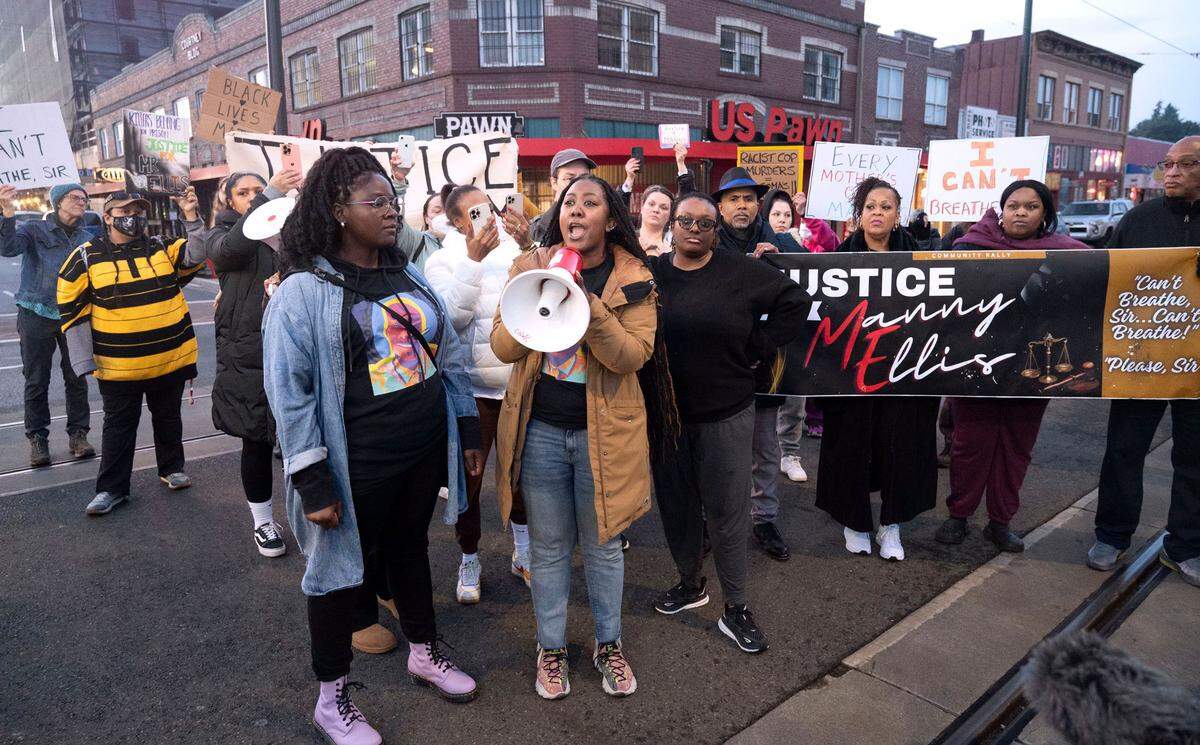
The city announced Tuesday that three officers acquitted by a jury last month in Ellis’ 2020 death would voluntarily resign after an Internal Affairs investigation exonerated each officer of violating the department’s use-of-force policy and found other allegations untrue. A claim that officer Matthew Collins violated policy related to courtesy was sustained, according to a city record.
The probe into their conduct reopened when testimony concluded in the 10-week trial. Two officers involved in Ellis’ death but not charged with a crime were previously cleared of wrongdoing following an internal investigation.
Complaint findings
Exoneration was the second-most likely outcome for all citizen claims investigated by Internal Affairs since 2015. Twenty-nine percent of all allegations resulted in findings that an officer’s behavior was justified under the circumstances, city data shows. Allegations were considered “unfounded,” or untrue, almost 17% of the time.
In a fractional portion of cases, a probe’s finding was unspecified (1.6%) or an officer was fired (0.18%) or resigned during the internal probe (0.09%).
A survey of 213 Internal Affairs units in large police departments across the country found that, on average in 2019, about one in three citizen complaints were sustained — much higher than the rate from TPD’s Internal Affairs section. The finding was published in a 2022 joint report from the University of Massachusetts Lowell and National Internal Affairs Investigators Association.
Muse said that variations in how data is reported might account for the stark difference in rates. The department could not comment on the policies of other agencies, he added, noting that each agency has its own plans and procedures.
In 2022, 6% of 128 bureau-level allegations brought by people were sustained, according to a Jan. 8 presentation to the city’s Community’s Police Advisory Committee by new Internal Affairs Lt. Jeffrey Katz. The claims originated from 85 complaints in a year where there were nearly 149,000 police calls for service, Katz’s presentation noted.
Katz said that complaints brought by fellow officers or supervisors were much more likely to be sustained, with the majority proven. He credited that in part to complainants being familiar with department policy and what constitutes violation of it.
Disciplinary measures
A key difference that separates bureau-level and Internal Affairs complaints is the potential resulting discipline. Bureau-level complaints can arise from issues such as an officer writing an insufficient report or erring on paperwork, Katz said, while those taken up by Internal Affairs include more consequential allegations such as violations of use-of-force policy, according to city data.
While sustained bureau-level complaints can lead to re-training, counseling and reprimands for officers, the potential consequences related to Internal Affairs complaints are more severe: An officer can be suspended, demoted or fired.
The data analyzed by The News Tribune doesn’t reveal how officers were disciplined in the instances when allegations were supported by the subsequent investigation.

In March 2021, a consultant’s report, commissioned by Tacoma in the wake of calls for police reform following high-profile deaths of Black people in custody, raised concern with the department’s internal disciplinary measures.
The consultant, 21CP Solutions, reviewed citizen complaints against Tacoma police between 2017 and 2020 as part of its report and noted there had been no sustained discipline higher than a written reprimand in 2019 or 2020.
“We do not foreclose the possibility that TPD officers were not engaging in misconduct or making mistakes requiring the department to take remedial action,” the report said, “but, based on 21CP’s experience with a number of departments across the country, having no sustained complaints resulting in a suspension for a continuous two-year period is extremely unusual.”
The consultant also noted instances when an imposed disciplinary action was insufficient based on the sustained violation. For example, an officer in 2019 or 2020 punched a person who had awakened from a diabetic coma “because they began to struggle,” according to the report. An Internal Affairs sergeant determined that the officer violated department policies on use of force and courtesy, but the officer was only provided written disapproval as a result.
While Internal Affairs investigates complaints, it’s the police chief who ultimately makes disciplinary decisions, according to Muse, who noted that TPD has had three leaders since 2019.
In most cases, he added, progressive discipline is considered when addressing sustained complaints. To adhere to state law, disciplinary records are retained for a decade after an officer leaves the department. However, for the purposes of progressive discipline, sustained violations are only used against an officer for two years in bureau-level claims and for five years in Internal Affairs complaints, according to Katz.
‘Policy-driven unit’
The consultant made a series of Internal Affairs-related recommendations, including that TPD provide clear expectations for discipline based on sustained violations; enact more detailed investigative policies and processes to ensure probes are fair, thorough and timely; and proactively publish a yearly report that the department reportedly compiles about complaints that is accessible to the public by request.
“The Internal Affairs Unit is a policy-driven unit,” Muse said, in response to an inquiry about how the department had addressed the recommendations. “As policies change, the unit’s focus changes with them.”
Since 2019, the department has shifted, he said, including by implementing broader reforms to align with the “8 Can’t Wait” campaign, which resulted in TPD banning chokeholds and requiring officer intervention when another is using excessive force.
As for internal accountability measures, Muse said the department uses in-vehicle and body-worn cameras that are accessed during Internal Affairs investigations.
“Whereas in the past, investigations were conducted without the benefit of independent and collaborative review using all resources, the Department now has that,” he said in an email. “As a result, some complaints are withdrawn by complainants upon being advised of the presence of video evidence. Additionally, through the Public Disclosure Request, redacted copies of camera footage can be made available through the PDR process.”
In its analysis of TPD data, 21CP found that citizen complaints were sustained 16% of the time between 2017 and 2020. The number of allegations and incidents cited in the report over that period differed from the city data made available online, and it’s unclear if the data used by the consultant accounted for more than just Internal Affairs investigations.
“We cannot specifically speak to what may explain any discrepancies – though, in our experience, differences in terms of categorization or classification of certain incidents could account for some differences in numbers in the area of complaints or misconduct investigations,” Ben Horwitz, who worked on data analysis for the report, told The News Tribune.
Most frequent allegations
The data available online provides associated case numbers for each allegation, which The News Tribune used to obtain — via public records request — corresponding police reports for several incidents, including the domestic dispute involving a juvenile.
In one from August 2022, a woman in northwest Tacoma became upset with police after calling on a neighbor who allegedly stared through her window following a verbal argument — an alleged violation of a court protection order, she claimed. When the woman, who reportedly was using methamphetamine, learned there was no order found in the system, she pulled out her phone and began to record an officer.
The officer attempted to explain the order process and turned up the volume of his portable radio so that the woman could hear dispatch confirm that an order wasn’t served, according to his written account of the incident. Ultimately, the woman requested his supervisor. Once on scene, the officer and supervisor unsuccessfully tried to serve the woman’s copy of the order on the neighbor, who did not answer his door.
Three citizen allegations stemmed from the incident: One for unsatisfactory performance, which was not sustained, and two for courtesy — claims that, in general, accuse a TPD employee of being rude or using profanity. One courtesy allegation was sustained; the other was not, city data shows.
The allegations were the two-most common types raised by community members since 2015 that Internal Affairs investigated, according to the data. Allegation categories are directly tied to department policies.
About 46% and 28% of all claims during the period were for unsatisfactory performance and courtesy, respectively. Slightly more than 6% of allegations were related to vehicle operations and under 5% were connected to unbecoming conduct.
The consultant, 21CP, described “unbecoming conduct” in its report as wholly inappropriate behavior and found instances in 2019 or 2020 of “officers photographing themselves with a person in crisis wearing only underwear and, separately, officers making vomiting gestures or laughing when a person defecated on themselves.”
Violations of use-of-force policy were the fifth-most reported claim at roughly 3%. Fewer than 3% of those claims were sustained and officers were exonerated nearly half of the time, city data shows.
During this month’s meeting, Adrienne Jones, a new member of the city’s Community’s Police Advisory Committee, questioned whether the internal investigative process was meant to get to the root of an issue or simply a performative step that allowed TPD to check a box. The committee is tasked, in part, with reviewing completed bureau-level investigations.
“The determination if the complaint is validated is based on the very department that we’re making the complaint against,” she said, adding that she was concerned only 6% of bureau-level complaints were sustained in 2022. “For me as a community member, it seems like there isn’t — you have to trust that the police are going to police themselves through this process.”
Katz replied that he understood her point and was open to a different and better accountability method if there is one.
“From my heart, what I want out of this is a robust, effective, objective and fair way to hold officers to account,” he said. “So if they violated a policy, so be it. If they didn’t, then so be it.”