Federal judge in Tacoma finds immigration detention of U.S. Army vet unlawful
A federal judge in Tacoma on Monday ruled that a U.S. Army veteran’s detention at the Northwest ICE Processing Center was unlawful and ordered his release. The judge said there were “serious concerns” about substantive due process in the case.
U.S. District Court Judge David Estudillo also made note of “significant concerns” about the government’s inability to provide appropriate medical care to the detainee. Muhammad Zahid Chaudhry, a Lacey resident originally from Pakistan, has lived in the United States for more than two decades and was detained by U.S. Immigration and Customs Enforcement in August at a citizenship interview.
Chaudhry’s wife, Melissa Chaudhry, told The News Tribune that her husband’s vision has been “deteriorating badly.” According to Estudillo, Chaudhry has gone four months without being seen by an eye doctor. Melissa Chaudhry said damage to Chaudhry’s vision would be permanent if he doesn’t get treatment soon.
Melissa Chaudhry said she was grateful to the court for its attention to her husband’s case. She said she’d been “broken hearted” for four months while Chaudhry was detained.
“This is my husband. The heart of my family gets to come home,” Melissa Chaudhry said.
Estudillo found that Chaudhry’s detention violated an order from the Ninth Circuit Court of Appeals staying his removal from the country. Chaudhry received a removal order in immigration proceedings in 2008, and challenges to that decision have been winding their way through the courts ever since.
Estudillo noted that an immigration judge had previously ordered Chaudhry released while removal proceedings continued. The judge said the frustration is that after 17 years Chaudhry was detained without due process.
“Clearly someone is not looking at this in the right way or right context,” Estudillo said.
Melissa Lambert, an attorney for the government, recognized that because of the stay, the period to remove Chaudhry had not yet begun.
“I apologize for this mistake,” Lambert said. “I apologize, Mr. Chaudhry.”
Dozens of Chaudhry’s supporters and his wife filled the lower courtroom gallery to capacity to observe the hearing. Chaudhry appeared for the proceeding via remote video and represented himself. When Estudillo gave him a chance to speak, Chaudhry thanked the judge and said the government had failed for 26 years to expedite his naturalization.
“I am requesting the court to make those wrongs into rights,” Chaudhry said.
Estudillo told Chaudhry that they were only there today to address whether his current detention was unlawful. The judge said if the Ninth Circuit lifts the order staying Chaudhry’s removal, there is a possibility he could be detained again.
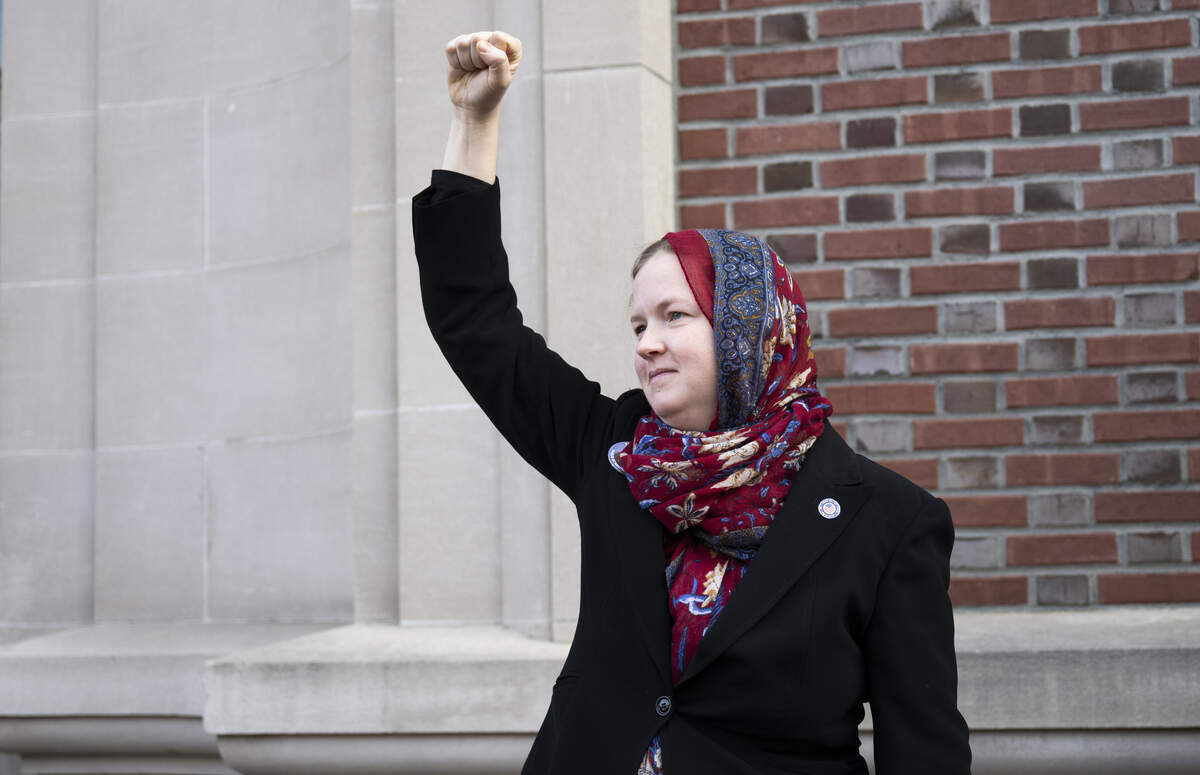
After court adjourned, Melissa Chaudhry spoke to a crowd of people on the sidewalk on Pacific Avenue. She pumped her fist and thanked those who had supported her and her children while her husband has been in immigration detention. She said the writ of habeas corpus exists for moments like this when a person’s liberty is at stake.
“The Constitution must not be a slogan, but a shield,” Melissa Chaudhry said. “Today’s hearing was about that shield, and today, in that courtroom, the rule of law did its job.”
“My family gets to be whole again,” she added.
Supporters of Chaudhry have pointed to his case as an example of the Department of Homeland Security detaining and deporting U.S. military veterans. According to court records in Chaudhry’s habeas corpus case, he enlisted in the Washington Army National Guard in 2001 and was honorably discharged in 2005 after an injury left him wheelchair-bound.
Chaudhry had come to the U.S. on a tourist visa and gained permanent resident status after marrying a citizen, the Seattle Times reported in September. Chaudhry applied for citizenship after he was discharged from his military service, and he disclosed that he had a prior criminal conviction in Australia for using a false passport and credit card.
It’s those prior convictions that the government has cited in its efforts to deport Chaudhry, according to court records. In a September news release from the Department of Homeland Security, federal officials called Chaudhry a “career criminal” and said he lied about his criminal history in Australia to obtain a green card.
“President Trump and Secretary [Kristi] Noem have been clear: there is no place in the U.S. for illegal alien criminals,” the release stated. “ICE will continue to enforce the law across the country.”
Melissa Chaudhry said her husband has no criminal history in the U.S. She said he was a decorated, disabled veteran with “deep roots, a family and a documented history of service.”
This story was originally published December 22, 2025 at 2:15 PM.