
Expert testifies that restraint used on Manuel Ellis by Tacoma police ‘impairs breathing’
The trial of three Tacoma police officers charged in the death of Manuel Ellis, entering its sixth week, remains on track to be in jurors’ hands during the first week of December, lawyers on both sides told the court Monday morning.
As of last week, the trial, originally estimated to conclude around Dec. 4, was three weeks behind schedule. After Pierce County Superior Court Judge Bryan Chushcoff last week disallowed a handful of witnesses the prosecution had intended to call and instructed prosecutors to step up their pace, the Washington Attorney General’s Office informed the court Monday that it intends to rest its case by the end of this week. There is no court Thursday in observance of Veterans’ Day.
Ellis, 33, died March 3, 2020, after repeatedly telling police he couldn’t breathe while they applied force. The Pierce County Medical Examiner ruled Ellis’ death a homicide caused by oxygen deprivation from physical restraint. Lawyers for the officers contend that the high level of methamphetamine found in Ellis’ system, combined with a heart condition, killed him.
Officers Matthew Collins, 40, Christopher “Shane” Burbank, 38, and Timothy Rankine, 34, are on trial for first-degree manslaughter - marking the first time in 85 years that so many officers in Washington state have been charged for an on-duty death. Collins and Burbank, the first officers to encounter Ellis and contact him for reportedly trying to enter a car as it passed through an intersection, also face charges of second-degree murder.
Rankine responded later and sat on Ellis’s back for minutes, even though Rankine admitted to detectives that he heard Ellis say he couldn’t breathe. All three officers have pleaded not guilty. They are free on bail and remain employed by the Tacoma Police Department on paid leave.
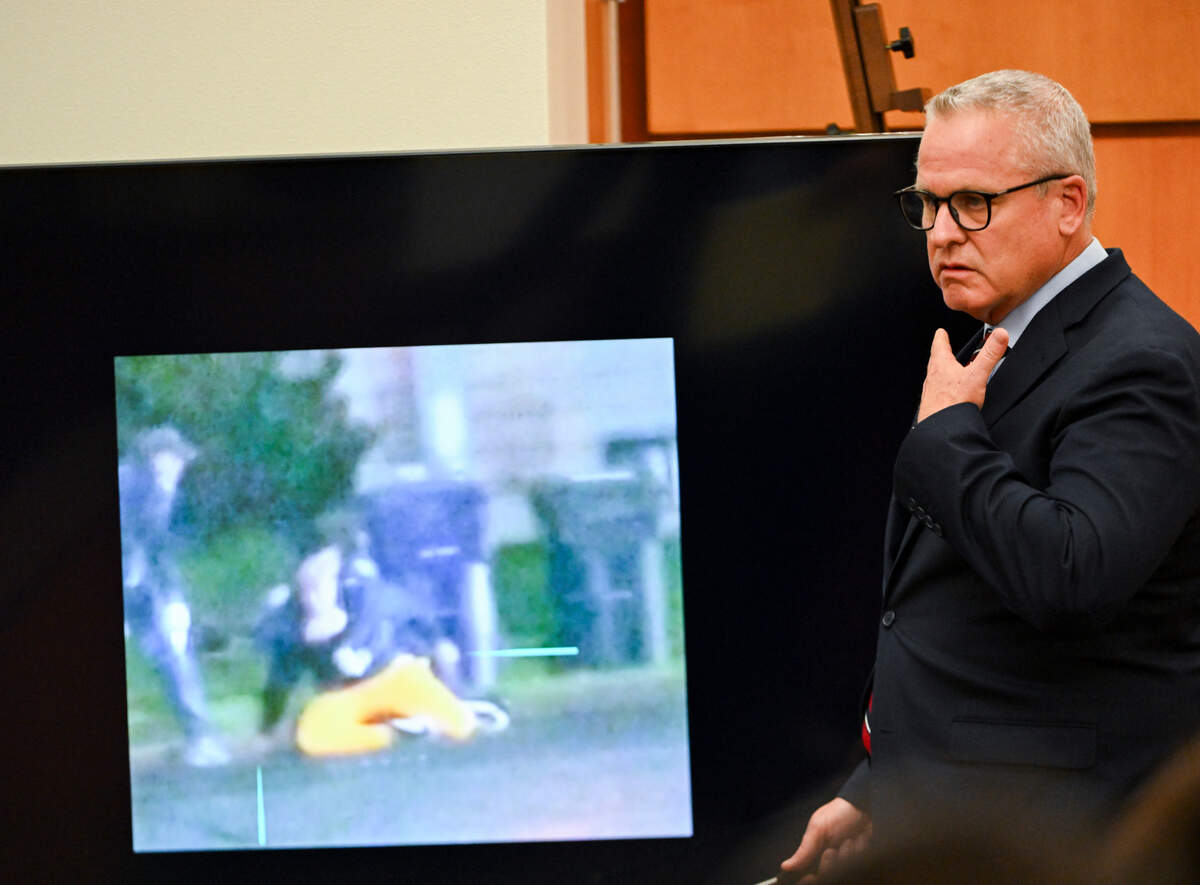
Collins and Burbank told detectives that Ellis, who went by Manny, initiated the aggression, but their accounts contain inconsistent details. Four eyewitnesses, two of whom recorded cellphone videos of police handling Ellis roughly, have testified that the officers were the aggressors and Ellis did nothing to provoke them.
Ellis was struck, jolted with Taser strikes, placed in a carotid artery neck hold and rendered unconscious, cuffed with his hands behind his back, hobbled with a cord linking his ankles to his wrists, and sat and knelt upon by officers with a spit hood over his face while he was lying prone and repeatedly saying he could not breathe.
John J. Ryan, a national expert on police use of force policies and a cop for 20 years, testified Monday morning that officers’ restraints combined with their body weight on Ellis impaired his ability to breathe. He said police training mandates that someone handcuffed should be either seated upright or on their side in a recovery position to facilitate breathing.
“Anytime we take a suspect into custody and restrain them, we’re supposed to watch for signs of distress,” Ryan testified, including when “a person tells you they can’t breathe.” Ellis told officers he couldn’t breathe at least five times, according to evidence presented to date.

Ryan testified that if Ellis were only crossing the street and did not provoke officers, as the four eyewitnesses said, there was no reason for officers to stop or arrest him. Conversely, he said, if the officers’ account that Ellis acted aggressively toward them were true, their use of force would have been justified.
Ellis’s movements when the officers were on top of him, characterized by the officers as resisting, could have been Ellis’s desperate attempts to position himself where he could breathe, Ryan said.
For decades police have been trained about the hazards of prone restraint - the type of position Ellis was placed in on his stomach while police tried to gain control of him by cuffing his hands behind his back.
“It impairs breathing,” Ryan said. The fact that Ellis was hobbled with a strap connecting his ankles to the handcuffs behind his back, “makes the position even worse,” he said.
Police generally are trained to get suspects out of this position by rolling them onto their sides, where their chests and lungs can expand to allow easier breathing, as quickly as possible after handcuffing them, Ryan testified. Ellis was moved temporarily onto his side when he was searched for weapons by Rankine and again when medics arrived to treat him, but had minutes-long stretches with the weight of police on his back, testimony to date has shown.
Testimony concluded a half-hour early Monday morning with Ryan still on the stand to accommodate a juror who wasn’t feeling well. Whether that juror will be fit to continue in the afternoon remains to be seen.
This story was originally published November 6, 2023 at 12:47 PM.