Tacoma says trees are critical. So why do we let so many big, old ones get cut down? | Opinion
It was standard fare, the type of email thread Tacoma’s small but feisty community of tree advocates fires up all the time.
It concerned two trees in particular, unremarkable — at least to most. But not here. Not among this group.
Sent by Tim Olsen, a 70-year-old lifelong Tacoma resident, the Nov. 30 email was addressed to “Tree People” — a handful that included me, likely because Olsen and I have chatted a few times about the importance of the city’s urban canopy in the past.
It was an alert of sorts, highlighting the recent removal of a pair of elm trees near North 10th and Yakima.
Olsen described them as healthy, and on city right-of-way property — at least until a contractor broke out the saws. The felled trees were part of a grove of 100-year-old, 100-foot-tall elms, his email indicated.
“As we all know, trees in Tacoma have no protection,” Olsen wrote before signing off.
You could almost hear the amens.
If you’ve followed the Great Tree Debate in Tacoma — or elsewhere, for that matter, including places like Puyallup, where the demise of a giant chestnut tree was the talk of Stewart Heights Elementary, or Lakewood, where the Garry oaks are under constant siege — the angst and frustration expressed in the email exchange that followed was familiar.
Elected leaders have expressed a growing recognition of the importance of improving local tree canopies, as a protection from a warming climate, a necessity for quality of life and as repentance for the racism and redlining that shaped our neighborhoods. Along the way, experts have been brought in, studies have been done, plans have been drawn up and thousands of fledgling trees have been put in the ground.
Still, talk is cheap and big, old trees keep coming down.
Especially in Tacoma, Olsen told me this week.
He raised a valid question, and a timely one, considering the Tacoma City Council is currently weighing proposed changes to city code related to trees in the public right-of-way.
Do we actually care about trees, at least when it means protecting the ones we already have?
Or is planting itty bitty trees while we continue to allow almost anyone to hack down almost anything disingenuous greenwashing?
“I am not an expert in anything. I don’t have a degree in anything. But I walk around a lot and look at trees — and notice patterns,” said Olsen, who, contrary to the self-effacing assessment, knows more than most. As a co-founder and board member emeritus of the nonprofit Tacoma Tree Foundation, Olsen could be described as a tree hugger.
Only he’s in no mood for warm embraces.
“The city has been talking about the climate emergency, they’ve been talking about canopy laws, they’ve been talking about social injustice — and that’s great,” Olsen told me.
“But when you lose the canopy of one big tree, it is so hard to replace it. … You just can’t afford to lose the big trees.”
The State of Trees in Tacoma
To understand the state of trees in Tacoma, you don’t have to be an expert. You just have to know the basics.
For starters, the city’s existing tree canopy is objectively pathetic, at least by comparison. That much is certain.
As The News Tribune’s Olivia Palmer reported in September, Tacoma has the lowest percentage of urban tree canopy cover of any major city in the region. In many neighborhoods, the canopy is half the city average, if not lower, Palmer’s reporting found.
The hardest hit places are south of Sixth Avenue, where most of the less wealthy, more diverse people live — a fact that should surprise no one. The racist origins of the landscape in Tacoma have been spelled out by prominent local academics. So has the present-day impact on residents, which includes living with increased levels of pollution, greater exposure to extreme heat and worse health outcomes across the board.
The disparity has also been documented with hard data, including a 2017 light detection and ranging assessment that determined only 20% of Tacoma’s land area was covered by tree canopy. Officially known as LiDAR, the technology relies on pulsing laser scans beamed from aircraft high overhead.
For comparison, Seattle has had roughly 28% in similar surveys; so has Kent. Lakewood has had 26%. Renton registered 29% in 2017. The same year, Auburn touted 32%.
In response Tacoma has sought to step up its efforts to improve the local tree canopy, according to Mike Carey, Tacoma’s urban forest program manager.
The city established a goal of increasing its urban canopy — shooting for 30% by 2030 — and has supported ambitious efforts to plant new trees, Carey said, including Tacoma’s Community Tree Program, which received $100,000 in funding earlier this year.
The city’s Urban Forestry Management Plan, adopted by the city council in 2019, provides a blueprint for this work, he indicated.
Got it? Good. Now, there are a few more things you need to know — and they’re big ones.
Unlike other places, including Lakewood — which in 2022 established new protections and permit requirements governing the removal of trees on private property, including potential civil penalties — almost anything goes in the City of Destiny. If it’s your property, you can do what you want.
“Every tree in Tacoma exists based on the goodwill of the property owner,” said Lowell Wyse, the executive director of Tacoma Tree Foundation. “If a property owner doesn’t want a tree, they can just take it out.”
At the same time, Tacoma has historically employed fewer people and invested less money in its urban forestry efforts.
We also have no idea how many established trees Tacoma is losing each year, which significantly complicates matters.
Even with recent tree planting efforts, folks like Olsen suspect we’re treading water, at best — nowhere close to reaching the goal of reaching 30% tree canopy coverage by 2030.
LiDAR data is the “best way to tell on a gross scale whether we are increasing or decreasing the tree canopy,” Carey explained.
It’s also challenging to collect, which is one reason there have only been two airplane-laser assessments conducted in the last two decades. The most recent LiDAR scan over Tacoma cost roughly $120,000, according to Carey. It also relied on collaboration between partners, allowing the city’s Urban Forestry department to utilize a Tacoma Public Utility flight to conduct the aerial survey.
Ideally, a fresh scan would be conducted over Tacoma every five years or so, Carey said. The feasibility of conducting a new one is currently being researched; it will likely cost around $100,000, he indicated.
“Tree by tree, we don’t really know,” Carey acknowledged when asked where things currently stand.
“A new analysis every five years would allow us to see in real time the growth or decline of our urban tree canopy, so that we could make corrective policy decisions without having to wait 10 years to find out if we are going in the right direction,” he added.
“That said, $100k is not an insignificant amount of money, and we need to weigh that expense to collect data versus spending the (money) on tree planting or other programming to improve tree canopy.”
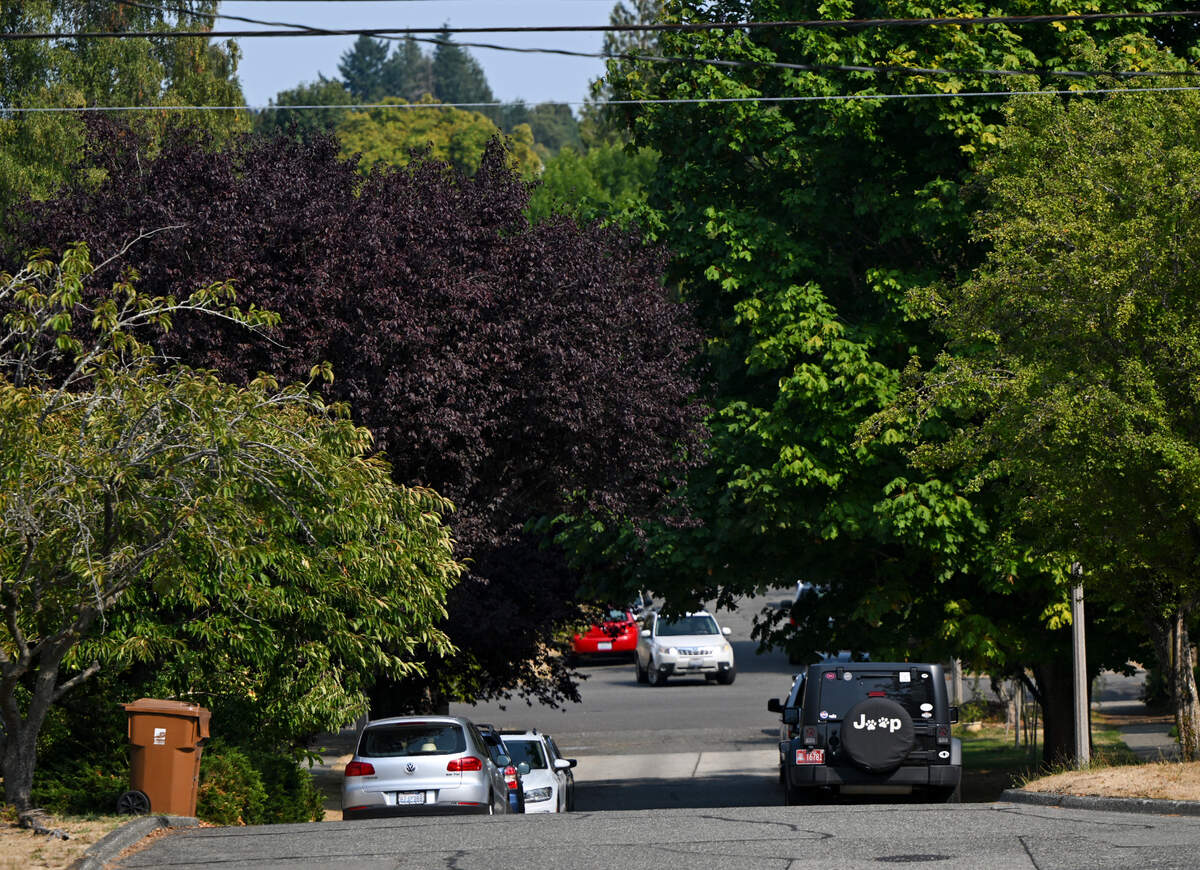
Proposed Tacoma tree code updates
It’s the slow, steady progress that gives Carey hope.
While he’s no stranger to public criticism of the city’s efforts to grow its urban tree canopy, he also lives and breathes this work.
Carey vouched for Tacoma’s sincerity this week, particularly the dedication of his colleagues and the value of the city’s partnerships with agencies like Metro Parks Tacoma and Tacoma Tree Foundation.
He also expressed faith in the city’s commitment to solving its tree problem and ability to do so, eventually, particularly with continued support from the City Council.
When we spoke, Tacoma’s elected officials were top of mind for Carey — for good reason
A few hours later, the City Council introduced an ordinance that, if passed in coming weeks, would amend city code governing public right-of-way, establishing real permit requirements and specific conditions that must be met before a tree on public land can be removed — for the first time in city history.
The bulk of Tacoma’s existing tree code dates back tot he Coolidge administration, and essentially allows residents to do what they want with trees in the public right-of-way outside their property, including chop it down. Currently, “there really are not any grounds for the city to deny a permit for tree removal in the right-of-way, unless those trees are also located within a regulated critical area,” city of Tacoma spokesperson Maria Lee explained.
In the grand scheme, the impact will be minimal, Carey acknowledged, since the vast majority of Tacoma’s landmass is privately owned — roughly 75% of it, according to his estimate.
Unless Tacoma establishes regulations and limits on what local land owners can do to the trees on their property — like Lakewood, dictating when they can cut them down and when they have to stay, for the public good, including enforceable penalties — we’ll be beating around the bush, he suggested, no pun intended.
Carey said he expects the City Council to weigh such changes in the coming years as part of the ongoing Home in Tacoma rezoning effort.
He also anticipates significant, passionate public engagement throughout the process. That comes with the territory.
A small, overdue step
That’s not to suggest the public right-of-way tree removal code currently being considered by the City Council would amount to nothing.
Remember those trees Olsen emailed about?
According to permitting information provided by the city, they were cut down because a local developer determined they were in conflict with a project.
If the proposed changes to Tacoma’s tree code are approved, a developer or land owner applying for a tree removal permit would have to prove there were “no reasonable alternatives” to removal, Lee confirmed.
If a tree in the public right-of-way must be sacrificed to make way for development, the developer would be required to pay into a dedicated fund, Lee said.
The money collected would be earmarked for planting, maintaining and replacing trees across the city, for years to come, Lee indicated.
In this case, none of that happened.
According to Olsen, the proposed updates to Tacoma’s tree code would be a start — albeit small and overdue. He’s not holding his breath, worried it will still be too easy to obtain a tree-cutting permit and skeptical that the city will have the time, staff power or inclination to enforce the new code.
Still, Olsen is in this fight for the long haul, he indicated. It’s that important.
“Tacoma — by which I mean the people in Tacoma, and especially the government — need to realize the value of our standing trees and start taking it seriously. It’s like our other public goods,” Olsen said.
“You have to maintain them. You have to improve them. You have to value them,” he added.
“We should protect our trees, and celebrate them.”
This story was originally published December 7, 2023 at 11:04 AM.