Homeless providers see urgent need for safe parking. They’re asking churches for help
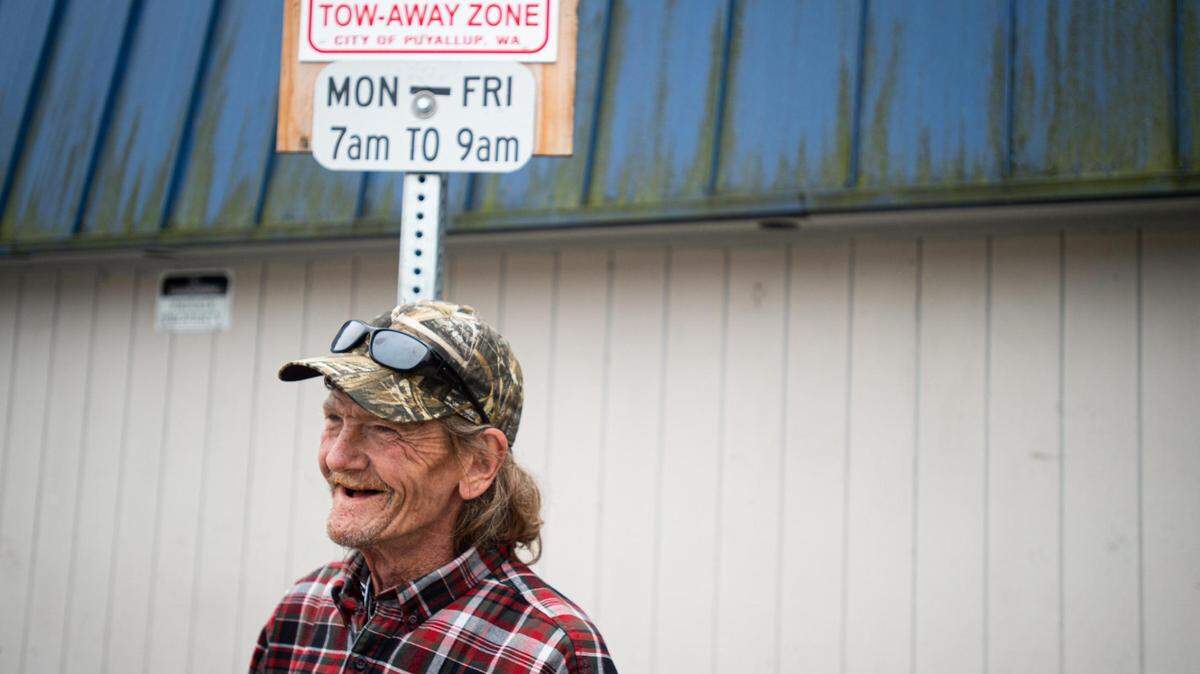
On cold nights, Michael Boggs was especially thankful for his old Ford F150.
Standing outside the New Hope Resource Center in Puyallup, Boggs recalled the 18 months he recently spent living in his truck, including the small survival techniques he learned, like burning candles in the cab to stay warm.
Often, Boggs said, he would park for the night not far from where we spoke — near New Hope, which he depended on for meals and other services.
However, there was another, more important advantage to the spots he chose, he explained.
Boggs looked for places that were empty and secluded.
His goal: avoiding detection or harassment.
“When you’re homeless, you’ve kind of got to stay away from the people who have homes,” Boggs said, describing a nightly ritual that — by the design of those trying to survive this way — often goes unnoticed.
While Boggs, 61, was recently able to secure stable housing, for many in Pierce County the struggle he described is all too familiar.
Every night an untold number of individuals and families go through the same taxing routine, according to local service providers like the Tacoma-based Metropolitan Development Council.
The fastest way to reach these people and get them the help they desperately need is to provide a safe place to park at night, providers said.
That’s why, in recent months, it’s something MDC, the Tacoma-Pierce County Coalition to End Homelessness, New Hope and others have been working to establish.
Discussing the effort with The News Tribune this week, many described the end goal as a “safe parking network” made up of area churches and nonprofits.
The idea, according to New Hope executive director Paula Anderson, is to provide individuals and families with a place to get stabilized, connect with services and end the chaotic cycle of survival.
The effort is more than a pipe dream, according to MDC spokesperson Rob Huff.
It already has received $150,000 from the Greater Tacoma Community Foundation’s COVID-19-related Pierce County Connected Fund to get it off the ground, and MDC has agreed to act as a fiscal agent to make decisions about how to dole out the funds, he said.
Colin DeForrest is a former homeless services director in Tacoma and Olympia who has been working with MDC to help establish a safe parking network. DeForrest said the available funding could be used by churches to pay for necessities like fencing, additional lighting and security.
DeForrest estimates it would take $10,000 to $15,000 in support to help churches and nonprofits establish the sites, which means the money could stretch a long way.
Now, Anderson said, attention has turned to finding churches to participate.
While Huff said no sites have been officially identified, conversations “about potential locations” are underway.
Anderson said she’s confident something will come together.
“There are several churches that have parking lots, and I think if they knew about the program and had the opportunity to see how they could partner with the group to provide this, I think they would be willing to take a look at it,” Anderson said.
“Churches are looking for ways to serve people who are continuing to experience homelessness,” she continued. “There are a lot of people who are trying to help.”
Working with churches and faith-based organizations provides flexibility and permitting leeway, but Anderson is hopeful the county and local cities will see the wisdom of the idea and lend their support.
DeForrest echoed the sentiments, noting that right now there really isn’t anywhere in Pierce County where “you can safely park your vehicle and live in it and not be breaking the law.”
“It’s a huge concern,” he said.
A stopgap
With an established homelessness crisis in Tacoma and throughout Pierce County, the fact that such a resource doesn’t yet exist is an inducement in itself.
While the 2020 Pierce County Point in Time County identified 172 people living in vehicles in January — a figure that represents just under 10% of the total number of homeless individuals counted — local homeless service providers have long suggested that the true number is far greater, the problem far more severe.
“Anyone who knows the Point In Time County knows, historically, that this sub-population of homelessness is one of the most challenging groups to have any quantifiable data on because they truly are invisible,” DeForrest said.
It’s a population that includes families with schoolchildren and women attempting to escape domestic violence, DeForrest said. Many, he added, don’t see themselves as truly homeless; instead, they consider their circumstances temporary and seek to avoid detection, often out of fear that being found would mean losing custody of their kids.
“It’s not just a good situation,” DeForrest explained. “They’re parking at the end of the darkest dead end alleys and staying in the shadiest spots. Right now, what’s protecting people from whatever is outdoors is a window and a car lock.”
Janet Runbeck, a retired volunteer nurse and member of the Pierce County Medical Reserve Corp, agrees.
Runbeck, who also volunteers with the Commission to End Homelessness, believes the need to establish a safe parking network in Pierce County is urgent.
Already, the Puyallup-based Freezing Nights program — which has helped shelter homeless people in East Pierce County for the past 15 years — has been canceled due to the coronavirus pandemic, Runbeck noted.
In an area already suffering from a lack of homeless services, Runbeck described it as one more blow for people who need help the most.
Amid a continuing pandemic, Runbeck also sees providing a safe place to park as a public health imperative.
With COVID-19 significantly limiting the places people living in their vehicle can use the bathroom or access hygiene essentials, she described providing a safe option for them as “basic stuff.”
Like the others, Runbeck said the goal is to create an option for people living in their vehicles that is “safe for them and safe for neighbors” while helping them quickly find more permanent housing.
Huff described the proposed safe parking network a stopgap for homeless individuals and families, designed as “a place to engage people and find long term solutions for them.”
Outside of New Hope on Thursday, Boggs left little doubt about how much difference that could make.
Pushed into homelessness after a separation from a longtime partner, for more than a year Boggs said his truck was his refuge, and finding a place to park and sleep every night was his constant challenge.
Now, he’s settling into his new home, not far from New Hope.
It’s “not much,” he acknowledged — paid for through his Social Security benefits — but it’s a start.
Asked how much easier a safe parking network would make it for others in Pierce County to achieve the same thing, Boggs didn’t hesitate.
“It would make a big difference,” he said before heading home.
This story was originally published October 3, 2020 at 8:00 AM with the headline "Homeless providers see urgent need for safe parking. They’re asking churches for help."