Green Book saw Black travelers safely through the USA. Learn about it at this exhibit
The lure of the open road is understandable. The undiscovered land beyond the next horizon and the freedom to explore it seems like a birthright.
For African Americans in the decades before the civil rights movement of the 1960s, traveling in unknown territory was fraught with obstacles.
Blacks could find themselves in peril after dark in so-called sundown towns. Even in Tacoma and the Pacific Northwest, Blacks were shut out of hotels and restaurants that were otherwise open to whites. Just getting gas and finding a bathroom could be a challenge.
That’s why the “Negro Motorist Green Book” became so important. It was an annual pocket-sized guide that helped Blacks navigate the hazards and rewards of traveling in Jim Crow-era America. Using the book’s listings and advice, they could venture beyond their home territory with less worry.
“The Negro Motorist Green Book”, a traveling exhibit on the Green Book and its era, opened Saturday at the Washington State History Museum in Tacoma. Through artifacts, text and interactive exhibits, the show recreates the world the Green Book offered a metaphorical road map through.
With advice from the Green Book, Blacks could see Mount Rainier, lodge in San Francisco, eat dinner in Minneapolis and participate in everything a white tourist could.
It also empowered Black-owned businesses to pull in customers from beyond their local region.
The private homes, restaurants, gas stations and other businesses that advertised in the Green Book were safe for Black travelers and the book became an essential guide during its publication from 1936-1964.
HISTORY EXHIBIT
The Smithsonian-curated exhibit touches on the sometimes dangerous atmosphere a Black traveler might have experienced but also the happiness they found, said Gwen Whiting, lead curator for the Washington State Historical Society.
“Joy, itself, was an act of resistance and an act of resilience,” she said. The Green Book allowed Blacks, “To experience life fully, to travel without fear, to join other folks, to enjoy their lives and to live, to love, dance, to have all the experiences that are their rights as human beings.”
Images of frivolity contrast with iconic moments of America’s racist history in the show.
“You see the brutality of segregation and discrimination,” Whiting said. “It does not shy away from that.”
The show has local components, including a photo of Little Harlem Rondivoo. Marked “Sept. 6, 1935 / 3:15 a.m.,” it shows Blacks and whites gathered in a festive atmosphere at 2503 S. C St. in Tacoma.
The Rondivoo was, Whiting explained, a black and tan club. The term came about in the early 20th century to describe clubs where Blacks and whites mixed, despite social norms.
VICTOR HUGO GREEN
The Green Book was created by Harlem postal worker Victor Hugo Green. He and his family had experienced prejudice and segregation as they traveled the country, Whiting said.
“He got this idea that he could make a guide so that people knew where it was safe to travel, that they could experience the same freedom of the road as any other American,” she said.
Green published his first guide in 1936.
At first, the guide was New York-centric. But as its reputation grew, it expanded to cover the entire country and eventually added Canada and a few other countries.
The book played a title role in the 2018 film “Green Book,” starring Mahershala Ali and Viggo Mortensen. The film won Oscars for Best Picture, Best Original Screenplay and Best Supporting Actor for Ali’s performance.
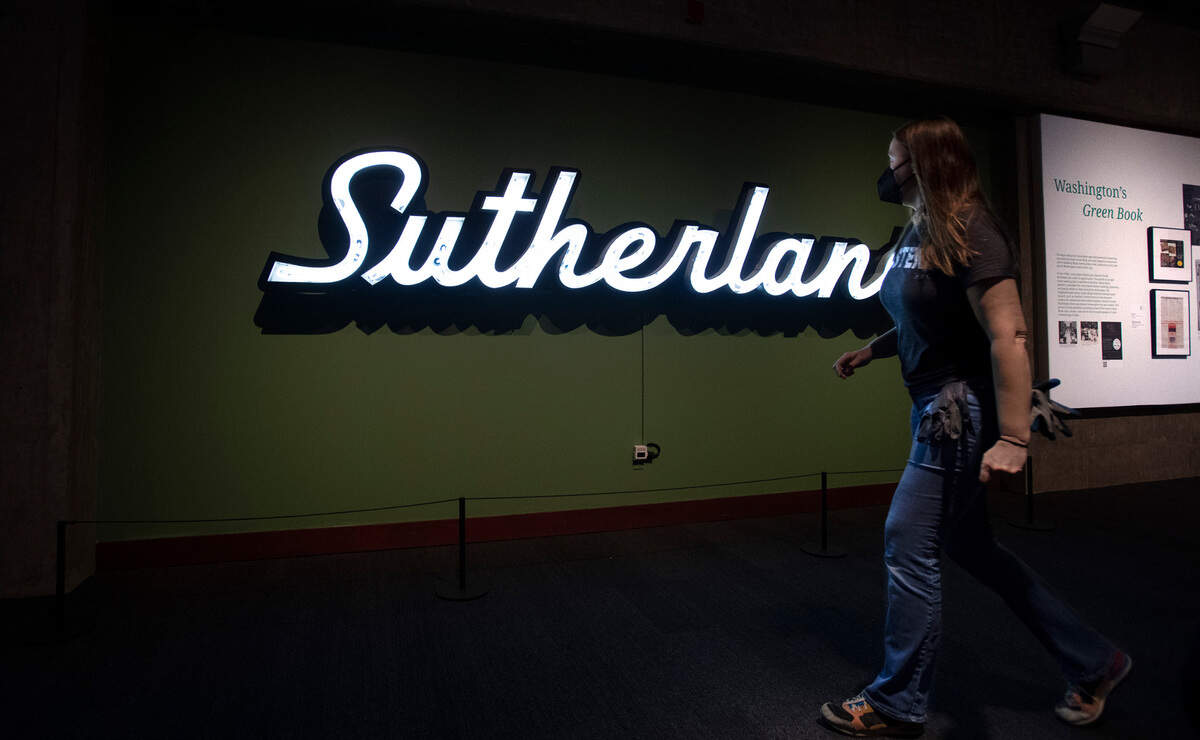
The Smithsonian show in Tacoma takes advantage of technology to bring the past alive.
An interactive exhibit allows the museum visitor to pack their car for a road trip. A matronly guide explains why each item would be necessary. Food, for instance.
“If people are gonna choose not to feed me because of the color of my skin, I still plan to eat good, child,” she says. “Nothing like your best comfort food to buck you up.”
Travelers then make choices on where they will lodge, eat and even gas up their car from the perspective of a 1950s Black motorist.
A gas station attendant appears in the windshield to tell the motorist they’re allowed to use the bathroom, but they better be quick about it.
EVOLVING
The Green Book naturally expanded as its reputation grew. It also evolved in its content, Whiting said.
“Many of the businesses that you see in the Green Book supported the civil rights movement one way or another,” Whiting said. “Whether that was providing a venue like a beauty parlor for women to come together and talk and organize or whether it was being a hotel or a site for folks to organize on a more national level.”
Many businesses that advertised in the book were owned by women, Whiting said.
“Black women, who are then able to take that livelihood and become the cornerstones of their own communities,” she said.
In Tacoma, Mrs. J. H. Carter advertised her home at 1017 S. Trafton St. as a “tourist home” in the 1940 edition of the Green Book. Mrs. A. Robinson also offered her home at 1906 S. I St. in 1940. The two women advertised for years in the book. Carter’s house still stands. Robinson’s home is gone, now a parking lot for St. Joseph Medical Center.
Later editions of the book were dedicated to civil rights.
“Your rights, briefly speaking!” one page is headlined.
By 1963, the need for private homes serving as lodging had apparently dissipated. Dittemore’s Court, Monte Carlo Hotel and the Winthrop Western Hotel at South 9th Street and Broadway advertised, as did Travelers Restaurant at 1506-1/2 Pacific Ave.
Green died in 1960. His widow and others kept the book going a few years more. The guide became less necessary as the civil rights movement finally swept away “whites only” signs and other overt signals of racism from America’s roadways and towns. It ceased publication in 1967.
“There will be a day sometime in the near future when this guide will not have to be published,” Green wrote in his first edition. “That is when we as a race will have equal rights and privileges in the United States.”
LOCAL PROGRAMMING
Stephanie Johnson-Toliver, president of the Black Heritage Society of Washington, created local programming for the exhibition.
While Johnson-Toliver said her Seattle family didn’t do enough travel to use a Green Book, others in her organization did.
“It was absolutely considered the Bible of black travel,” she said. “When Black folks were leaving to get on the road with no real idea of what to expect on the other end, particularly during Jim Crow era.”
Green Book scholar and author Candacy Taylor will speak at the Tacoma museum on May 19. Her book, “Overground Railroad: The Green Book and the Roots of Black Travel in America,” is the basis for the exhibition. Taylor will give an author talk and book signing.
The program will begin with members of Seattle’s African American Writers Alliance reading original poems and responses inspired by Taylor’s book, Johnson-Toliver said.
See the museum’s website at washingtonhistory.org for the full list of events.
IF YOU GO
▪ What: ‘The Negro Motorist Green Book’
▪ Where: Washington State History Museum, 1911 Pacific Avenue, Tacoma.
▪ When: Now through June 12.
▪ Hours: 10 a.m.-5 p.m., Tuesday through Sunday.
▪ Tickets: $14 adults, $11 military, student, senior.
▪ Information: www.washingtonhistory.org/exhibit/the-green-book/
This story was originally published March 23, 2022 at 5:00 AM.