
Tacoma artist with reputation as global agitator now has solo show at Seattle Art Museum
Anida Yoeu Ali is an artist, and as she describes it, a global agitator. She has an international reputation whose work has literally spilled out onto her Tacoma home’s front yard.
Now, the rest of the region will get to see her art up close.
Ali’s show, “Hybrid Skin, Mythical Presence,” opens Thursday at Seattle Asian Art Museum in Volunteer Park. It’s the first solo show SAM has held for a Cambodian American artist in its history, the museum said in a statement.
In Tacoma, Ali might be best known for creating a large sign that reads, “Hello. How are you?” in her front yard. The 2018 work, in collaboration with her husband Masahiro Sugano and others, was reinstalled in October.
You won’t find “Hello” or anything like it in the SAM show. It instead highlights Ali’s work in performance art, sculpture, video, photography and installation art and features two of her best known works, “The Buddhist Bug” and “The Red Chador” series, in 6,500 square feet of gallery space.
Cambodian
Ali was born in 1974, as a refugee in Battambang, Cambodia. As a young girl, she relocated with her family to Chicago where she grew up. She’s Muslim Khmer. Identities, particularly mixed or hybrid ones, are a major theme of her work.
“I’m constantly fluctuating between the insider/outsider perspective at any one point,” she explained Tuesday during a press preview of the show. “I’m never quite the person that people expect me to be, whether that’s a local or a foreigner, an insider to a culture, or an outsider, whether I’m here or there.”
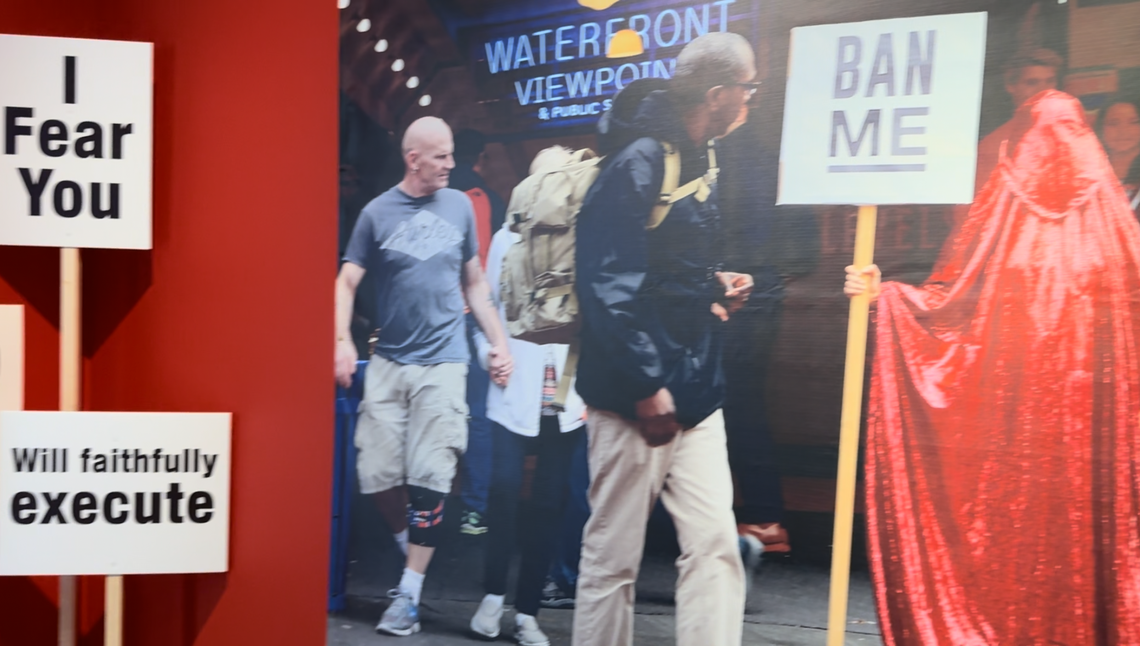
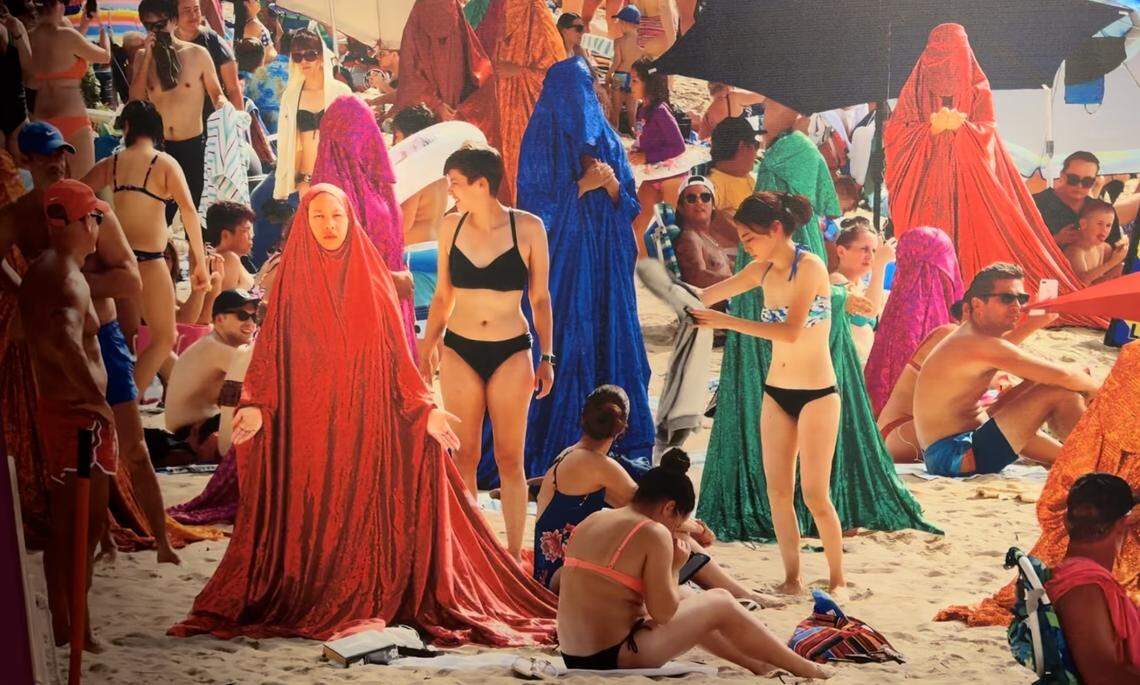
It’s that state of otherness that Ali explores in her work. Not content to merely observe and report, she challenges it where she finds it, particularly Islamaphobia. One gallery is filled with American flags, signage and photos that make a statement on patriotism, protest and the veiled presence of Muslim women.
Buddhist Bug
Using photography and video, Ali and Sugano have documented her appearances as “The Buddhist Bug” around the world, but mostly in her home country of Cambodia.
During a performance, only Ali’s face emerges from the orange, 100-meter-long flexible fabric cylinder. Another person’s bare legs can be seen emerging from the bug’s end.
.jpg "IMG_6064 (1).jpg")
Ali created The Bug out of a desire to make something that was both a bridge and tunnel, something that could coil up tightly or expand. The bright orange hearkens to Buddhism while the head covering is reminiscent of Islam. In Cambodia today, between 2 and 5 percent of the population are Muslim. Hundreds of thousands were killed by the Khmer Rouge in the mid-1970s.
Most of the photos were shot by Sugano and they range from surreal to comedic. In various photos, The Bug resides in a school cafeteria; The Bug rides a river boat; The Bug travels by tuk tuk through the streets of Phnom Penh at night.
In one photo, “The Exiles,” The Bug is surrounded by Cambodian Americans deported to their country of birth because of immigration violations. They grew up in America and identify as American but must now spend their lives in Cambodia, usually because of an offense they committed as young men.
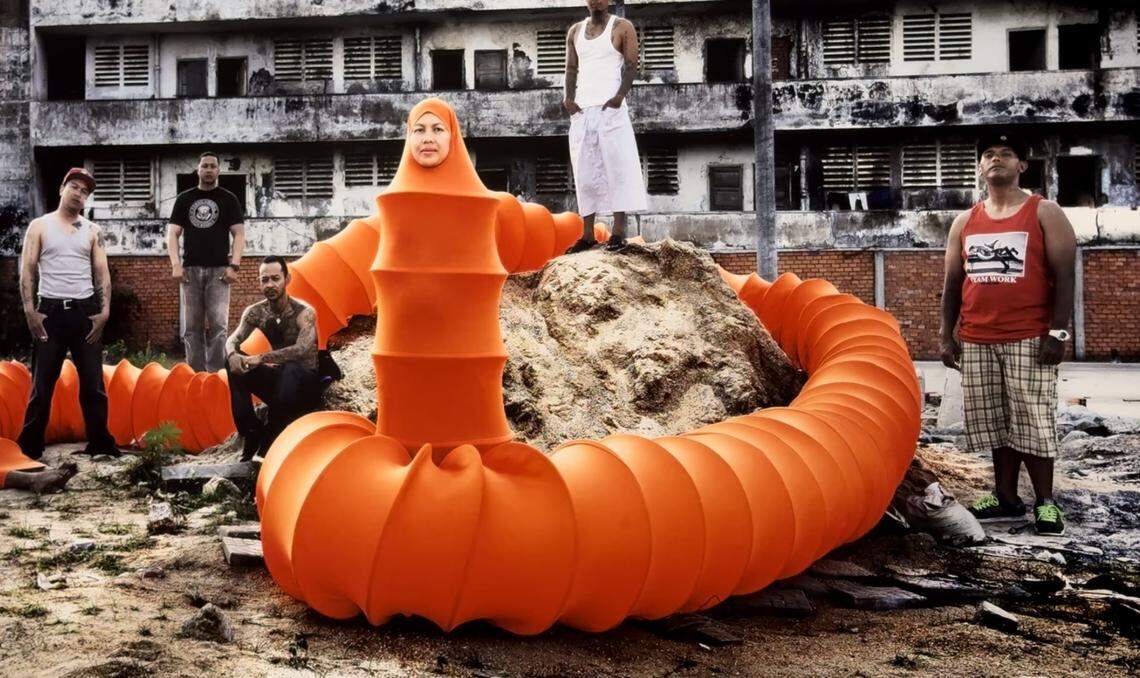
“Did The Bug wander home? Has The Bug finally found a community to belong to, one made of exiled Americans?,” Ali asks in an accompanying text.
The entire bug itself is on display, hanging from the gallery’s ceiling. Ali will perform “The Buddhist Bug” on March 23 at the art museum.
The Red Chador
Ali’s “The Red Chador” project has taken her from Pike Place Market to Australia to Europe. In the photo series, Ali dons a sparkling red chador — a full length cloak and head covering some devout Muslim women wear. In America, she draws stares from passers-by, particularly while holding a sign that reads, “Ban Me.” In other parts of the world, she’s ignored.
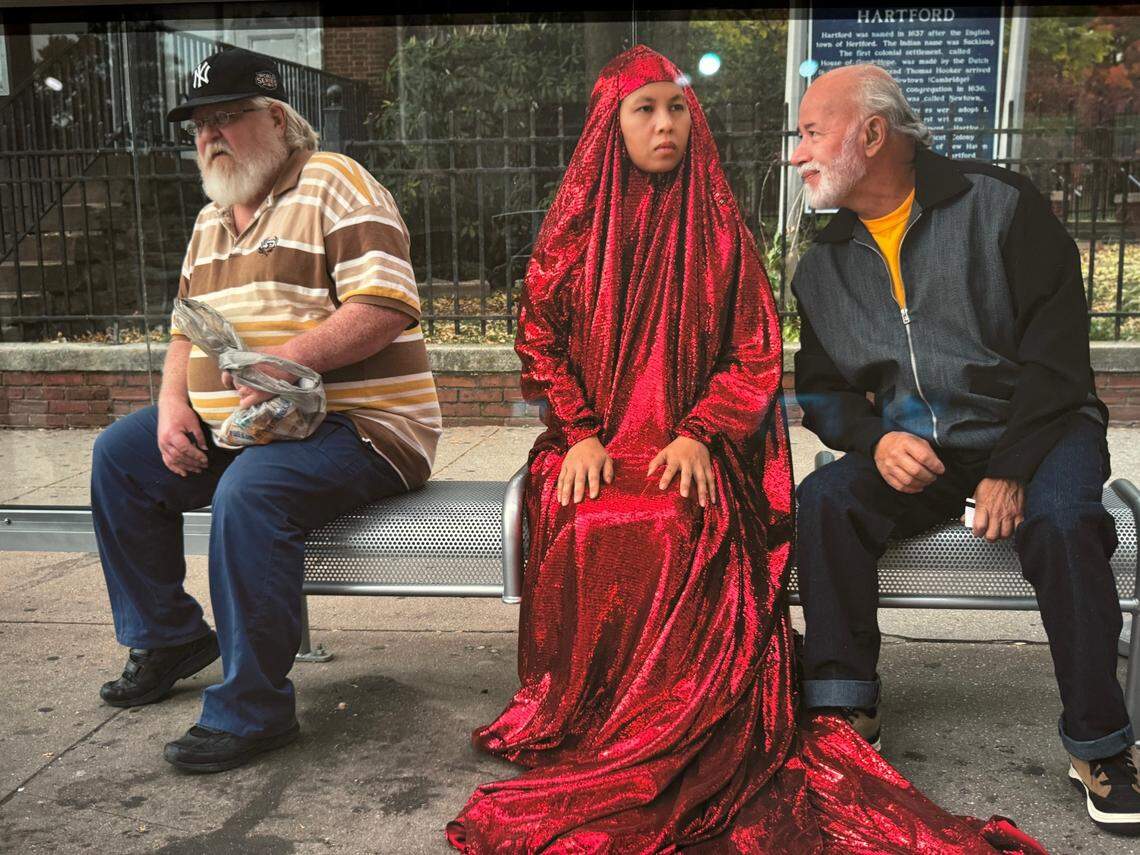
The project ended for Ali during a 2017 trip to Israel. She had been in Ramallah, Palestine when she crossed into Israel. Detained, questioned for hours and searched by Israeli authorities, Ali was finally released to give a speech in Tel Aviv. The chador stayed packed in a suitcase while she was in Israel. After checking in her luggage at the Tel Aviv airport for the return trip home, the chador bag never made it on to the plane, she later learned. It has never turned up.
Ali devotes one of the galleries to the chador, the cities it was worn in, and its demise. In the main gallery, Ali has created a circle of seven new sparkling chadors, each a different color. They form a protective circle.
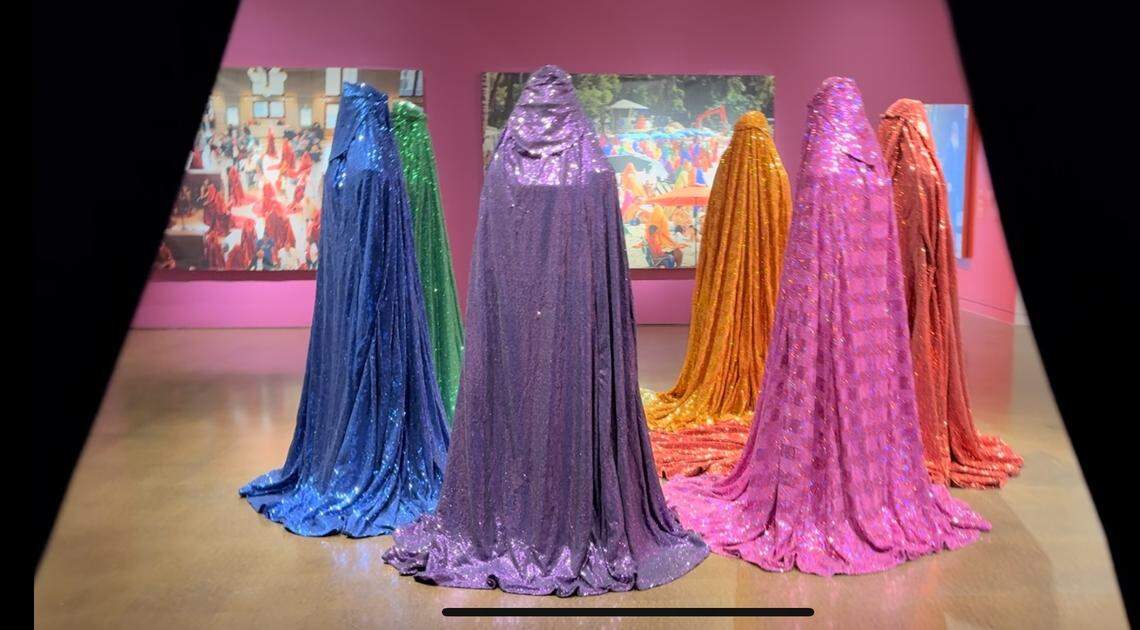
“Because she died in such a lonely way, like you can just think about being in luggage and just disappearing,” Ali said of the Red Chador. “That, to me, just painted a very morbid and lonely picture.”
In Tacoma
Both Ali and Sugano are on year-long sabbaticals from their teaching positions at the University of Washington Bothell campus.
In between preparing for the SAM show, they’ve been repairing the “?” on their front yard sign. It was vandalized the day it was reinstalled in 2023. They are repairing it using the traditional Japanese repair art called Kintsugi, where cracks are filled with a substance more beautiful than the original.
Ali had originally been talking with officials at the Tacoma Art Museum about a solo show. But, leadership upheavals there, the pandemic and other issues sent her to SAM. TAM did provide facilities to process some of her photographic prints.
While the SAM show spans 10 years of her life, Tacoma passers-by can get a quick “Hello” from Ali as they drive past the corner of South 17th Street and South Grant Avenue.
If you go
What: “Anida Yoeu Ali: Hybrid Skin, Mythical Presence”
Where: Seattle Asian Art Museum
When: 10 a.m.-5 p.m. Thur.-Sun.
Runs: Now through July 7.
Admission: $14.99 adults; $12.99 seniors, military; $9.99 students, teens; free for children.
Information: seattleartmuseum.org/visit/seattle-asian-art-museum
This story was originally published January 18, 2024 at 11:00 AM.
