
Think you’re busy? Try juggling 2 orchestras, 3 cities, 3 kids
Anyone who thinks they have a busy life should follow Sarah Ioannides around for a day.
The Tacoma Symphony’s music director is in town this month to finish up her second season with the orchestra, conducting the season finale concert Saturday in the Pantages and a children’s concert May 22.
But there’s much more to being a professional conductor than just waving the baton on a Saturday night.
Shuffling her family among three cities, juggling multiple orchestras and somehow fitting in the odd cup of tea, Ioannides has the organizational powers of a general, and driving ambition and musical talent.
The News Tribune followed the 44-year-old British conductor around Tacoma earlier this week, and discovered that being Sarah Ioannides is a very complicated thing.
Sunday: 8:30 p.m. arrival
Ioannides is flying into Sea-Tac Airport from her other music director position in Spartanburg, South Carolina. She played a concert the night before, and awoke at 5 a.m. to get a flight via Washington, D.C.
Andy Buelow, executive director of the Tacoma Symphony, is on standby in the airport’s cellphone lot to pick her up and take her to the loaner car dealer in Fife. Then she’ll drive to Lakewood to stay with friends.
Because this is a longer-than-usual stay in Tacoma (more than three weeks), Ioannides’ family is here as well: husband Scott Hartman, a trombonist and professor at Yale University; three kids Audrey, 9, and twins Elsa and Karl, 6; and au pair Franziska Winterling.
Between Tacoma, Spartanburg, their other home in New Haven, Connecticut, and various guest-conductor gigs, Ioannides has spent almost every week traveling this season, except for holidays.
But she makes the most of it.
“Most of my time on flights is spent working,” she says. “If I’m coming from a concert and I’m not still needing to prepare for a rehearsal … then I might kick back and watch a movie.
“I have trained myself to sleep on a plane, even if it’s just 15 to 20 minutes, because obviously traveling a lot is tiring.”
This week Ioannides is launching straight into a Monday night rehearsal for one of classical music’s most difficult pieces, Stravinsky’s “The Rite of Spring.” So she studies the score, listens to recordings and plans her week and the ones ahead.
“(Conductor) Otto Werner Müller told me when I was a student that being a conductor is 24/7,” Ioannides says. “And at the time I didn’t really believe him, but now I do … You’re constantly planning and you’re also constantly learning music, and it’s very, very demanding.”
I have trained myself to sleep on a plane, even if it’s just 15 to 20 minutes, because obviously traveling a lot is tiring.
Sarah Ioannides
Tacoma Symphony music director and conductorMonday: 6:30 a.m. wake-up
The morning routine in the Ioannides-Hartman household varies, depending on which city the family is in: three school districts and start times, plus variables such as which parent is traveling or working late.
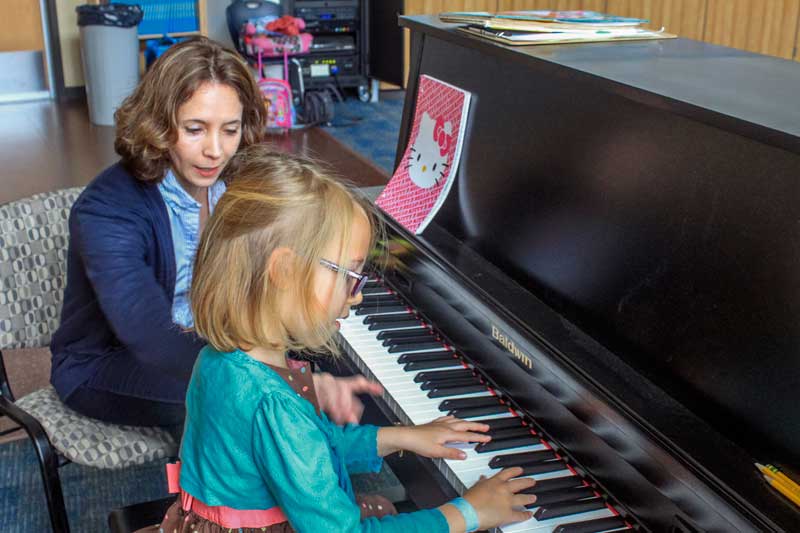
When Ioannides is home, three excited kids jump on her in her bed. Then it’s music practice — Ioannides teaches all three children, from Audrey’s violin to Elsa’s piano and Karl’s ukulele.
“The goal is to make sure they each practice five times a week,” she says. “And they’ll get their rewards at the end of the week!”
Working out who does what in the child department is a management task that takes shared Google and nanny calendars, plus a spreadsheet.
This morning, Ioannides gets to squeeze in a shower and a cup of tea while Hartman takes the children to Geiger Elementary School, where they take classes several weeks a year.
“The separation problem is better when I’m not there,” Ioannides says.
9 a.m. running
“It’ll be good to shake out ‘The Rite of Spring,’ ” Ioannides says.
In black workout clothes and hair pulled in a ponytail, she’s doing stretches in front of the Gig Harbor home of symphony supporter Patty Wyckoff. Ioannides stays here sometimes when she comes to Tacoma.
The house has a wooded running trail down on the bluff but more importantly, it also has a small wardrobe of spare clothes — running gear, concert outfits, shoes — that saves Ioannides a lot of extra packing and, in one case, a concert shoe emergency.
“That’s the only time I’ve ever seen Sarah make a mistake, when she left her shoes behind,” Wyckoff says.
Meanwhile, Ioannides has plugged in her earbuds — upcoming program music — and set off down the track.
“I do find that running is a really easy thing for me to do … so I always take my trainers with me,” she says.
The conductor also likes doing yoga, but often goes to a gym, where she can study her music scores while on the treadmill.
Running also is a good way to reinvigorate during tired afternoons, she says, and to change mental focus from the strategic planning of emails and meetings to the zone of music study.
As Ioannides returns to the house, she hits the ground for 25 pushups, stretches again and clicks her stopwatch off before heading inside to change.
That’s the only time I’ve ever seen Sarah make a mistake, when she left her shoes behind.
Symphony supporter Patty Wyckoff
11 a.m. production meeting
Music directors, like anyone in charge, have a lot of meetings. Staff members, musicians, board members — Ioannides meets with them all regularly to iron out immediate and long-term issues.
This morning she’s sitting in an office in the Broadway Center for the Performing Arts, talking to Buelow and the symphony’s general manager, engagement manager and patron services assistant.
They arrange priority parking for Saturday’s soloist Pepe Romero and a sound check time. They check on the air conditioning for the rehearsal studio, talk about musician absences and news — and plan more meetings.

Noon lunch
Today it’s a working lunch at Galanga Thai. Over curry, Ioannides and Buelow chat to patrons Dick and Marcia Moe about expanding audiences, partnering with other music groups and bringing symphony musicians into schools.
She talks quietly but with her usual intense focus, getting to know the Moes and exploring ideas, such as how to integrate digital better into the symphony world.
“As a conductor you’re interacting with a large variety of people … from all walks of life,” she says. “There’s a lot of needs to be met.”
1:30 p.m. study time
After lunch, Ioannides walks up Broadway to the Roberson building on Market Street, where she has the use of the lounge for private study time.
Just as a concert pianist will spend hours practicing, so conductors need to learn, refresh and practice their music.
Keeping time during the concert is just the tip of the iceberg: Conductors need to rehearse an orchestra thoroughly for basics such as staying together, intonation and balance, then move onto unity of expression and interpretation.
For the Tacoma Symphony, this includes playing “The Rite of Spring” for the very first time.
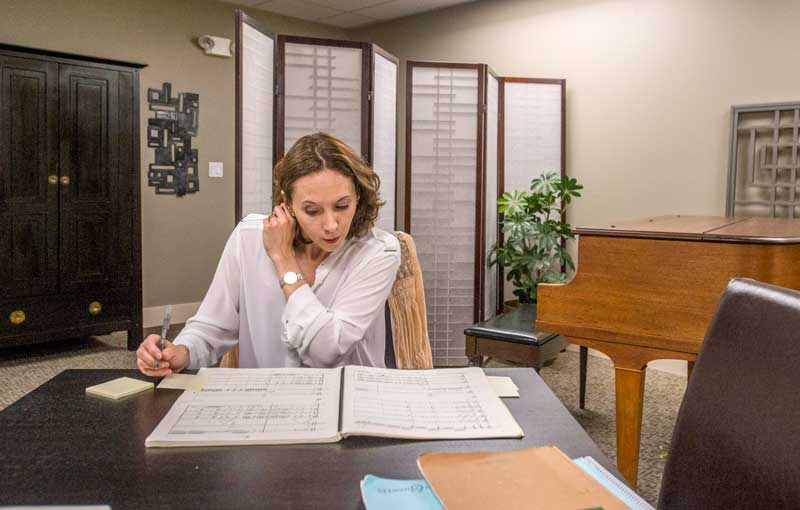
“It’s trying to use those rehearsals to bring everyone up to speed as quickly as we can so that we can start to make music,” Ioannides explains. “Often, making music is what you expect to do when you walk in the room and start rehearsing. But, in reality, you do have to rehearse, you do have to take things apart, repeat things.”
So Ioannides needs to know the music inside out.
Alone in the lounge, she flips methodically through the pages, counting aloud, singing under her breath, making small gestures with her baton hand. Occasionally she’ll play through something on the piano. As she reaches places where she remembers mistakes from rehearsal, she’ll pop in a Post-It note.
The Stravinsky, with its two-dozen instrument lines and constantly shifting meters, is tricky even for a conductor who’s done it many times.
Ioannides counts herself into a section with 11 beats, using the 11-syllable mnemonic “I-gor Stra-vin-sky is a son-of-a-b**ch!,” grinning wickedly.
3:30 p.m. school pickup

Consulting on cellphones, Ioannides, Hartman and Winterling converge on the Geiger Elementary playground at pickup time.
Everyone’s nervous — the twins were moved up to first grade today, for consistency with their other schools, and had a new teacher and classmates.
As they emerge into the hot sun, the kids swarm Ioannides with hugs and information before running off to play. Mom, loaded up with three backpacks, chats to the teacher and other parents.
“It’s hard,” Hartman says. “As a conductor, you have to travel, but as a mom you don’t want to be away from your family too much. Sadly, dads (as conductors) have gotten away with that.”
After sorting out car seats, the entourage drives to Titlow Park, stopping for ice creams en route. When they arrive, Ioannides suggests a race to the gazebo, setting out some no-pushing rules.
“On your marks, get set,” she begins.
The three kids tear off.
“Hey! I didn’t say ‘Go,’” she calls. “Did you hear me say, ‘Go’?”
Three heads, now under the gazebo, shake a no.
“Then I suppose I win,” Ioannides says amiably.

Family time is hard to come by with any traveling job, let alone one that involves evening and weekend work. But Ioannides makes the most of what she can get.
“I try to do something together once or twice a week,” she says. “We’ll go on an adventure, have a picnic outside, see a movie.”
She also gives each child one-on-one time, letting them decide how to spend it.
“Of course, they love that,” she says.
As the kids play under Winterling’s watchful gaze, Ioannides stares into the distance, thinking about the future.
With only a year left at Spartanburg, she’s already packed up that house and put it on the market, and has an audition coming up with the Cincinnati Chamber Orchestra.
Conductors at this stage of their careers are constantly applying for positions, moving up the ladder; but the Ioannides-Hartman family is looking for a new base, and they all like Tacoma.
“It’s so hard to predict in this career,” she says.
7:30 p.m. rehearsal
After a brief dinner, Ioannides is back at the Broadway Center, waiting for the orchestra to tune. She’s in a fresh outfit but looks pale and tired. The crowded studio is hot and stuffy.
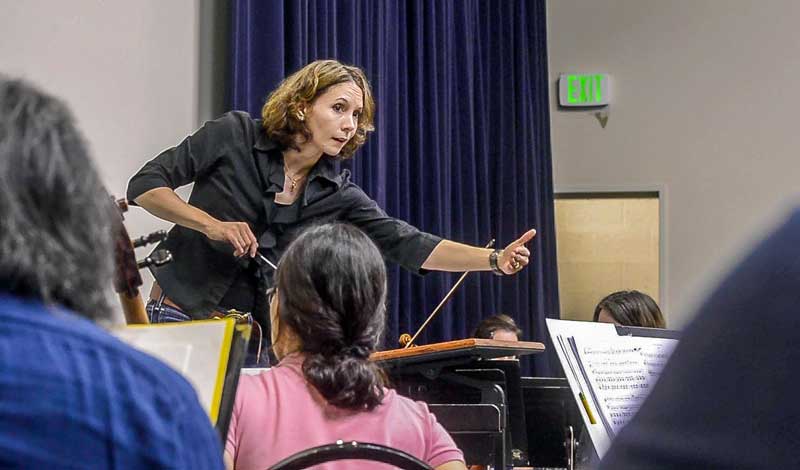
But the moment she lifts the baton for the famous high bassoon opening of “Rite,” Ioannides has the same utter focus and energy as she does in concerts, her eyes sparking and hair swaying during the fast sections.
For now, she’s not stopping much, or even calling very many instructions, just communicating with glances and gestures, and occasionally repeating a nasty spot more slowly.
“When you only have four rehearsals and a difficult program you’re having to make choices very fast on the spot as to what will fix itself and what you need to immediately stop for and redo,” she says. “And that comes with experience.”
10:30 p.m. home
It’ll take Ioannides a while to wind down before she gets some rest for the next day. Ahead of her in Tacoma are three weeks of rehearsals, meetings, concerts, a board retreat and some musician auditions.
She’ll also be preparing for upcoming gigs elsewhere, though she’ll manage to take some days off with the family, maybe make up for missing Hartman’s birthday.
A conductor’s life is demanding, but is it also rewarding?
“It’s totally rewarding, absolutely,” Ioannides says. “For me, the moment when I’m glad and thrilled that I’m doing this is obviously the concerts, and when people are enthusiastic about the music performed and you can talk to them, see them afterward and see that it has affected them. …
Music “can truly be an amazing healing gift,” she said. “... I feel fortunate to have the gift of music … to be able to pass that on to as many people as possible.”
Midnight
Sleep.
Rosemary Ponnekanti: 253-597-8568, @rose_ponnekanti
See Sarah Ioannides conduct the Tacoma Symphony
When: 7:30 p.m. Saturday (May 7)
Where: Pantages Theater, 901 Broadway, Tacoma.
Tickets: $19-$80; from $12 students.
Information: 253-591-5894, tacomasymphony.org, broadwaycenter.org.
This story was originally published May 6, 2016 at 2:00 PM with the headline "Think you’re busy? Try juggling 2 orchestras, 3 cities, 3 kids."