
Sukiyaki hot pots and homemade mochi cupcakes at annual Buddhist Temple lunch
Sukiyaki is such a notable Japanese dish that it has its own pot. The Tacoma Buddhist Temple has hundreds of them, metal mostly, though they can be cast-iron.
The more than 100-year-old temple hosts three public fundraisers every year, starting with the spring sukiyaki lunch — this year on Sunday, March 1.
Lynne Tanino, who co-chairs the massive undertaking with her husband Ken, remembers attending the event as a child in the ‘50s and ‘60s, when the sukiyaki flowed for two days.
“Japanese food wasn’t very well known in the ‘60s,” she said, so the event became a popular destination for South Sounders to enjoy a different kind of “freshly cooked beef dinner.”
At that time, teriyaki wasn’t ingrained in the American lexicon, let alone sukiyaki. Sushi didn’t reach beyond Los Angeles until the ‘70s and ‘80s; mochi ice cream only landed in mainstream grocery stores a few years ago. When restaurant critic Ruth Reichl reviewed a Japanese soba house for The New York Times — in 1993 — she was lambasted by readers wondering why they should care about buckwheat noodles.
More than a half-century later, many sukiyaki seekers return to the basement of 1717 Fawcett Ave. in Tacoma year after year.
“It’s kind of unique because each order is prepared in a separate pan, so we have all the cooks displayed on the floor. We all come up smelling like sukiyaki,” Tanino told The News Tribune, adding that other temples host similar events, but they rarely prepare each serving to order in individual pots. “That makes us unique.”
The dish starts with oil in a hot sukiyaki pan, followed by thinly sliced beef and onions. Then comes the broth — a mixture of soy sauce, sake, mirin (a sweet-and-tangy rice wine) and sugar. Next up: shirataki noodles, made from konjac, a type of Japanese yam. Finally, a sprinkle of scallions and tofu, simmered just long enough that the tofu absorbs some of the broth.
It arrives at your table hot, alongside a bowl of rice and a small cup of pickled cabbage, and a fortune cookie.
PREPPING 1,000 SUKIYAKIS
Swaths of volunteers, including non-members just helping out, start preparing a week out. A dedicated temple member has been buying the meat and produce for years, she said, gathering 80 pounds of cabbage to make pickles, 300 pounds of beef for the sukiyaki and 450 pounds of chicken for teriyaki — a bonus dish.
After chopping and slicing, the team weighs each portion to ensure consistency and efficiency.
“We’ve got the process down — everyone has a role,” said Tanino.
The lunch starts at 11 a.m. and runs until 3 p.m., but she recommends arriving early in the day. The crowds wind down after 2:30 p.m.
You’ll likely have to wait in line, winding down the staircase to the basement social hall. Make your way to an empty table, where a server will take your order.
Keep in mind that the “servings are really generous,” said Tanino, but each sukiyaki ($14) is built as an individual hot pot. Pairs might order one sukiyaki and one chicken teriyaki ($10 for a full order, $8 for a side). Add a cup of miso soup, also homemade, for $2.
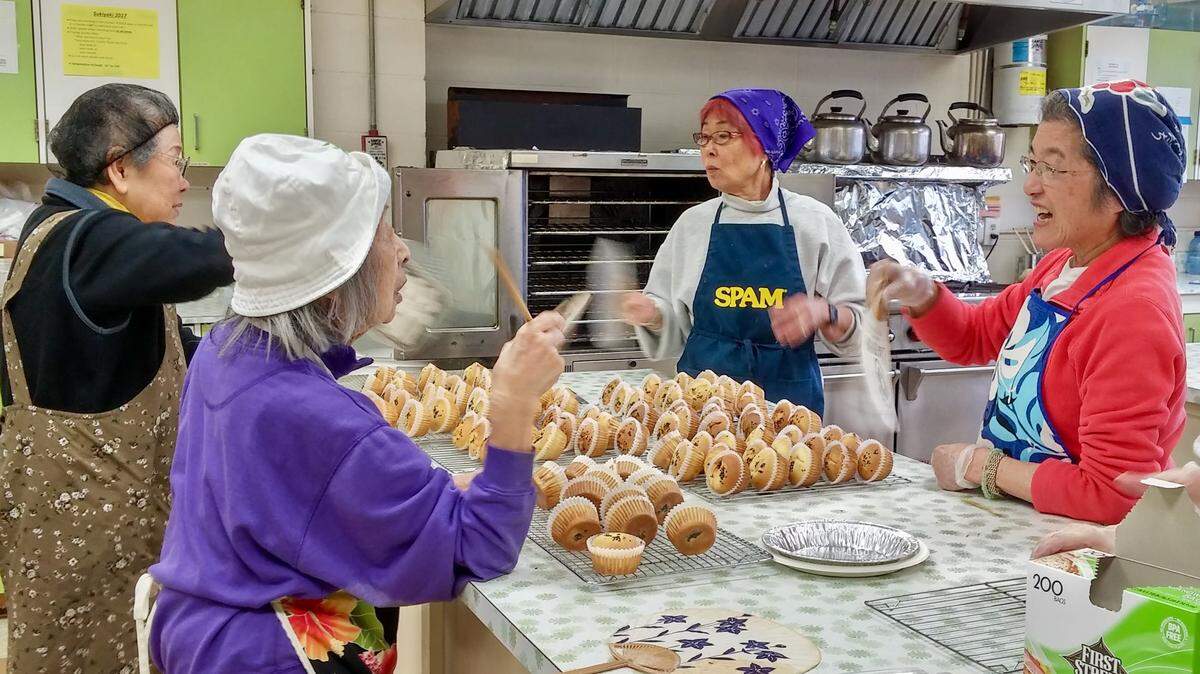
For dessert, the temple makes mochi cupcakes ($2 each) with a red bean paste filling from scratch. Store-bought mochi ice cream in strawberry and mango will also be available for $2 a pop.
Once you’ve finished your meal, head to the cashier to pay with cash or card.
You also can order any of the above dishes to-go, which now accounts for about half of the day’s business, according to Tanino, but she cautioned, “Nothing like having it fresh out of the pan.”
If you’d like to learn more about the temple itself, volunteers will be on hand to share what the community has to offer.
“Everyone there is like an aunt and uncle to us,” said Tanino, whose parents owned 15th Street Laundry on Fawcett. “The makeup of the temple has changed, but we’ve found some interest in Buddhism. We’re hoping to continue that family community.”
Just a couple years ago, the temple welcomed a young minister, Rev. Dr. Takashi Miyaji. She believes he’ll bring a younger perspective to the next generation of Buddhists.
Stay tuned for the temple’s summer fundraising events with more food and fun: the summer Bon Odori festival in early August and the Fall Food & Crafts Bazaar in November.
Sukiyaki Lunch at Tacoma Buddhist Temple
▪ 1717 Fawcett Ave., Tacoma, 253-627-1417, tacomabt.org
▪Sunday, March 1, 11 a.m. to 3 p.m.
▪ Prices: $14 sukiyaki, $10 chicken teriyaki, $2 desserts