
Everything you need to know about WA’s bag ban and what it’ll cost you
Start stashing all those tote bags in the trunk: Washington state’s ban on single-use plastic bags kicks in Oct. 1, and with it comes a mandatory cost of 8 cents for most other bags one might procure at a grocery store, boutique or restaurant.
Now there are approved bags — some that incur this charge and some that don’t — and there are prohibited bags, with the long-term goal of drastically reducing the amount of unrecyclable plastic in our waste streams and waterways.
Many cities across the state have already banned single-use plastic bags, including Seattle, Olympia, Tacoma and Gig Harbor. Some, like Bellingham, have moved to extend the ban to all single-use plastics, including straws and silverware.
State Bill 5323 was passed in the 2020 legislative session, but its effective date was delayed from Jan. 1, 2021, due to pandemic supply chain issues.
Here’s what to know as the statewide bag ban and associated fee takes off.
What kind of bags incur a charge?
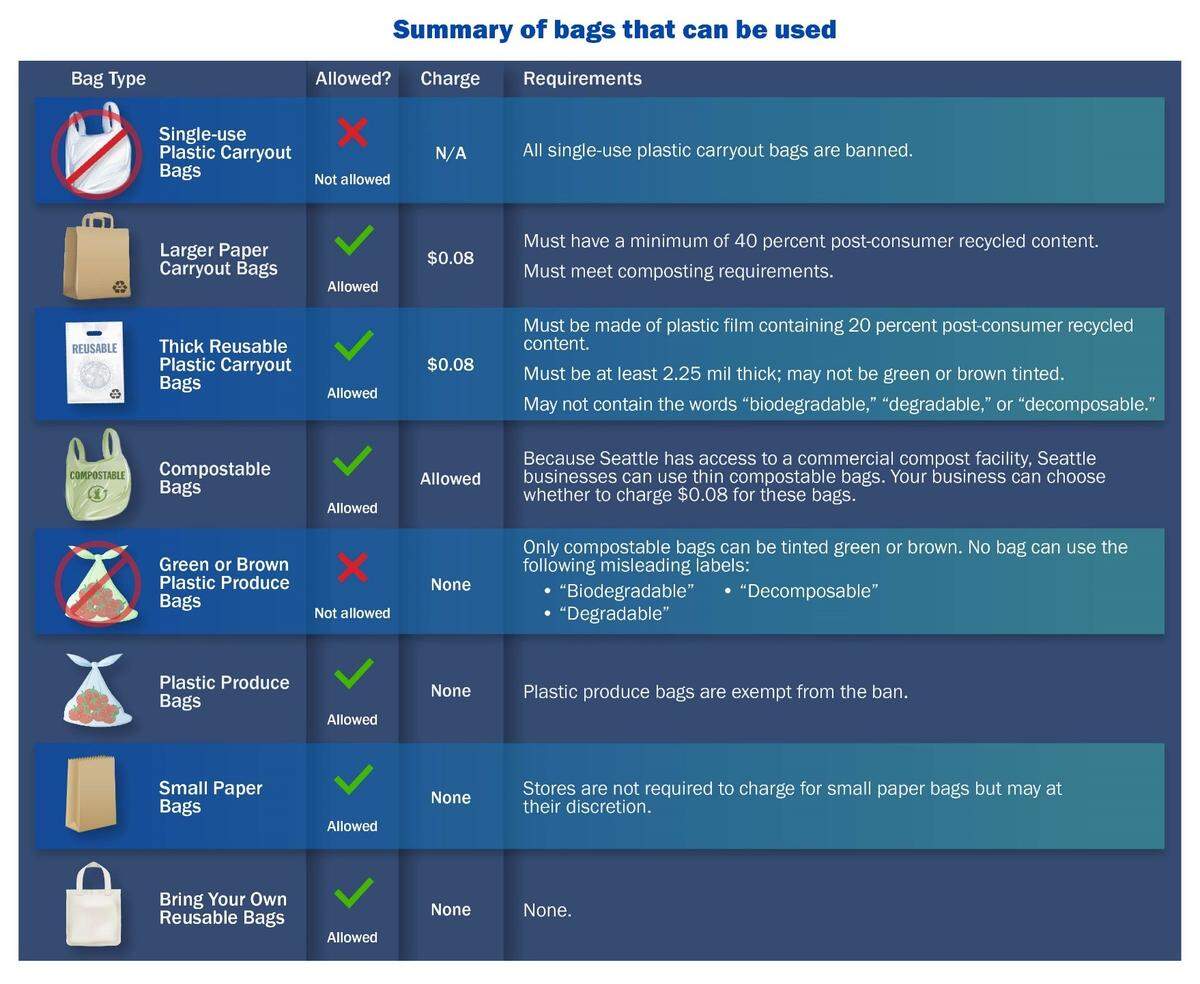
You’ll pay at least 8 cents for large paper bags, such as the handled kind that have already replaced plastic at some grocery stores, and thicker, reusable plastic bags. In both instances, these bags must meet a threshold of post-consumer recycled content and cannot be labeled as biodegradable, degradable or decomposable.
Actual compostable bags — made from corn or other plant-derived materials — are permitted, but retailers can choose whether to charge the customer. While Seattle has a commercial composting facility that accepts compostable packaging, most municipalities do not. Tacoma’s environmental services department, for instance, does not accept compostable serviceware in its food and yard waste bins.
What about produce bags for lettuce and such?
Exempted from the fee structure are plastic produce bags, often used for bulk food or to cover meat packaging, and small paper bags like lunch sacks.
It goes without saying, but you won’t be charged for using your own bags.
Won’t some retailers just eat the cost for me, to be nice?
No. Retailers are required by law to list the charge on receipts, and it’s taxable, according to the state Department of Revenue.
It’s also a minimum required charge, stressed Dave Bennett, communications manager for the solid waste team at the Washington state Department of Ecology, which is tasked with overseeing the implementation and enforcement of the new law. That means retailers could, in effect, charge whatever they want — he’s already seen a charge up to 25 cents.
“That minimum charge, it helps the merchant recover the cost of those more durable bags, but it’s also an incentive for customers to bring their own,” he said a week before the Oct. 1 effective date. “Bring your own bag: That’s where we want the shift in the public. It’s not a tax; it’s a sale.”
Are there any exceptions?
Yes, but they are limited for both consumers and retailers.
The only shoppers excluded from the fee structure are those paying with benefits programs such as the Supplemental Nutrition Assistance Program or Washington state Food Assistance Program.
The only exempted “retailers” are food banks or similar support organizations.
What about curbside pickup or restaurant delivery?
There are no exceptions for situations where bags are seemingly unavoidable, such as for curbside grocery pickup or food delivered from a restaurant.
By eliminating single-use bags from the retail ecosystem, said Bennet, the state hopes people will reconsider if they really need a bag at that moment, for that purpose. A new pair of shorts, for instance, could easily be tucked into a purse or a backpack already on your shoulder.
The law also requires that bags used to carry things, like groceries or takeout boxes, become of the reusable variety.
“Our goal right now is to have those bags meet their purpose for reuse,” said Bennett, adding that with change comes an opportunity for new systems that are simultaneously more friendly to the environment and more convenient for the public.
Some day, for instance, a solution might entail checking a box during online grocery ordering to swap bags for boxes retailers have on hand from receiving shipments.
What should I do with these “reusable plastic bags” when I’m done with them?
Reuse them as many times as you can: They are intended to be an alternative to flimsy plastic bags that easily tear and then end up piling high in landfills, floating in rivers or clogging recycling sorting systems.
Per Washington’s law, they must be manufactured with at least 20 percent post-consumer recycled content (40 percent by July 2022) and be at least 2.25 millimeters thick. Likewise, paper bags must be produced from at least 40 percent recycled content, and, if dry and grease-free, can then go into the recycling bin.
With most plastic bags that have outlived their usefulness, said Bennet, there are only two things you should do with them: 1) Drop them off at a collection point if one exists near you; or 2) Throw them away.
Some retailers offer collection bins for thin plastics, and services like Ridwell provide home pickup, for a fee. Keep them out of normal recycling streams, though, as they are a hazard to workers and contaminate otherwise viable recycled material.
Will stores throw away all of the thin plastic bags still in their possession?
Hopefully not.
“We want them to use the stock that they have on hand,” said Bennett, adding they can charge customers for them if they want.
He cautioned that the Department of Ecology does not want retailers rushing out to stock up on banned bags before Oct. 1, and the agency expects to field complaints of non-compliance with the single-use ban as retailers deplete their existing stock.
The agency will follow up on these and all complaints filed online at ecology.wa.gov/bagban, with initial action focused on outreach and education.
Under a grace period with an indeterminable end, Bennett predicts that the farther we get from Oct. 1, 2021, the fewer single-use plastic bags will be in the retail stream — and the more people will notice them.
“It’s gonna take time,” he said.
Editor’s Note: This story has been updated to reflect that the City of Tacoma’s environmental services department, not Tacoma Public Utilities, manages solid waste utilities in that area.
This story was originally published September 27, 2021 at 5:00 AM.