
Surge in unpermitted street-food vendors has WA health departments on edge

The Tacoma-Pierce County Health Department has joined a growing chorus of agencies across the state raising a bullhorn over what they say is a rapid rise in illicit roadside eateries, urging the public to look for proper permits and “think twice” before buying a hot dog or taco on the go.
As of Oct. 31, TPCHD had received complaints of 123 unpermitted food vendors compared to 18 last year, a 460% increase. Since August, TPCHD has identified 21 unpermitted vendors — all fruit carts or taco stands — in Tacoma, Puyallup, Orting and Bonney Lake.
The agency has tracked such closings “internally for several years,” confirmed spokesperson Kenny Via, but only began sharing the data in weekly newsletters and on its website this fall. The effort is central to its National Food Safety Month campaign, according to a presentation at the Sept. 3 Board of Health meeting. Closures stay on the webpage for 14 days, the same timeframe for more permanent food businesses closed for health-code violations.
Pop-up vendors typically lack handwashing sinks, approved refrigeration or hot-holding capabilities, and a restroom for employees. They also often lack business licenses.
Even food trucks, which must be permitted on their mobile unit as well as at an approved commissary kitchen, must have access to a restroom wherever they park, as do farmers markets and other public festivals.
Drawing public awareness to the sudden rise continued Via, is “part of a strategy to alert people to this rapidly escalating threat to public health.”
“We want folks to know: The best way to stay safe is to eat at permitted vendors,” Via told The News Tribune in a phone call recently. “They do all the work to keep the food safe.”
Consumers are encouraged to ask vendors to see their permit if one isn’t already visible. Vendors “must show them to anyone who asks,” Via added by email.
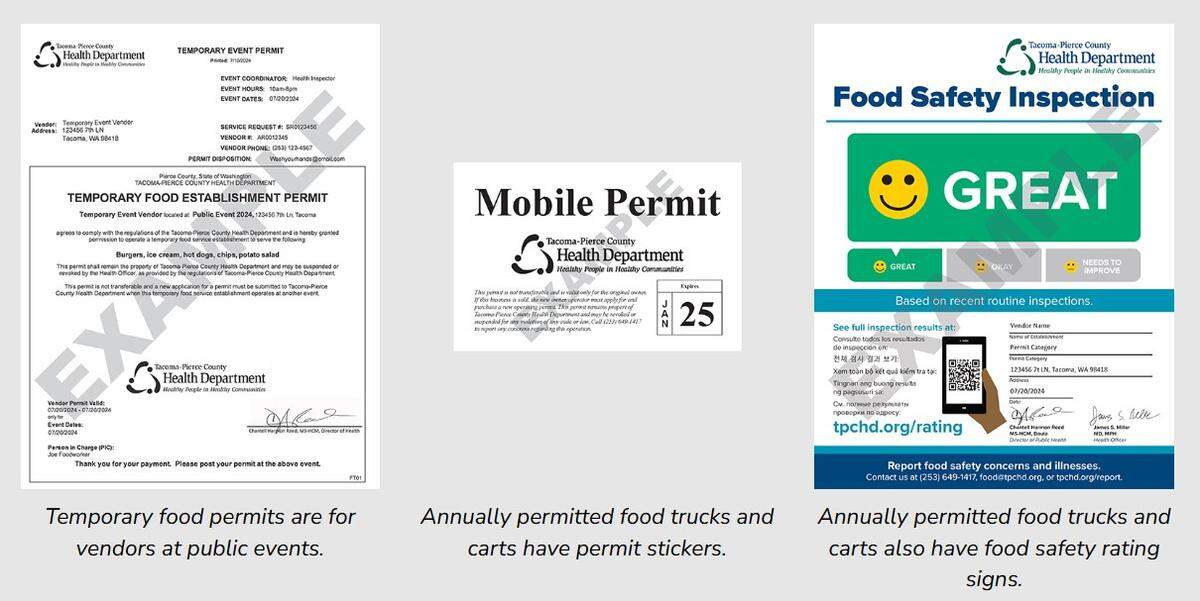
For vendors popping up on private property or at a large festival, for instance, it would likely be a temporary event permit issued by TPCHD. Look for details including an inspector’s name and date, a fixed address for the vendor as well as the date and address of the event or approved time period.
Those approvals differ from the conspicuous emoticon rating signs, adopted in 2022, affixed to windows and counters at properly permitted brick-and-mortar restaurants, food trucks and other mobile-food vendors. Inspectors aim to visit those businesses, unannounced, at least once a year.
“The process of permitting and inspection is among public health’s most tried-and-true practices,” TPCHD said in a statement. “It’s an absolutely vital tool we use to protect our residents from foodborne illnesses that can cause serious illness and death.”
Food permits are required for any vendor selling meat, eggs, fish or dairy products; any food that must be prepared in order to eat it; and cut, peeled or otherwise “prepared” fruits and vegetables. Permits are not required for commercially packaged food that does not need to stay cold or for whole, uncut fruits and vegetables.
The health department stressed the impact off-the-grid operations can have on those who are following laws and procedure — and paying for it.
“Unpermitted vendors not only pose a significant risk to public health, they also create unfair competition for permitted vendors who invest the necessary time and resources to make sure your food is safe,” TPCHD added in its statement to The News Tribune.
Surge in unpermitted vendors across WA
Seattle-King County Health Department issued a similar warning late last year after closing around 100 unpermitted vendors — up from one to dozen every year since 2019, The Seattle Times reported. As cart sightings proliferated around Lumen Field and T-Mobile Park, permitted, fee-paying vendors grew increasingly disgruntled at the uneven playing field. During the Mariners playoff run, on a single day in early October, local health inspectors caught 14 unpermitted carts, according to KOMO News, while a group that says it represents 200 licensed Mexican restaurants has filed complaints about unlicensed stands in several cities, including Tacoma, according to KOMO.
County health agencies in Yakima, Thurston and Clark, which includes Vancouver, also noticed an uptick.
Some departments in Central and Eastern Washington have alluded to possible coordination of vendors across the state or even criminal activity, The Tri-City Herald reported of Benton County this month. In September, a controversy erupted in Yakima, where around half of the population is Hispanic, after commissioners for the county board of health — in response to concerns raised by the health department — issued a letter calling for state and federal support to dampen what it described as a “dangerous and violent criminal enterprise.” As KIMA, the local CBS affiliate, reported, commissioners retracted the letter after local uproar. Many in the community believed the call-out unfairly targeted immigrant communities, according to KIMA’s Sept. 25 story, blaming taco stands for purported human trafficking and illegal drugs without much evidence.
In Pierce, Via could not speak to the origins of the local surge but emphasized that unpermitted vendors have “quickly become a concerning issue across Western Washington.” The department has been working with other local health agencies, the state Department of Health and police on “a regional response,” he added.
Tacoma and Pierce County response
The local public-service campaign began in earnest as summer ended around Puget Sound.
On Sept. 15, TPCHD issued its first public call-out, focusing on the lack of approved food safety procedures and risk of illness to customers who might presume they’re like any other restaurant. Then in mid-October, the agency followed up with a more visual reminder of the potential dangers of street food after visiting a local residence that was purportedly “being used as a kitchen space for unpermitted roadside food vendors in Pierce County.”
Photos shared in the Oct. 16 blog post show a patio with a bus bin and Home Depot bucket holding what appear to be pork on a spit (commonly used for al pastor tacos) and a stockpot stewing on a portable burner, situated on the ground, with herbs and meat on the bone. Other images revealed trash bags and cardboard strewn across a yard, and inside a door to the house, boxes labeled for pork on a tile floor.
Inspectors who visited the site noticed “obvious food-safety violations,” according to the post, including meat stored outside without refrigeration and “food cooking next to trash.”
The search was instigated after a complaint, according to the health department, which enlisted support from the City of Tacoma’s Tax and License division as well as the Tacoma Police Department.
“Because we didn’t have a warrant, we could only render the food inedible and ask the operators to stop,” wrote Christina Sherman, a food and safety community manager at TPCHD.
The people on site rent the residential property, according to the health department’s post, and the city cited them for operating a business without a license. TPCHD requested that police “stand by to provide support and ensure a safe environment,” which Via said is not unusual due to limitations on what health inspectors are authorized to do.
.jpg "Food vendor cropped1 2025 (1).jpg")
Resources for unpermitted vendors
Inspectors have the authority to shut down a legally operating business for violating terms of their health permit, and they stay plenty busy with routine inspections of existing and new restaurants. With unpermitted vendors, though, they can ask the vendors to discard any food and leave, but they have little recourse to stop them from moving to a different location, officials at health agencies across the state have said.
TPCHD’s response has focused on educating the public of potential risks of consuming food from unpermitted sources and assisting vendors in securing the necessary permits, where possible.
When enforcing an unpermitted situation, inspectors follow one of two paths, explained Via.
If a vendor meets minimum sanitation requirements when an inspector shows up, they can complete a temporary event application on the spot and receive a bill to pay later. Those fees range from $81 to $301 for a roughly two-week permit, depending on risk level; meat and dairy would indicate high-risk, whereas a fruit cart would be considered low-risk. In that case, the vendor might instead choose to leave, but they would still be on the hook for a $230 “unpermitted vendor” fee.
If a vendor cannot meet minimum sanitation requirements in the moment, they must stop immediately and leave the site. They would also be charged the $230 fee.
Asked about resources for non-English speakers, Via said the agency offers applications, documents outlining requirements to operate, and educational handouts in Spanish. The latter is also available in a dozen other languages. Inspectors can also call an interpreter from the field.
“We can have a conversation with a vendor in whatever language is best for them,” he said.
Vendors interested in a long-term permit for a mobile business would also need to have proof of access to an approved commissary kitchen. TPCHD confirmed that it permits 70 low-risk commissaries and just four high-risk commissaries. Mobile food permit fees range from $368 a year for a low-risk menu to $817 for high-risk. A full-service restaurant with up to 25 seats is also $817, increasing to $1,051 for 26-74 seats and $1,329 for 75 or more seats.
The public can submit complaints about any “food concern” to TPCHD online or by phone, 253-649-1696.