
The PNW loves mushrooms. This KP farm grows thousands that end up on your plate
It was a cold, misty, mid-spring morning — as Pacific Northwest as it gets — when I officially met “the mushroom guy” in his habitat. If you live in or near Tacoma, and you like good food, you probably know him, too.
For nearly 15 years, Adam DeLeo quietly has been an essential player in the city’s culinary culture, selling foraged and farmed fungi directly to chefs and to consumers by way of local grocers and farmers markets. Last year, Adam’s Mushrooms achieved the significant new title of major mushroom grower with the debut of a fully operational farm, now nurturing around a dozen species at a time on an acre of land in the Key Peninsula.
This ecosystem involves no trees upright or fallen. It relies instead on custom-blended substrates packed into very specific plastic bags from Japan, hyper-clean air and damp rooms with cool lights. These mushrooms are born under the cover of hoop houses and the watchful eye of humans who carefully control the process, from sawdust to spawn and fruit to harvest.
For certain chefs, a resource like Adam’s is go-no-go — you can’t have a restaurant that serves local produce without local farms. At Field Bar, one of the few Tacoma restaurants committed to such sourcing, chef Ike Hippensteel said if a company like Adam’s Mushrooms didn’t exist in the South Sound, “I would make a resource like Adam’s.”
Hippensteel’s ever-changing menu always features a fungi or two, always from Adam’s. In early spring, he doused creamy-white corals in a spicy house version of Old Bay and roasted them on high in the convection oven, allowing the heat to circulate into the “beautiful fractoloid structure,” as the chef described the unmistakable crevices of this varietal that resembles its under-the-sea namesake. Served over “the last of the winter cabbage” with a salted, peppered zabuton and a sweet, tangy, fermented plum chamoy, the corals overachieved compared to what a quotidian baby potato or Brussels sprout might do for a balanced plate — protein, veg, starch. No, no, no. Mushrooms act with the gumption of a fungus that eats forest floors for a living.
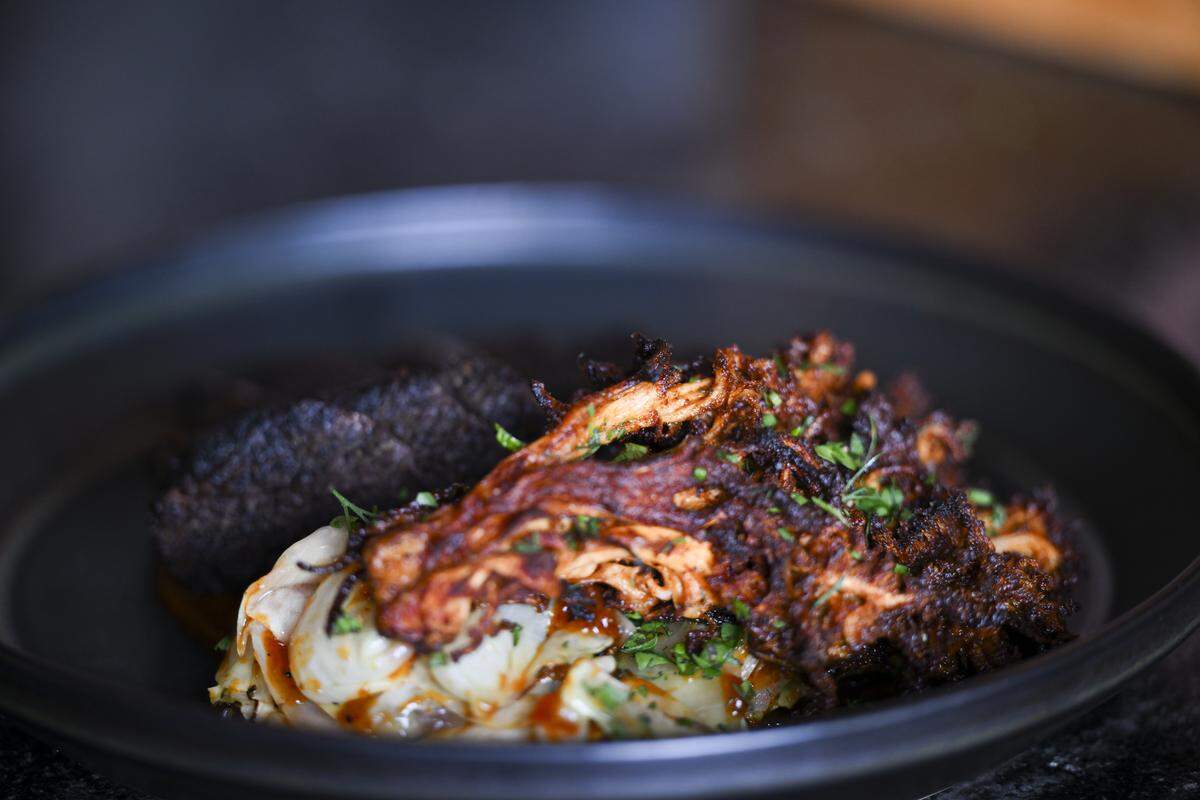
“Mushrooms want high heat,” explained Hippensteel. “To really get the mushroom out of them, roast them high … just the driest, most powerful heat. They can take a lot. A mushroom drying out is part of the mushroom flavor.”
Now that fresh mushroom flavor — approximately 850 pounds a week of it — comes directly from DeLeo’s farm.
Mushroom farming in the PNW
DeLeo grew up on the Key Peninsula. He didn’t study biology and hadn’t fallen into any particularly woodsy habits as a youth. When I inquired during my April farm visit, he said that friends did call him “the mycologist” during his stint in college, then an unearned nickname as he hadn’t yet pursued the study of fungi.
“It’s kinda weird in retrospect,” he said.
In the early 2010s, after years of fishing in Alaska, unsure of his next lot in life, he saved some money to travel and stayed in Scotland for two-and-a-half years. He casually attended a seminar with none other than Washington’s own Paul Stamets, a mycologist, author, owner of Fungi Perfecti and, in DeLeo’s words, “the original PNW mushroom guy.”
“I was getting goosebumps,” recalled DeLeo.
He picked up some reference books and got a job in a kitchen, where he tested his mycology skills by night. He also met his wife, Astrid, across the pond.
“She seemed to believe that my dream that we were gonna be able to grow and sell mushrooms for a living was not totally a harebrained idea,” he laughed.
They returned stateside, settled into his hometown and had two kids. They started growing mushrooms in a small shed in his parents’ backyard. He trekked into the mountains to forage and partnered with existing mushroom-growing operations in the region. By 2013, selling mushrooms had become his job — it was paying the bills. The couple bought a piece of land near Key Center, slowly built a house and moved in 2019. Then, just a half-mile down the road, another empty lot went up for sale. By July 2021 it was theirs, and a farm was in their future.
I first connected with Adam’s Mushrooms as a customer, chatting with DeLeo and his oldest employee, local chef Tim Hartman, at the Proctor and Tacoma farmers markets. I would take mushrooms home for Sunday supper and take note of Adam’s name on restaurant menus at established spots (Primo Grill, Marzano, Brix 25, Millville Pizza Co.) and playful newcomers (Bar Rosa, Corbeau, Manuscript, Field Bar). But I became enamored of DeLeo’s trajectory to professional mushroom-dom in 2022 when I called him with my own harebrained idea: Could I join him on a foraging trip?
He was game, but schedules, families, oaths of secrecy and the entrepreneur’s big-picture vision took precedence. By June 2023, with the spark of a $370,000 U.S. Department of Agriculture farm loan — “a naive amount” in retrospect, said DeLeo — he was too busy to take a clueless forager into the mountains for morels. He was knee-deep in building the mushroom farm of his dreams.
We kept in touch. I watched his progress from afar, via peeks on Instagram. A year later, most of the excavation and construction work was complete. It took another 15 months, but in August 2025, they were producing and harvesting mushrooms on site: pointillist lion’s mane, beautiful blue oysters, shiitakes, black pearl, chestnuts, enokis.
He called me out of the blue in February. The farm had found its rhythm.
A tour of Adam’s Mushrooms
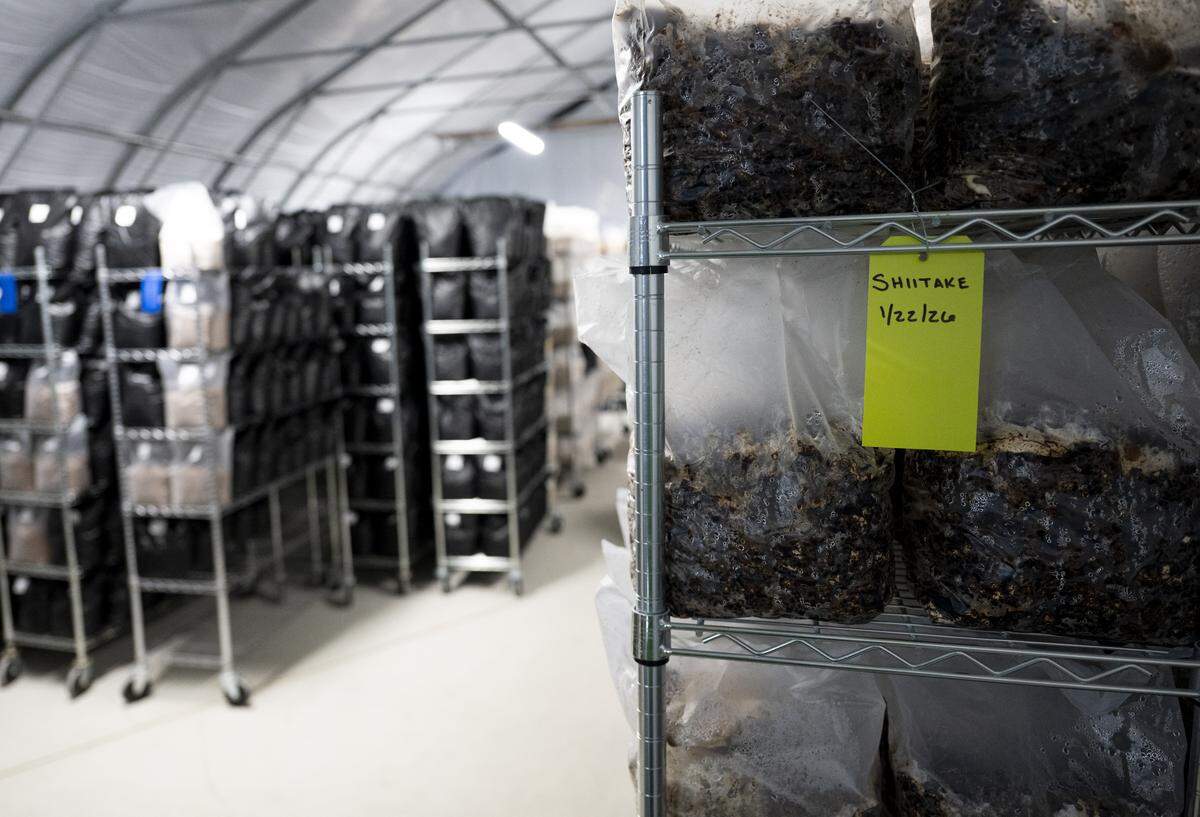
On this particular Tuesday, two of DeLeo’s employees were prepping the substrate for shiitakes, which begins with a pile of finely milled alder sawdust from trees that once grew in Washington’s own soils. DeLeo picks up the pile in Longview and drives the 100-ish miles back to the farm in Key Center. Every batch has a different water content; this morning it’s 65%. The sawdust runs through an industrial mixer with wheat bran — shiitake’s preferred food source — and, with the tap of a pedal, flows into a Japanese growing bag. They’ll repeat this step 875 times today.
“You see, mushrooms are weird. It’s not like a plant. It’s actually going to consume this,” said DeLeo, pointing to the substrate. In the woods, mushrooms act as a kind of digestive catch-all, converting dead or decomposing plants into energy that supercharges the development of the fruit — the mushroom bodies we see and eat. The caps eventually spore in an effort to reproduce, and the cycle continues in perpetuity.
“Everything will be digested by a mushroom,” said DeLeo.
Adam’s sticks with non-industrialized saprophytic mushrooms, which are far more interesting in taste and structure from the “field” varieties of buttons and creminis shrink-wrapped in Styrofoam on supermarket shelves. Some of the most prized mushrooms — morels, chanterelles, matsutakes, porcinis, truffles — fall into the mycorrhizal category that require certain host trees to thrive. DeLeo agreed that attempting to replicate that environment is a fool’s errand, and why repress the occasional thrill of foraging for these little wonders of the world?
Staff wheels metal racks stacked with freshly packed bags of substrate into an “oven” (really a converted shipping container outfitted with exhaust pipes and connected to natural gas lines), where they steam for 16 hours at 205 degrees Fahrenheit. The next morning, the bags — still open, not sealed — get blown with “really clean air” for a full 24 hours. On the third day, the substrate shall be inoculated.
“We’ll get all labbed out,” said DeLeo.
Like research scientists, they meticulously place a shiitake culture, developed from spawn bred in house, in each of the 875 bags before sealing them up. They are “introducing a single organism, trying to keep the spawn as close to the original strain as possible” while maintaining a “vigorous and clean” environment inside the bag, explained DeLeo.
Fungi, yes. Dirty? Far from it.
“There’s 1,000 things in the air that will grow in there if you let them,” he said.
The bags get shaken in a cylindrical tube before heading to a moderately warm, dry room where hyphae — the white, root-like, cells that make up the basic structure of fungi — begins to spread through the substrate to form the underground network that supports fungi’s growth, known collectively as mycelium.
After a couple to a few weeks, depending on the variety, the bags are moved into the “birthing room,” as DeLeo and his team endearingly call the hoop house where the magic happens.
Like the Pacific Northwest forests it mimics, it’s almost always raining here. The air is heavy, wet, delicately musky. The lights emit 6500 lumens of bright-white verging on blue, an artificial representation of natural daylight. The humidity hovers near a thick 95%.
“We try to create our little rainforest in here,” said DeLeo. “We need a happy place for our mushrooms to grow.”
By this stage, the mycelium has sucked much of the life out of the substrate. The once tidy blocks are bumpy and deformed, the plastic sticking to it like there’s no tomorrow. Staff tear open the top of every bag to let the fruit emerge.
Most of the shelves are stacked with shiitakes that started their journey to adulthood almost 12 weeks ago, longer than most of their peers. Despite being one of the most popular mushrooms out there, shiitakes are a pain, said DeLeo. Cooks know to chop off most of the tough stem. In cultivating them, too, their “kinda barky” nature means the entire plastic bag must be removed for the mushroom to fruit, which it does all over the block and not just from the top, like every other varietal DeLeo is currently growing.
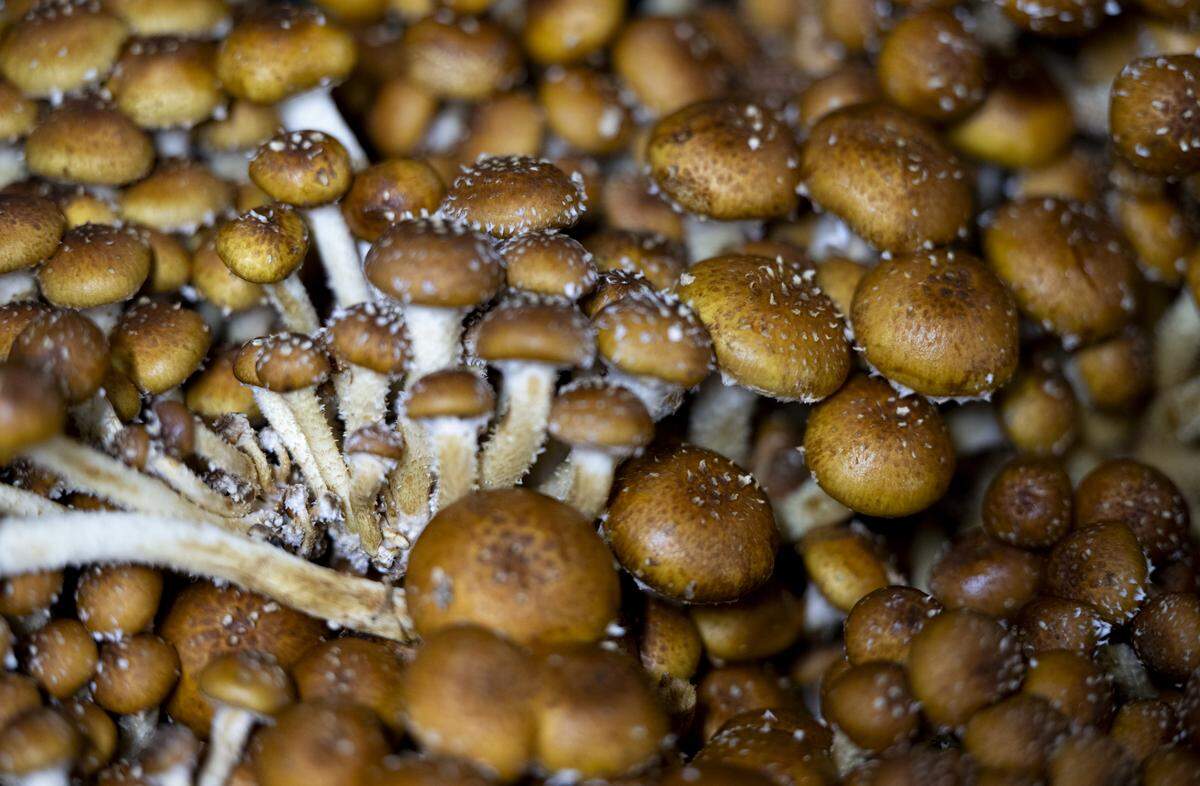
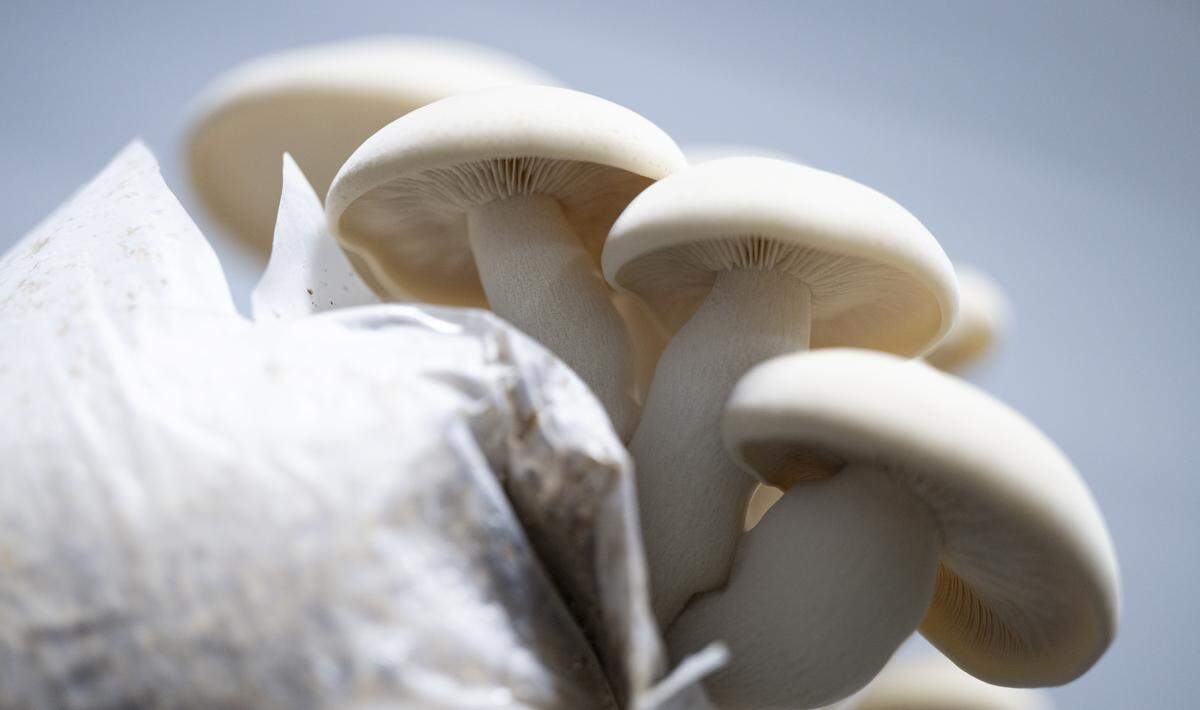
Some mushrooms take under four weeks from start to finish. DeLeo’s love for one over another ebbs with the flows of the farm’s controlled chaos. Maitakes, also known as hen of the woods, are nutty and fun. The pioppinos, a bushel of small, golden-brown caps, sing in a stroganoff, said DeLeo. He’s playing around with recreating native strands of beech mushrooms and Penrose lion’s mane he foraged from the Olympia Peninsula. Oysters with their pretty, wavy gills in hues of blue, gray and yellow intrigue the farmers-market crowd, while the bodacious king trumpets impress.
“Variety gives you resilience,” said DeLeo. Already they have expanded the farm, adding another hoop house to accommodate more fruiting ‘shrooms. They’re essentially over-producing and hope to add a few retailers. Are you out there, mushroom lover?
From mushroom farm to table
While the shiitakes were settling into their new homes, Hartman was harvesting mature corals, some of which would accompany steak dinners at Field Bar (which have since left the menu to make room for spring’s bounty).
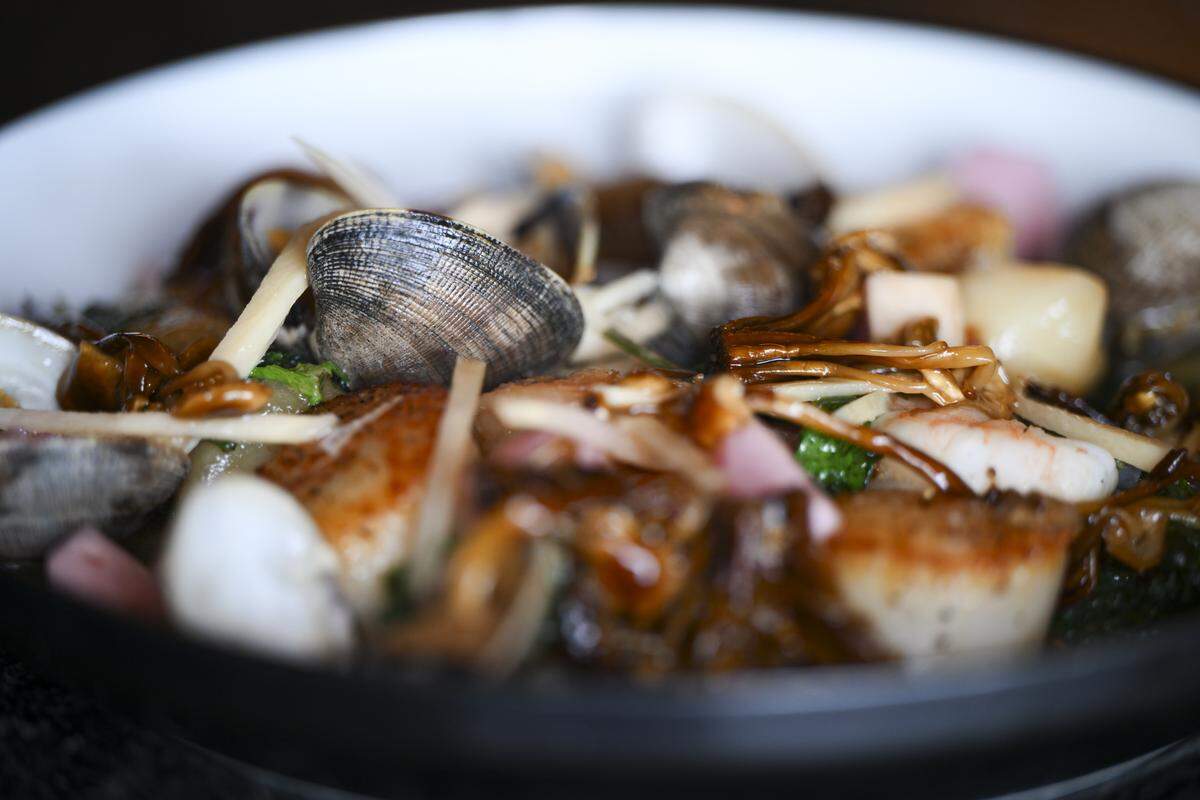
Hippensteel immediately said yes to harvests of enokis, miniature buggers with long, soft stems. Small mushrooms are highly qualified candidates for a soy pickle, he said, resulting in a version often served with ramen. At Field Bar, they star in a seafood primavera, which the chef admitted was not Italian at all but spotlights the “first green thing of the season”: stinging nettles, also foraged by the Adam’s crew. Hippensteel purees the leaves into a pesto and blanches additional leaves (to remove the sting) before sauteeing them with seared scallops, shrimp, Neptune Oyster clams and handmade mochi dumplings (instead of pasta). The savory pickled enoki pops with tart surprise next to pickled ginger and daikon from Local Color Farm & Fiber, a microfarm and yarn producer in Puyallup.
His chef brain works in endearingly mysterious ways, but when it comes to what ends up on the plate, he confessed: “I kinda just design the menu around what I can get from Adam’s and Local Color Farm & Fiber.”
From the tiny kitchen behind the bar, equipped with just two heat sources — that convection oven and two burners — he changes the menu frequently, by dish or by ingredient. The petite pickle plate of early May had some bitter Chinese celery. The housemade bread that carries the signature tartine has been rugbraud and rye and recently made with rhurbarb, swirled with decadent chicken liver mousse, pickled pieces of the fruit and the mind-bendingly good crunch of a black-sesame honeycomb. That primavera could accept a different Adam’s mushroom if something goes awry with the enokis.
“If there is a gap week, we’ll find a substitution,” said Hippensteel. “We trust him and he trusts us. To respect food is to be a little flexible … It’s Kronos, God of Time, who dictates when the menu changes. My vocation is knowing how to work with it.”
Adam’s Mushrooms
- Retailers: Stadium Thriftway, Harbor Greens, Central Co-op, Marlene’s Natural Market, Tacoma Boys (dried only)
- Buy direct: Tacoma, Proctor and Puyallup Farmers Markets; or pick up CSAs (weekly or bi-weekly) from the farm, order online and pay in advance
Tacoma Restaurants
- Bar Rosa
- Chez Lafayette
- Corbeau
- Field Bar & Bottle Shop
- Le Sel
- Manuscript
- Marzano
- McMenamins Elks Temple
- Primo Grill
- Tibbitts at Fern Hill
Gig Harbor Restaurants
- Brix 25
- Gourmet Burger Shop
- Millville Pizza Co.
Olympia Restaurants
- Alderbrook Resort (Union)
- ilk Lodge
- Swing Wine Bar
This story was originally published May 18, 2026 at 5:00 AM.