
Mariners roster breakdown: Who are free agents? Who’s signed? Who’s tradeable?
Seattle Mariners general manager Jerry Dipoto knows his club is stuck in the middle in a number of avenues and he’s in the infant stages of what should be an awkward offseason to navigate.
The Mariners were well ahead of the teams behind them in the American League (nine games up on the Angels), yet far behind the AL’s powerhouses (at least 11 back of the Yankees, Red Sox and Astros and eight back of Oakland).
Roster-wise, the Mariners have young, breakout players with plenty of club control, but also aging and declining players that take up what are likely unmovable portions of their payroll.
One thought is that the Mariners should take advantage of the value of their top assests by trading players like Edwin Diaz, James Paxton and Mitch Haniger, and then suffer through the final years of the team’s biggest salaries and call that a rebuild.
That’s not Dipoto’s thought.
“We have to consider all things,” Dipoto said. “But the likelihood of every truly considering a tear-it-down model, it doesn’t make a lot of sense. That being said, there are a lot of alternatives to tear-downs.
“Guys like Haniger, guys like Marco Gonzales, guys like Edwin Diaz, these are the pieces that you’re trying to build around, not the pieces that you’re trying to send away. We want to be conscious of the fact that we have built up what we think is that next sustainable young core, and build toward it.”
How, though?
That’s what Dipoto, Scott Servais and company have been meeting about the past two weeks since the regular season ended. All the while, they’re watching these playoff teams wondering what it’s going to take to end Seattle’s 17-year postseason drought – which is the longest active streak of any team in the major North American professional sports.
“There’s no reason for us to start from scratch,” Dipoto said. “But we do need to reassess where this roster is, and take a look at not just 2019, but how we catch the teams that are in front of us because I don’t think the Astros, the Yankees, the Red Sox or the Indians are going anywhere, and, frankly, the Tampa Rays and Oakland A’s just showed us that they’re real, and we have to consider that.
“We won 89 games and we’re sitting here today (watching the playoffs) close to 10 games back of the fifth-best team. That is a challenge, and we have to consider that. We’re not a piece away from making that type of move, and, frankly, as we sit here we have to assess where we are in terms of our age, our win curve and what makes the most sense for us.”
But let’s go through the Mariners’ roster, looking at who’s leaving, who’s staying and how the club manages the rest.
Free agents | 2018 salary |
DH Nelson Cruz | $14.3 million |
*OF Denard Span | $12.5 million |
RHP David Phelps | $5.6 million |
LHP Zach Duke | $3.7 million |
OF Cameron Maybin | $3.3 million |
RHP Adam Warren | $3.3 million |
UTIL Andrew Romine | $1.1 million |
INF Gordon Beckham | $545,000 |
*Mutual option for 2019
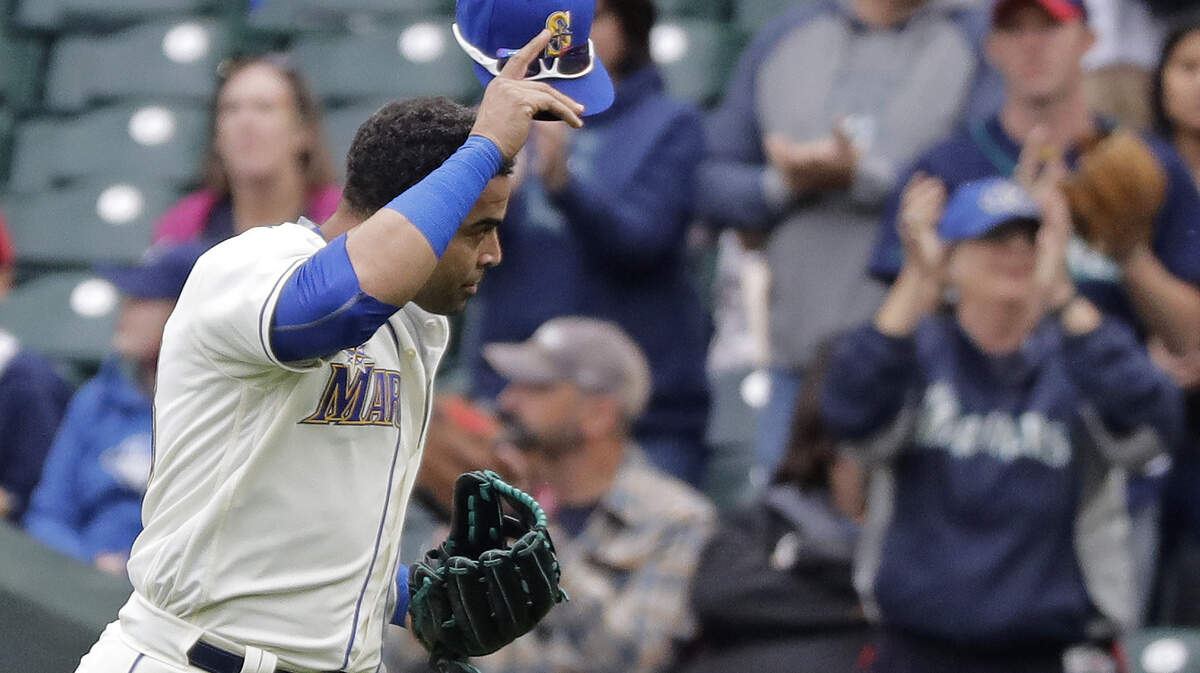
The two biggest questions are right at the top. Decisions with Nelson Cruz and Denard Span should most indicate the Mariners’ direction for the next few seasons.
They need offense and Cruz led them with 37 home runs, and his OPS (on-base plus slugging) of .850 was second-best on the team behind Haniger (.859). He said he wants to stay in Seattle, Servais wants him to stay, his teammates want him to stay, even though Cruz is 38 years old and many of his season numbers were well below those from his previous three years with the Mariners.
But do the Mariners let him walk in free agency and free up versatility with their designated hitter position, which also creates a place for Daniel Vogelbach?
Servais said last month that Vogelbach needs a team, whether it’s the Mariners or not, to give him opportunities. Vogelbach is also out of minor league options, so this is the Mariners’ final chance to create a role for him.
Span is much easier to bring back. He has a team option for 2019, but it would require paying the soon-to-be 35-year-old $12 million next season, and it would leave less playing time for Ben Gamel and Guillermo Heredia.
Signed players | Signed through | 2019 salary | Option |
RHP Felix Hernandez | 2019 | $27.9 million | None |
RHP Juan Nicasio | 2019 | $9.3 million | None |
LHP Wade LeBlanc | 2019 | $2.79 million | 2020-2022 |
RHP Mike Leake | 2020 | $16 million | 2021 |
2B/OF Dee Gordon | 2020 | $13.3 million | 2021 |
3B Kyle Seager | 2021 | $19.5 million | 2022 |
SS Jean Segura | 2022 | $14.9 million | 2023 |
2B Robinson Cano | 2023 | $24 million | None |
For those who struggle with mathematics, the Mariners have four players (Felix Hernandez, Robinson Cano, Kyle Seager and Mike Leake) who will combine to make $87.4 million next season. That’s more than the entire payrolls of the Rays, White Sox and Athletics (oh, and the Rays and A’s both won more games than Seattle this season).
Add Jean Segura and Dee Gordon into that mix and that’s $115.6 million for six players, which is more than 10 teams in baseball dished out in 2018.
Some of Leake’s contract is still being paid for by the St. Louis Cardinals. But it’s very, very unlikely (next to impossible) that the Mariners would be able to trade Hernandez, Cano or Seager. Gordon was already offloaded by the Marlins to send him to Seattle as part of their tear down, while Nicasio is coming off a disappointing 2018 that concluded with season-ending knee surgery.
But what about Segura?
There’s value there. He had a torrid first half of the season on his way to the AL All-Star team as the final vote recipient (then he was almost the All-Star MVP). And he figures to have higher trade value since he can play both middle infield positions.
The Mariners would then have to decide what to do at shortstop, but Gordon did play eight games there this season and that’s what he entered the league as. He was clearly a skilled middle infielder, at times flashing why he was a Gold Glove second baseman for the Marlins, but the Mariners brought him to Seattle to play center field.
Arbitration eligible | Options remaining | 2018 salary | Free agent |
RHP Alex Colome | 0 | $5.3 million | 2021 |
LHP James Paxton | 2 | $4.9 million | 2021 |
RHP Erasmo Ramirez | 0 | $4.2 million | 2020 |
C Mike Zunino | 1 | $3 million | 2021 |
RHP Nick Vincent | 0 | $2.8 million | 2020 |
LHP Roenis Elias | 0 | $598,000 | 2022 |
RHP Ryan Cook | 0 | $545,000 | 2020 |
RHP Justin Grimm | 0 | $545,000 | 2020 |
C Chris Herrmann | 0 | $537,992 | 2020 |
Another reason some wonder if the Mariners might try to move Edwin Diaz: Alex Colome.
Colome had a strong second half after arriving from the Rays, where he led the AL in saves in 2017. So Seattle has an in-house option who won’t become a free agent until at least 2021, if there’s a sizeable return available for Diaz.
But that would mean shedding a 24-year-old who saved 57 games this season – tied with Bobby Thigpen for second-most in a season in MLB history.
James Paxton has plenty of value, too, but that just means the Mariners would have to find another ace starter of his caliber sometime down the road (and it’s not like the Mariners are loaded with touted starters with 16-strikeout or no-hitter stuff in their farm system).
Under club control | Options remaining | 2018 salary |
OF Guillermo Heredia | 2 | $782,000 |
RHP Edwin Diaz | 3 | $570,800 |
OF Mitch Haniger | 3 | $560,200 |
1B Ryon Healy | 3 | $559,200 |
OF Ben Gamel | 1 | $558,100 |
RHP Sam Tuivailala | 0 | $554,600 |
LHP James Pazos | 2 | $553,900 |
LHP Marco Gonzales | 0 | $550,300 |
RHP Dan Altavilla | 1 | $549,000 |
RHP Casey Lawrence | 1 | $546,000 |
RHP Shawn Armstrong | 0 | $545,000 |
RHP Chasen Bradford | 2 | $545,000 |
RHP Matt Festa | 2 | $545,000 |
C David Freitas | 2 | $545,000 |
UTIL Kristopher Negron | 0 | $545,000 |
RHP Nick Rumbelow | 1 | $545,000 |
1B Daniel Vogelbach | 0 | $545,700 |
Plenty of young talent here with Haniger, Diaz and Gonzales at the forefront of that.
They need Healy to become more of an overall hitter, and he took steps to address his poor strike-zone discipline in the final month of the season. Then there’s Gamel, who could be on the verge of a breakout season if he combines his power numbers of 2017 with the .358 on-base percentage he had this past year.
Kristopher Negron is out of options, but he seems like the likely super-utility replacement for free-agent Andrew Romine. Shawn Armstrong is in a similar boat, but he was maybe the Mariners’ most reliable bridge reliever after he was selected from the Rainiers near the end of August.
Now it’s just about how all these pieces (and what’s available in free agency) form a playoff team – whether that’s in 2019 or beyond.
“You’ve all heard me talk about we have built this with the intent of being sustainable,” Dipoto said. “We want to be forward-thinking, and since 2016 we’ve had the fifth-best record in the American League. We are trapped behind four teams that have had extraordinary success, and we’ve not been able to get over that last hump.
“Now we have to figure out as we move forward what it takes for us to catch the front-runners because we don’t want to make it to a wild-card game. We want to be a consistent playoff presence and ultimately win World Series. So we’re going to have to reassess where we are in the marketplace.”
This story was originally published October 15, 2018 at 2:42 PM.