The ‘Six Sovereigns’ are fighting for the Columbia River basin’s future. Who are they?
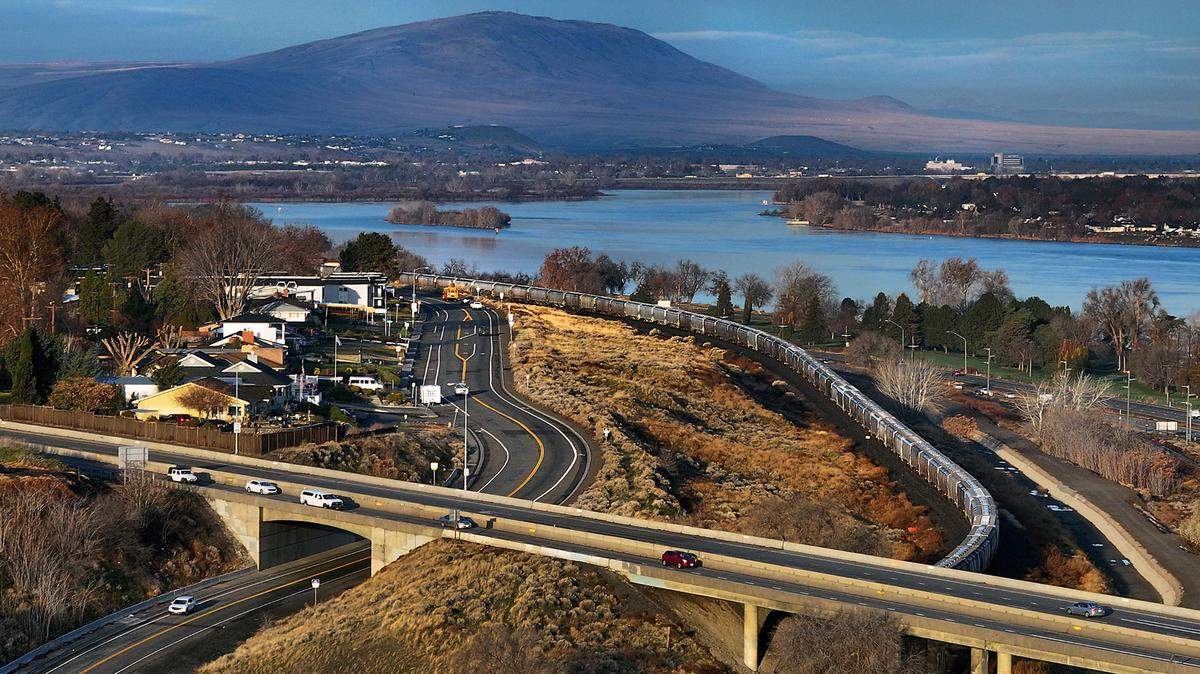
You’d be hard-pressed to find a part of the Pacific Northwest that’s more important than the Columbia River basin. Fed by the mighty Columbia and Snake rivers and their many tributaries that eventually reach the Pacific Ocean, it stretches from southeast British Columbia and extends into much of Washington, Oregon and Idaho. It even reaches as far as some portions of Nevada, Wyoming, Utah and Montana.
All in all, the Columbia River basin is one of the largest in the country and covers an area of over 87,000 square miles. That covers about 36 percent of the state of Washington alone.
It’s a major source of regional power, hosting about 150 hydroelectric projects, 250 reservoirs and dozens of dams. About 50-80% of the energy supplied to the region comes from hydroelectric power, according to the Northwest Power and Conservation Council. On the Columbia River, the Bonneville Dam alone supplies enough electricity to power 900,000 homes.
But the basin is crucial to the region for myriad reasons beyond power.
The 1,240-mile long Columbia drains about 250,000 square miles. One of the longest rivers in America, it is second only to the Mississippi in terms of volume of water flow. It is a crucial source of water for agricultural irrigation, supports a range of diverse wildlife and offers myriad recreational opportunities.
Crucially, the Columbia River basin is a cornerstone of the region’s Indigenous history, culture and daily life. The reverence and connectedness to the land expressed by tribes in the area are in large part due to the basin’s historically epic salmon population.
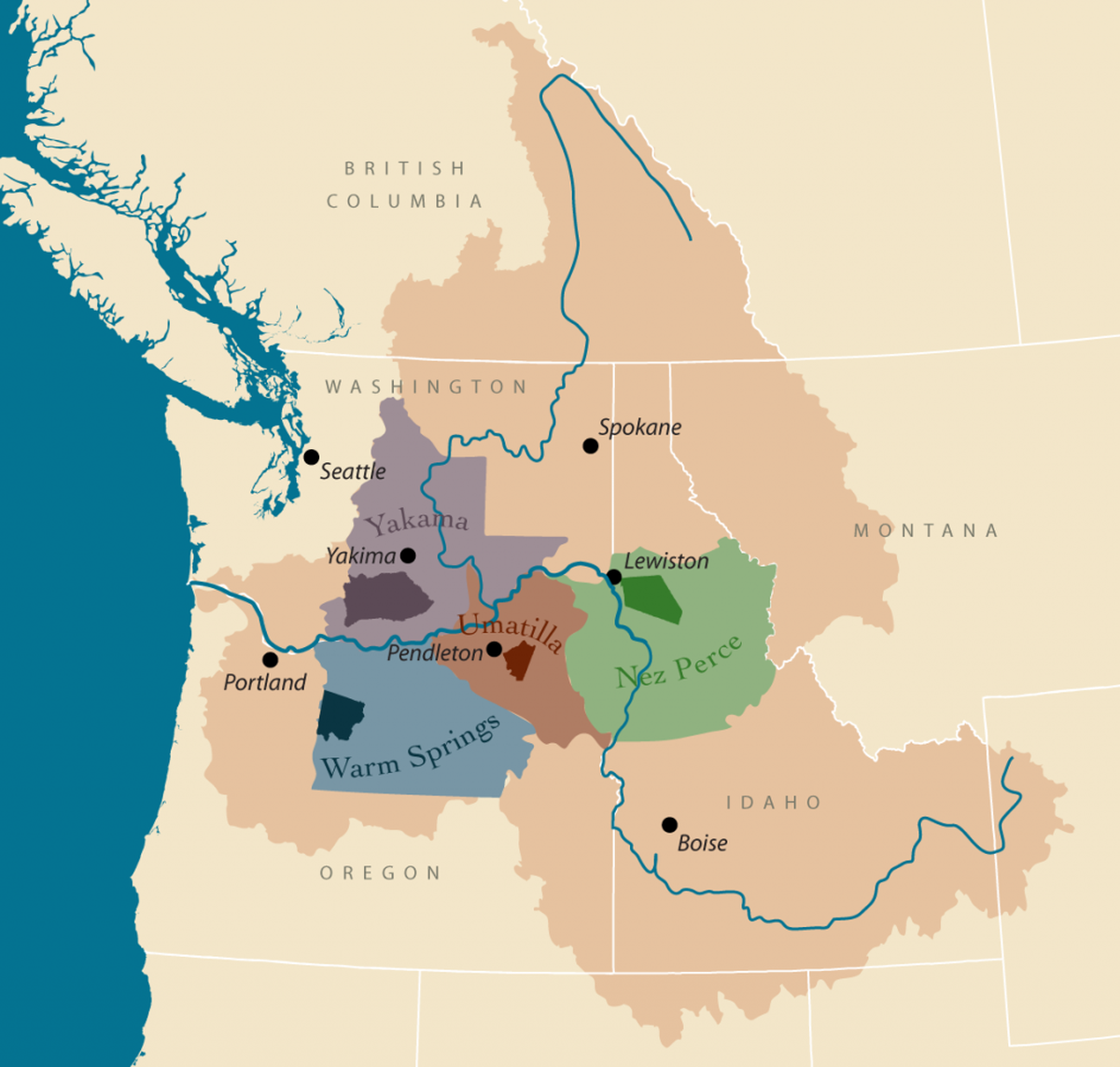
In fact, much of the Columbia River basin is part of the ancestral lands of the Yakama, Umatilla, Warm Springs, and Nez Perce. With the influx of European settlers — who brought an increase in demand alongside a lack of experience in regional fisheries management — that number plummeted.
Up until the first half of the 19th century, as many as 16 million salmon and steelhead would return to spawn every year, according to Columbia Riverkeeper. Stories passed down through tribes over the generations tell of a time when the salmon spawned in such great numbers that you could practically walk on their backs to cross the water.
That’s not the case today.
The Columbia River Basin is still home to some of the richest wild salmon spawning grounds in the world, but many species of the fish are in crisis.
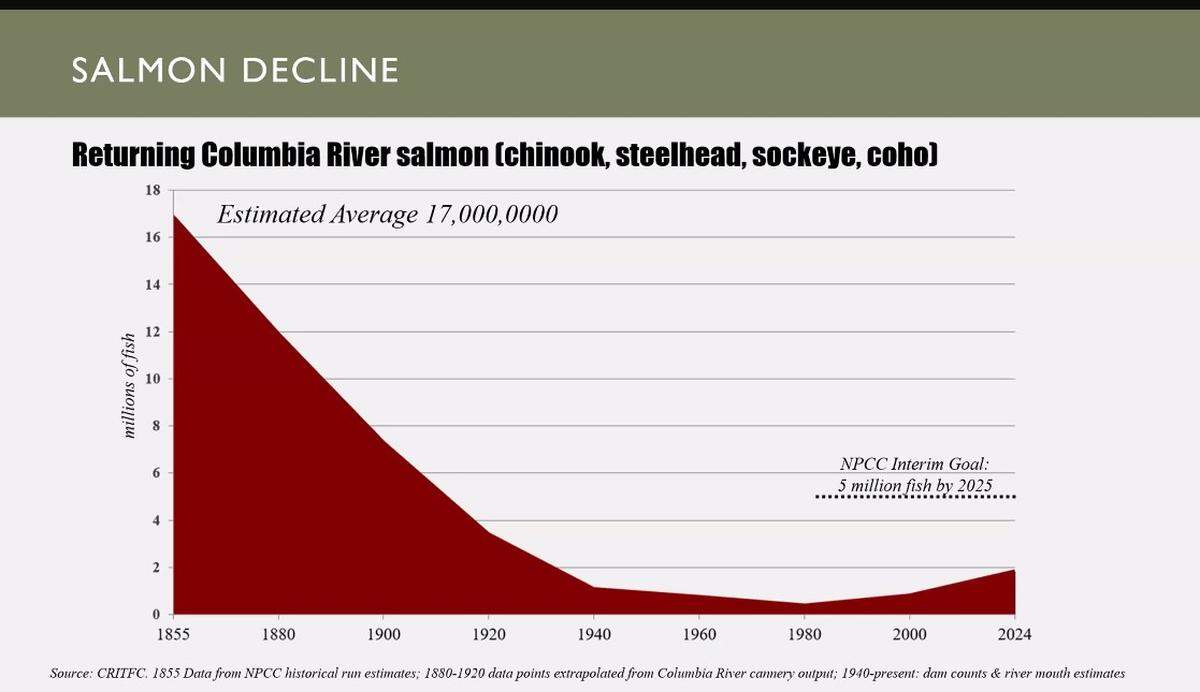
The salmon in this area are struggling — some species more than others — due to population increase, development and dams. The average number of salmon that return every year is at 2.3 million, according to the most recent NWPCC report from December 2024.
That’s far short of the interim goal of 5 million that should have been reached when 2025 dawned.
Columbia basin tribes have said time and again that effective conservation efforts in the basin are a matter of necessity for the future survival of everyone in the region.
“Since time immemorial, the strength of the Yakama Nation and its people have come from Nch’í Wána – the Columbia River – and from the fish, game, roots and berries it nourishes,” said Gerald Lewis, chairman of the Yakama Nation, in a statement in March 2024. “We have fought to protect and restore salmon because salmon are not just a natural resource, they are a cultural resource.”
Nch’í Wána roughly translates to “Big River” in the Yakama Sahaptin language. The name is generally the same across other regional tribes and bands, but in their languages.
Lewis’s comments came at the formation of a new landmark agreement created between the federal government and four regional tribes to form what’s now known as the “Six Sovereigns.” The grouping of governments under the moniker includes Washington state, Oregon and four basin tribes — the Yakama, Umatilla, Warm Springs and Nez Perce (Nimiipuu).
Their goal is to restore, protect, defend and conserve the Columbia River basin in collaboration with one another, and to represent the collective interests of the region vis-a-vis the federal government.
Who are the Six Sovereigns?
Balancing priorities for ecological and commercial goals related to the Columbia River basin isn’t an easy undertaking. That’s where the Six Sovereigns come in.
Created in late 2023, the coalition is formed by the Confederated Tribes and Bands of the Yakama Nation, the Confederated Tribes of the Umatilla Indian Reservation, the Nez Perce Tribe, the Confederated Tribes of the Warm Springs, as well as the states of Washington and Oregon.
After forming, they came to an agreement with the Biden-Harris administration to stay litigation related to the basin while committing to a far-reaching set of actions crucial to its future success on all levels. The agreement has been hailed as a landmark step toward recovery of the basin.
“President Biden understands that the Columbia River System is the lifeblood of the Pacific Northwest,” noted Brenda Mallory, chair of the White House Council on Environmental Quality in a statement when the agreement was announced. “This agreement charts a new path to restore the river, provide for a clean energy future and the jobs that come with it, and live up to our responsibilities to Tribal Nations.”
Around the same time, the Six Sovereigns also created the Columbia Basin Restoration Initiative, known as the CBRI. Through collaboration, the goal of the CBRI is to comprehensively and collectively develop crucial solutions and honor tribal treaty rights. It will ultimately serve as a sort of collective negotiation table for the Six Sovereigns to sit across from federal and other sovereign and regional stakeholders.
One of the Six Sovereign partner organizations, Earthjustice, has recently faced questions over whether legal aspects of the work will be delayed with a new federal administration in place.
Part of the agreement made with the Biden-Harris administration was that there would be a halt to all lawsuits by the tribes and states regarding the activities of the federal government for 10 years while urgent solutions-based actions are taken. The U.S. Army Corps of Engineers maintains a number of federal hydropower projects in the region.
Those agreements are now facing potential uncertainties. But just days into the new administration, representatives for Earthjustice were clear that their work will be ongoing.
“The alliance will continue, and that policy will continue,” said Amanda Goodin, an attorney for Earthjustice, in a phone interview. “The agreement that’s in place is a strong one, so they [feds] would be wise to continue.”
She says the agreement for the Columbia River basin makes sure that salmon conservation strategy “looks at ways we can strengthen our region.”
“For a long time, some have pitted healthy and abundant salmon against other interests in the region,” Goodin said. “You can have salmon and agriculture.”
Why is the Columbia River basin important?
The Columbia River basin’s status as an indisputable powerhouse of resources makes it an easy target for development. In some ways, it’s a victim of its own success and importance, particularly when it comes to the future of salmon.
At an NWPCC status update meeting in January 2025, Council Member Louie Pitt, who represents Oregon and is a member of the Confederated Tribes of the Warm Springs, spoke on a December 2024 analysis on the total run size of salmon and steelhead in the Columbia River basin.
“Increased salmon and steelhead abundance in the Columbia River Basin – especially above Bonneville Dam – over the past 40 years marks important progress,” Pitt said at the meeting, which was livestreamed to the public. “These fish still face severe stresses from climate change, pressures from human population growth in the basin and other environmental impacts.”
Pitt added that the situation for some species of fish is more dire than others.
“Some stocks are struggling right now,” Pitt said. “We cannot ease up in our collective efforts to help these fish populations grow stronger and larger everywhere we can – including in blocked areas of our basin such as above Chief Joseph and Grand Coulee Dams.”
Others at the meeting, which included the Six Sovereigns, echoed the sentiment of celebrating wins but remaining vigilant on the critically urgent interests that are at stake.
“We get asked all the time, ‘What are your top three?’,” Kate Markworth, a lawyer for the Yakama tribe responded in part when asked to comment on prioritizing things like irrigation for farmlands over the removal of dams. “This is not a buffet. Everything is urgent.”
Why do the Six Sovereigns matter?
The work to protect salmon, steelhead and other fish and wildlife in the basin has been going on much longer than just a few years.
In 1977, the tribes that are part of the Six Sovereigns came together to create the Columbia River Inter-Tribal Fish Commission, with the goal of protecting and preserving salmon and other fish crucial to the regional ecosystem.
But a myriad of complex circumstances over many years was part of what led to the historic agreement with the Biden-Harris administration, including numerous lawsuits filed by tribes, largely to enforce treaty-guaranteed rights.
Perhaps the most infamous decision in the last 100 years was the damming of Celilo Falls in the 1950s. The area was a critical fishing, trade and residence area for Columbia basin tribes. Known in Sahaptin as Wy-am, the salmon-rich waters of the legendary Celilo Falls were just upstream on the Columbia River from what is now Dalles, Oregon, in central Washington. It rivaled Niagara Falls during spring flooding, and was a crucial cultural and commercial center for 10,000 years.
The ramifications of that loss still echo today.
At the Yakama reservation’s cultural center and museum, you don’t have to look very hard to find deeply emotional references in the exhibits to the history of Celilo Falls, and the damage caused to both humans and salmon species when it was destroyed with damming.
Yet, hope persists that it will someday be restored, but it would have to be done right. According to a spokesperson for the CRITFC, the idea has been seriously proposed.
Several years ago, the Army Corps of Engineers did a full bathyscaphe scan of the rock formations at the falls that is currently underwater. According to the CRITFC spokesperson, all the landforms were found to still be intact.
That means that if the Dalles Dam was removed, the falls would return.
Whatever the outcome for Celilo Falls, the salmon and the other flora and fauna of the Columbia River basin, the Six Sovereigns remain committed to fighting for the future of the entire basin. They say it will be done through what they publicly describe as a shared understanding of a collective duty and obligation to protect, honor and cherish the place that we all call home.
This article was produced in collaboration and with support from the Solutions Journalism Network.
This story was originally published January 27, 2025 at 12:10 PM.