Tacoma’s tax exemption program for apartment development under review

AI-generated summary reviewed by our newsroom.
- Tacoma weighs MFTE changes to boost density and preserve rent-restricted units.
- Proposed rules raise 8-year MFTE project minimum from 4 to 20 housing units.
- One proposal calls for removing two Hilltop tracts over concern about displacement.
Members of the Tacoma City Council’s Government Performance and Finance Committee have been working on proposed modifications to the city’s multifamily property tax exemption program.
The city offers three options for apartment developers: an 8-year all-market rate version and 12- and 20-year versions, which require a percentage of units to be rent-restricted, or what the programs call “affordable.”
The property owner does not pay property taxes on the residential construction/improvements at the site of four or more units for the designated number of years but still pays tax on the land and any nonresidential improvements, such as a commercial portion of a mixed-use building.
At the Aug. 5 meeting, committee chairman John Hines outlined five proposed recommendations:
- Increase minimum number of units required for 8-year MFTE from 4 to 20 units per project to boost greater housing density and use of the 12-year MFTE.
- Expand Community and Economic Development Department’s efforts to share and centralize outreach resources for property owners and others to help get renters into MFTE units quickly.
- Allow households to continue to qualify as low-income or moderate-income for the purposes of the MFTE unless the household’s income exceeds 90 percent of the established income limit. The goal is to help residents avoid being pushed out because of increases in income.
- For properties applying for an extension, units would need to meet 70% AMI threshold and rents need to be 10% less than the market-rate units.
- Launch another review of the MFTE program in 2028, including efforts to evaluate ways for expanding unit size to better accommodate families.
Hines told the committee that in a meeting a few months ago with developers, “They were very adamant about not making any changes whatsoever,” because of higher interest rates, as well as “a lot of uncertainty at the national level around funding and where money could come from.”
As a result, the proposed changes focus on tweaks to help keep people qualified for rent-restricted units and to increase the number of units created by upping the requirements for the 8-year MFTE.
So far 10 projects have come before council in 2025 for approval of either the 8- or 12-year version, including one extension of an 8-year to a 12-year MFTE. Eight of the 10 sought the 12-year version. The bulk of the 12-year projects were small, with the exception of the Koz at Aviva Crossing LLC project of 226 units at 1602 S. Mildred St. which includes affordable and market rate.
Last year saw nearly 20 projects gain the exemption, and in 2023, there were 22. In 2022, there were more than 30.
Hines in 2021 led the last round of MFTE revisions, which included the removal of Proctor and Point Ruston from qualifying for 8-year MFTEs, as mixed-use centers designated “very high” opportunity based on the City’s Equity Index. The 8-year only requires market-rate unit development.
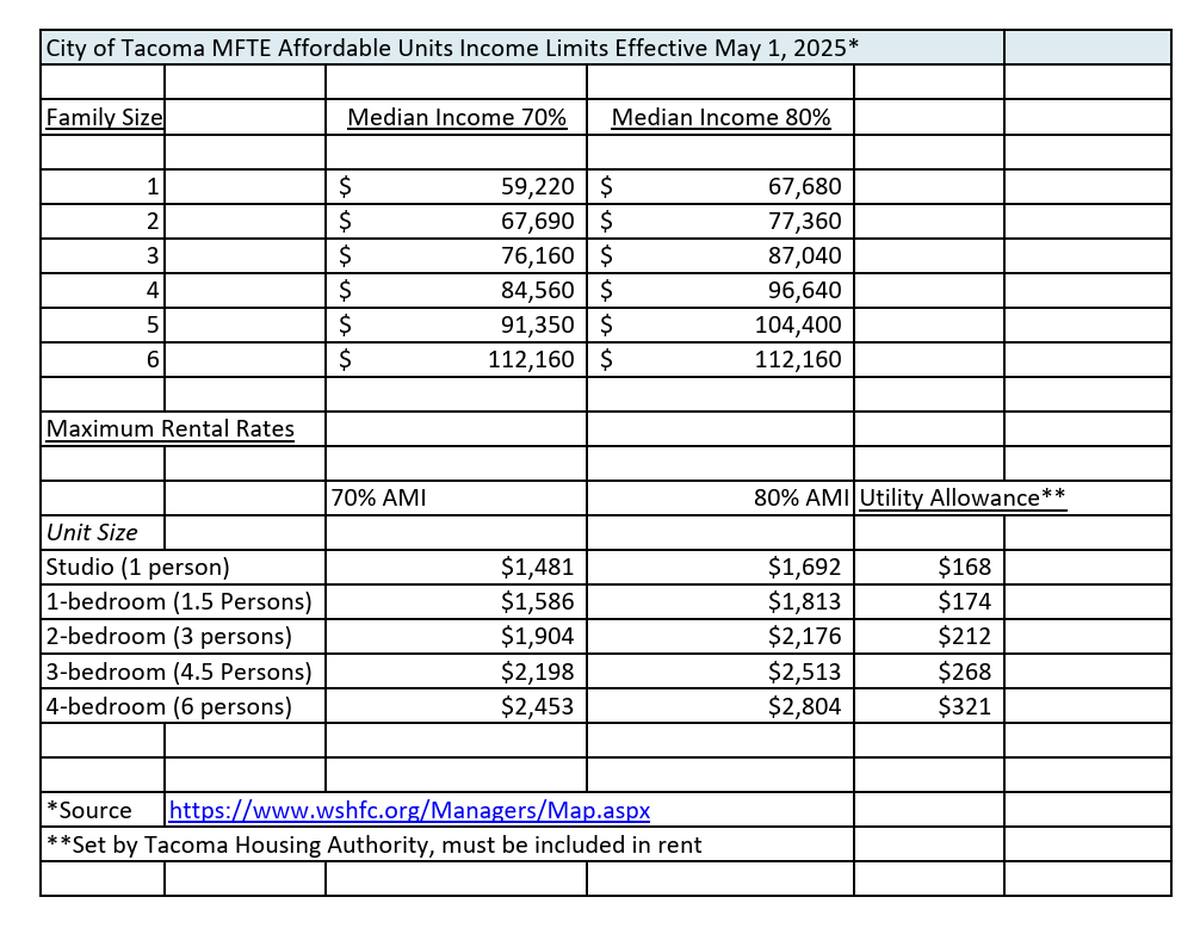
The 12-year version requires at least 20% of the units to be rent restricted at 70% Pierce County Area Median Income for 12 years, while the 20-year exemption requires 25% of the units to be permanently rent restricted.
At the Aug. 5 meeting, Deputy Mayor Kiara Daniels proposed for consideration removing two additional U.S. Census tracts from the 8-year program, both in Tacoma’s Hilltop neighborhood, to help blunt some of the rising housing costs.
The neighboring tracts, Census tracts 613 and 614, are roughly west and south of Tacoma General Hospital’s campus, respectively.
“I believe strongly that we should not continue to support the 8-year tax exemption in these locations, and we need to be careful that our economic development tools are not unintentionally aggravating displacement,” Daniels said at the meeting.
“My proposal is that we start by removing the 8-year MFTE from the two Hilltop tracts and evaluate the impacts” over the next 3 years, she added.
She noted that would allow council members time to decide whether to remove further tracts in other parts of the city.
Council member Sarah Rumbaugh asked how Proctor, for example, was able to be removed in 2021 from the 8-year program.
Hines responded, “It was the premise that buildings would come out of the ground and rents were high enough” that the market rate tax incentive was no longer necessary.
The committee recommendations to amend the MFTE program will eventually be sent to the full council for review or further modifications at a future study session.
Previous reporting from The News Tribune contributed to this report.