
Your kids are living through history. Here are ways to teach them some during COVID-19 outbreak
Jennifer Ott has spent a lot of time thinking about Washington state history and how to make it interesting to people.
It’s one of the things Ott enjoys about her job as a historian and the assistant director of HistoryLink.org.
While thinking about the past — in broad terms — can feel dusty, unwieldy and irrelevant, finding the right entry point can unlock it, Ott said.
Maybe it’s the story of how a place came to be. Maybe it’s a particularly compelling character.
Or maybe it’s a story about the time the Depression-weary people of Chehalis made a 7,200-egg omelet — in 1931 the world’s largest, requiring the world’s largest frying pan — in an attempt to outdo the 16-foot-high, 20-foot-long strawberry shortcake they’d baked three years prior.
“There’s always a story, and it’s always fascinating,” Ott said, not long after noting that the pan — which was 8-feet wide and weighed nearly half a ton — was greased by a woman who attached giant slabs of bacon to her feet and skated and skated around it.
Home school history
Technically, I reached out to Ott this week as part of my work for The News Tribune — though the conversation also was self-serving.
Like many parents, my wife and I have struggled to come up with ways to make our family’s coronavirus isolation experiment a bit more enriching and a bit less “Lord of the Flies” for our school-age children.
Also, let’s be frank: My wife and I are working, which we’re extremely thankful for, knowing well how many people aren’t right now. At the same time, we’re not teachers and don’t have the wherewithal to magically transform into them. We’re stressed-out, emotionally and physically exhausted, and just trying to get through this in one piece as a family.
Which brings us to our feeble attempts to maintain some normalcy, including education for our kids. While we didn’t have too much trouble finding ways to incorporate a little bit of math, science and English into our socially distanced lives, for whatever reason history has proven difficult.
In particular, our oldest is in middle school and should be getting Washington state history right now.
Instead, she’s up to level six of Super Mario Bros 3 (which, don’t get me wrong, is an admittedly impressive achievement).
So I called Ott, and a few others for some advice — figuring that what the historians told me might prove useful beyond the Driscolls’ House of Solitude, Boredom and Occasional Tears.
To make history interesting to children, Ott said, it often helps to “start with the unusual.”
Like the 7,200-egg omelet, or more specific to this area, the story of Galloping Gertie.
As part of her work, Ott oversees HistoryLink.org’s Pierce County editorial team, meaning she’s well aware of what the website has to offer.
“If you can have a little bit of fun looking for stories that will surprise your kids, I think that is always a good way to start,” Ott said. “It gives them a point of connection.”
Curriculum resources
To help, HistoryLink.org has compiled a list of potential curriculum resources for anyone — parent or teacher — in search of ideas.
Ott said the curriculum spans grade levels and interests. It includes information about how to best use the online encyclopedia and its nearly 8,000 articles, as well as specific lessons — and lesson plans — on topics ranging from the history of Washington suffragists to Seattle’s world’s fairs and the Vietnam War.
Ott said HistoryLink.org normally has resources for educators available online, but the COVID-19 outbreak and the statewide shutdown of schools (and just about everything else) quickly made her realize how helpful the resources might be to families trying to figure all of this out.
“So many of them are ideal for this particular set of circumstances because they are all accessible online and all the materials you need are online,” Ott said of the lessons. “It’s not like you have to plod your way through it. … (People) can just pick and choose as they go.”
Tacoma’s stories
For those interested in a more Tacoma-centric perspective, local historians Michael Sullivan and Bill Baarsma also offered a few ideas.
Asked about what kids in Tacoma are currently living through and anything that might compare, Baarsma’s mind quickly went to the earthquake of 1949, which hit between Olympia and Tacoma.
Baarsma, who served as Tacoma’s mayor from 2002 to 2009 and is now president of the Tacoma Historical Society, was 7 years old at the time.
He was a student at the old Lowell Elementary School when the 7.1 magnitude quake hit, and in the bathroom.
“When I pulled up my pants and got out of the boy’s room, everyone was kind of running and hysterical,” Baarsma recalled.
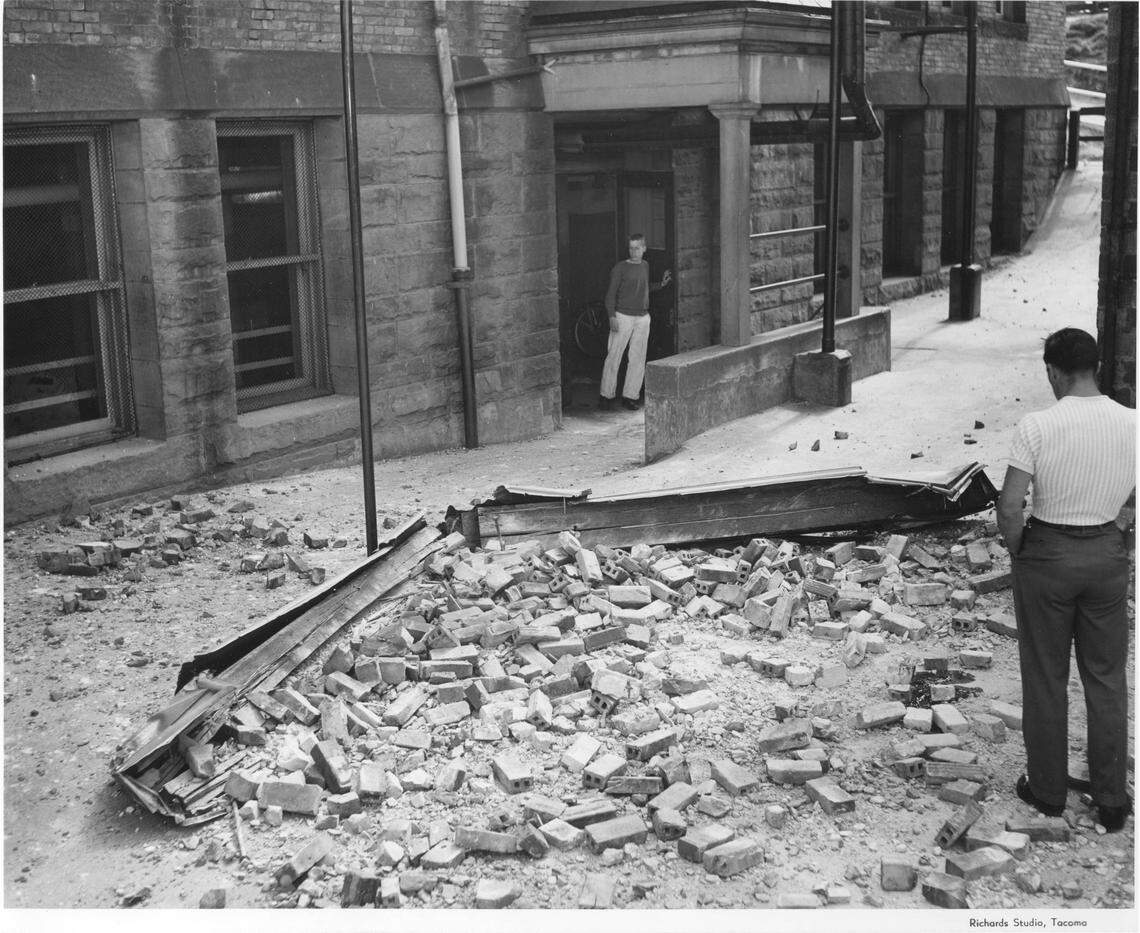
While Baarsma acknowledged that the disruption paled in comparison, he noted that schools were closed for a period of time and life — at least momentarily — changed almost instantly. The old Lowell Elementary, which was built in 1892, was ravaged.
The earthquake also was tragic. Eleven-year-old Marvin Klegman, a Lowell sixth grader on safety patrol, died saving the life of Kelcy Allen, who was 6 at the time. A bronze statue outside the rebuilt school now memorializes Klegman’s bravery and sacrifice.
Sullivan, naturally, also had plenty of ideas about stories from Tacoma’s past worth teaching at home.
Like Ott, Sullivan said the 1940 collapse of the Tacoma Narrows Bridge never ceases to fascinate children, especially when they see the Galloping Gertie video or learn “the only casualty was a cocker spaniel.”
Sullivan also noted the long and important history of the Puyallup tribe, which too often gets overlooked or ignored.
“This was an urban center for native people … that’s been here for 10,000 years,” Sullivan said of the city we now know as Tacoma, and the Puyallup people who made it so.
Make your own history
Flipping the script, Sullivan pointed out that families and students of today are living through a moment of significant historical importance.
Some day people will look back and want to learn about what life was like during the COVID-19 pandemic.
Sullivan recommended families take time to record what’s happening around them and what they’re doing.
He suggested documenting everyday life, through diaries or even by creating a family time capsule.
“In this case, I think it’s worth people recognizing that they are living through a unique moment in history. Now is a good time to make a record of what you’re doing, to create some records that you leave to the generations that follow us,” Sullivan said.
“Fifty years down the road, some seventh grader may decide to do a paper on how we survived COVID-19,” he continued.
“Why not give them the material?”
This story was originally published April 4, 2020 at 7:00 AM.
