The coronavirus is hitting Pierce County’s communities of color hard, health data shows
People of color are being hit hard by the coronavirus in Pierce County.
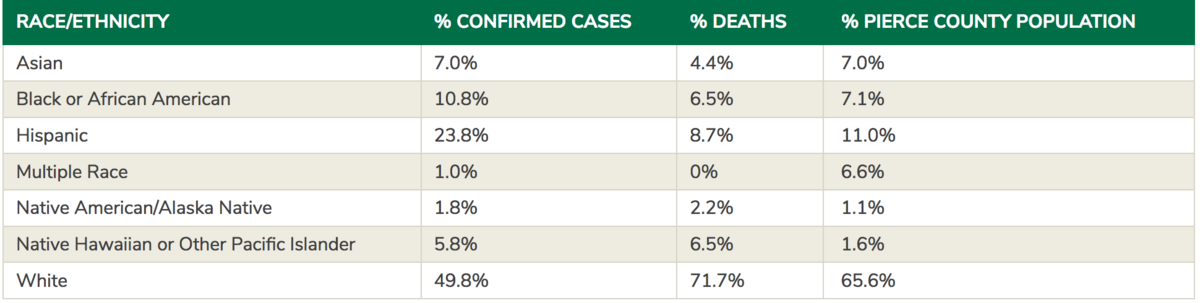
New data from the Tacoma-Pierce County Health Department show native Hawaiians and other Pacific Islanders, Hispanics and blacks are suffering from COVID-19 at rates far above their percentages of the county population.
“We are very concerned about the significant disparities we are seeing in COVID-19 cases,” Dr. Anthony Chen told The News Tribune in an email. “As the Health Department responds to our data and tries to tackle disparities, one strategy suggested is to improve access to testing and care.”
According to numbers released May 15:
▪ Native Hawaiian or other Pacific Islander residents, who make up 1.6 percent of the county’s population, have seen 5.8 percent of the confirmed cases.
▪ Hispanic and black residents account for 11 percent and 7 percent of Pierce County’s population, while the health department reports they make up 23 and 11 percent of confirmed cases, respectively.
A University of California Berkeley review of cases nationwide showed that Washington as a whole was doing better than Oregon and Idaho to the extent to which the racial differences in COVID-19 rates of infection and deaths diverged from the state’s general population.
Kansas ranked the worst nationwide.
David Reyes is a nurse and assistant professor in the University of Washington Tacoma School of Nursing & Healthcare Leadership. Reyes told The News Tribune the statistics are not surprising. He has worked extensively in East Tacoma and said there is a health inequity among minority populations.
Health inequities are a result of systemic disadvantages, like living in homes built in the 1950s with toxic chemicals or working jobs with higher rates of exposures, Reyes said.
Adverse social and economic conditions, such as poverty, discrimination, violence, lack of affordable housing and pollution, can create health inequities, the TPCHD said in a blog post.
Health inequities leave groups like communities of color, those experiencing poverty and the elderly at higher rates of risk for COVID-19, the blog said. They are less likely to have access to health care, and many do not have jobs that support physical distancing, flexible schedules or access to child care.
Contact tracing has led to other findings, the health department said. On average, native Hawaiian or other Pacific Islander residents with COVID-19 are in closer contact with more people than white residents.
“We don’t know for sure, but it is likely that more contacts lead to more exposures and higher rates of illness,” the blog post said.
Reyes said there are so many cultural differences that it can be hard to pinpoint the exact reason for elevated cases among some populations.
Reyes said it’s important to note that there are several cultures lumped into the Hawaiian and Pacific Islander category. Addressing the significant disparity should include reaching out to community leaders of all cultures to find out how to provide information and the importance of seeking medical care.
In fatalities, whites are over-represented, according to May 15 reporting from the health district.
Nearly 72 percent of COVID-19 deaths have been reported as white Pierce County residents. An estimated 66 percent of Pierce County is white. The second-highest rate of death is among Hispanics with 8.7 percent, followed by blacks and Hawaiian or other Pacific Islander, both with 6.5 percent of Pierce County’s reported fatalities.
TPCHD’s response to inequities
Chen said in a TPCHD Board of Health meeting earlier this month the health department has seen the significant disparity and hopes to provide more services to those hardest hit.
The health department held a five-day drive-thru testing event in March, and about 1,000 test kits were left over. FEMA announced that the remaining tests would be distributed locally. Chen said the department gave Community Health Care and SeaMar the tests for use on people living in disadvantaged communities.
Pierce County also recently received two coveted testing machines from the state. The Abbott ID-Now Covid-19 machines give results in minutes. Chen said the department wants to provide them to entities that serve rural communities and vulnerable populations.
“I am hopeful that we will be able to share those strategies with the public soon,” he said.
The test, also used by the White House, has received some criticism from researchers, with at least one non-peer reviewed study by NYU noting it missed more than 48 percent of positive samples. Chen said the health department has known about the concerns about false negatives with the test, and the study adds to the growing information on the virus.
While no test is perfect, the study shows that the test performs well in some situations and not in others, like in sensitivity and predictive values, he said.
“The strengths of the Abbott test are that it is quick, can be done at point-of-care, and has a high PPV that can inform patient management,” Chen said. “As the scientific knowledge base increases, medical providers will develop better guidelines on its use.
Abbott, in a statement sent to The News Tribune on May 19, responded: “The availability and ease-of-access of ID NOW, which delivers results in minutes rather than a day or more, is helping to reduce the risk of infection in society by detecting more positive results than would otherwise be found.”
“We’re seeing studies being conducted to understand the role of ID NOW in ways that it was not designed to be used. In particular, the NYU study results are not consistent with other studies. While we’ve seen a few studies with sensitivity performance percentages in the 80s, we’ve also seen other studies with sensitivity at or above 90 percent, and one as high as 94 percent.”
Story updated May 19 with statement from Abbott.
This story was originally published May 18, 2020 at 1:32 PM.