Is it risky or not during a pandemic? Graphic offers guide, but some say beware
It is hard to know what parts of typical life are and aren’t potentially dangerous when there is a pandemic on.
A recently released graphic from the Texas Medical Association categorizes the risks of different activities during the COVID-19 pandemic, but Washington state health experts say risk isn’t always easily categorized.
How does someone get COVID-19?
Most health experts now agree the coronavirus is spread by saliva and droplets from an infected person reaching the mouth, nose or eyes of someone not infected, said professor Ann Bostrom of the University of Washington Evans School of Public Policy and Governance.
While much about the coronavirus was uncertain at one time, experts now agree that certain factors greatly increase the likelihood of getting infected: not wearing masks, close contact with other people, especially for extended periods of time, and being in indoor spaces that don’t allow for much air circulation.
What the graphic says
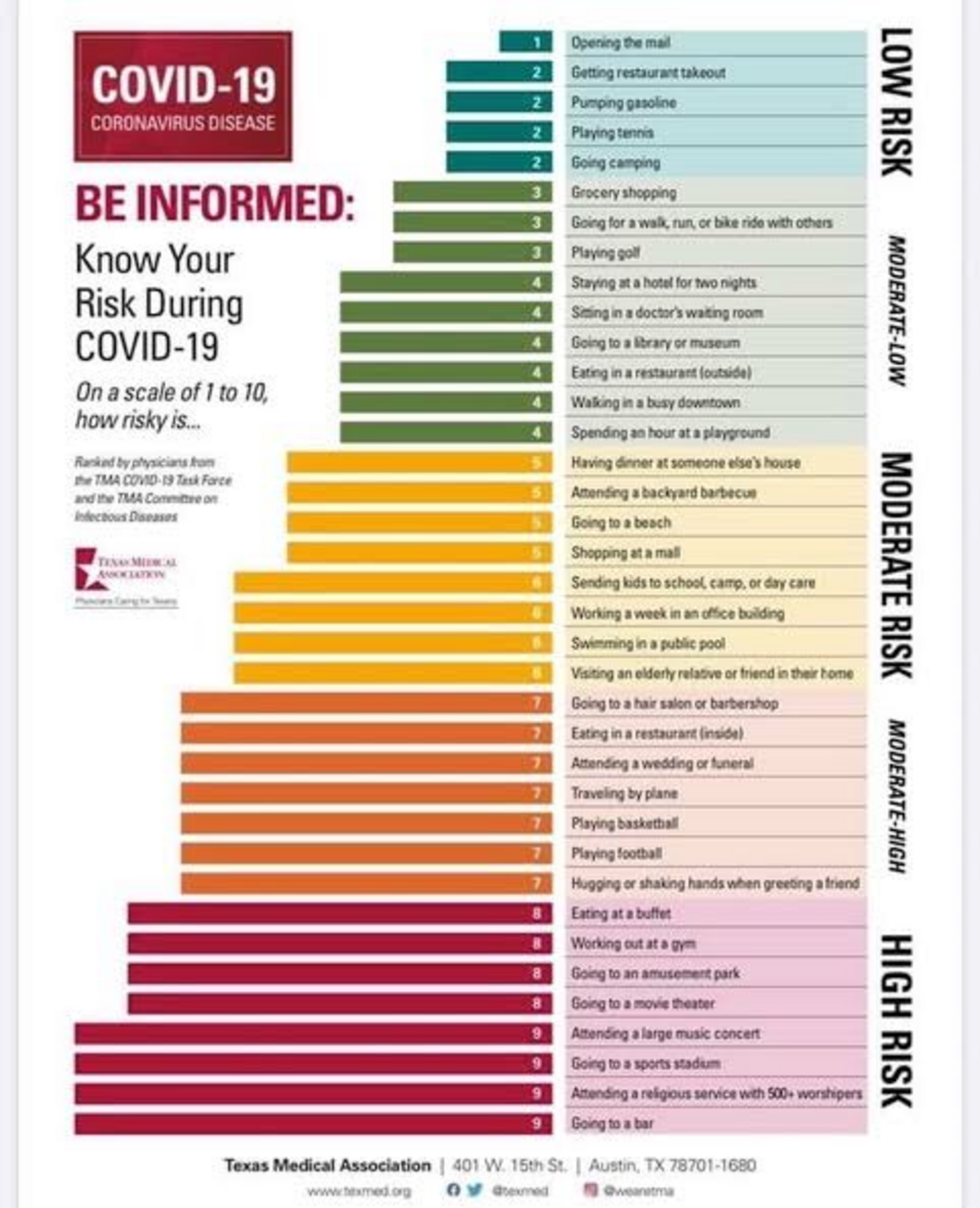
Activities such as opening the mail and going camping are designated as low risk, while going to a bar and attending a religious service with 500-plus people are categorized as the highest risk, according to the Texas Medical Association graphic.
Attending a backyard barbecue, sitting in a doctor’s waiting room and shopping at the mall are considered to have moderate risk.
These risks are determined assuming all people involved are following safety protocols such as wearing masks and maintaining social distance from each other.
For example, grocery shopping is designated as low-moderate risk on the graphic, but if you went grocery shopping and someone got very close to you and wasn’t wearing a mask, your risk would become quite high.
The graphic was developed by physicians from the Texas Medical Association COVID-19 Task Force.
Research has shown that showing safe ways to socialize — or a manual to the pandemic — rather than banning outright socialization, can lead to more effective compliance.
Why be skeptical?
In an email, COVID-19 communications lead Dale Phelps of the Tacoma-Pierce County Health Department wrote the department doesn’t recommend the categorization approach because of the different health situations of various segments of the population.
Phelps added traffic and cell-phone mobility are increasing, indicating to the health department that people are getting exposed and exposing others.
Bostrom wrote that research she did years ago demonstrated that risk comparisons like the graphic can “kick people into high gear and engage them,” which can be good in disseminating information.
“On balance, the graphic seems likely to be a useful way of getting people to think about the risks, especially if they take it with a grain of salt, recognize that such metrics aren’t perfect and take into account that the ranking requires making a lot of assumptions,” she wrote.
She added that another consideration that readers have to take into account is not just their own risk, but how much risk they’re willing to put onto another.
What about harm to others?
Bostrom noted that because during a pandemic every person’s actions can potentially affect another, a risk assessment isn’t just a personal decision but needs to take into account others, too.
“Another way of thinking about this graphic might be: if you had COVID-19 (and didn’t know it) and did these activities, how much risk would you be creating for others?” she wrote.
Her conclusion was that to decide whether each of the activities on the list is worth your personal amount of risk, you should take into account how many people in the area are infected, how vulnerable you are to suffering from the coronavirus, and how well you can protect yourself (masks and social distancing).
“Even in Seattle-Tacoma testing is not widely available, not everyone is following the rules (e.g., mask wearing), and the pandemic is dynamic. So even our best estimates of exposure risks are inherently uncertain,” she wrote.
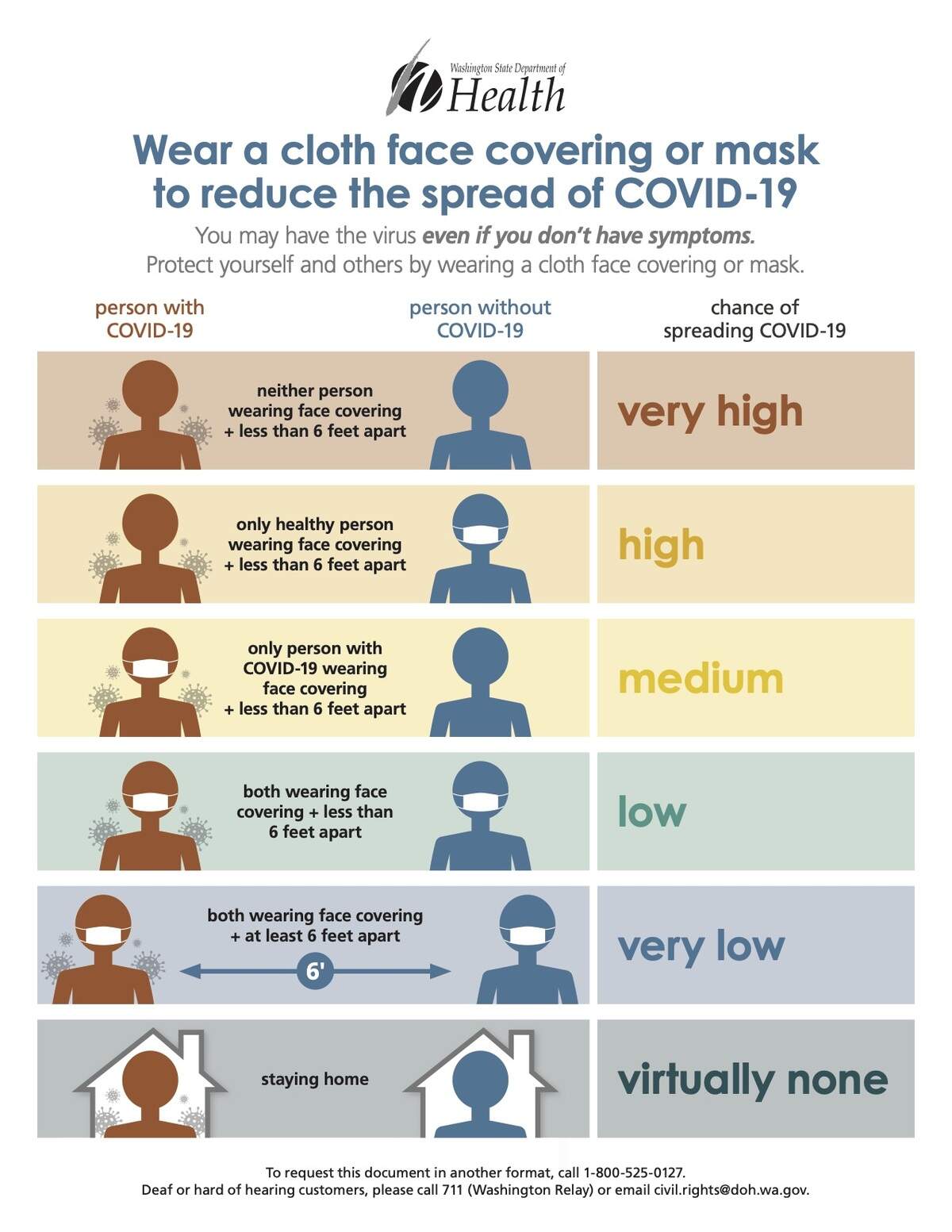
Washington State Department of Health emergency communications consultant Franji Mayes said everyone should wash their hands, stay six feet apart and wear a face covering.
“Together, these actions will reduce risk in Washington more effectively than any one action alone,” Mayes wrote in an email.