COVID cases dropping, immunity rising, but WA state’s hospitals still face hard season
Vaccines and the swarm of Delta cases that overwhelmed the state’s hospitals this summer have created some level of COVID-19 immune response among an estimated 61.5 percent to 65.7 percent of Washington state’s population.
That’s according to the latest Department of Health COVID-19 Situation Report released Oct. 20.
That level still isn’t likely to ease demand on hospitals through the end of the year.
Hospitals are set to remain strained with people seeking immediate care or care that had been delayed post-Delta, according to models also included in the report. Along with that, there’s a continued hospital worker shortage — a mix of people quitting/retiring from pandemic burnout, moving on to traveling nurse jobs, and those departing or let go over COVID vaccine mandates.
As of Oct. 8, an estimated 1 in 244 Washington residents had an active COVID-19 infection, including both symptomatic and asymptomatic.
September case levels exceeded any other COVID wave in the state so far.
According to the report: “The seven-day rolling average case count declined from a peak of 2,937 on Jan. 8 to 745 cases per day as of Feb. 15, remained at that level for a month, increased to 1,518 cases per day as of April 23 and declined to 376 as of July 3, and increased to the most recent peak of 3,552 as of Sept. 13 and declined to 2,224 as of Oct. 8.”
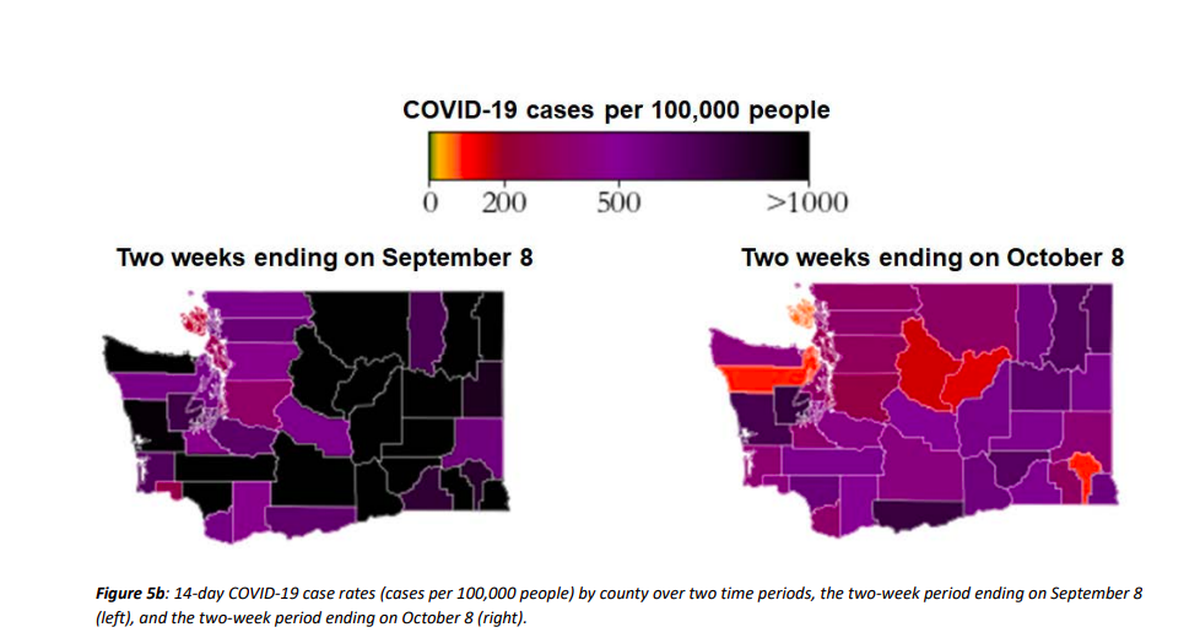
For a two-week period ending Sept. 8, 32 counties had case rates above 500 per 100,000, compared with just 17 counties for the two-week period ending Oct. 8. Case rates were increasing only in Chelan and Klickitat counties as of the October report; all other counties were either seeing case rates drop or flatten.
Chelan has 59.7 percent of its total population and 70.3 percent of eligible population (age 12 and older) fully vaccinated. Klickitat has 41.8 percent of its total population and 47.7 percent of its eligible population fully vaccinated, according to the state DOH dashboard.
DOH noted this fifth wave has been harder on children, who before Delta, were thought to be relatively safe with few cases reported. The state DOH in a release Thursday said children represented about 25 percent of all COVID-19 cases last week:
“While case rates among adults at the peak of the Delta surge were similar to those at the peak of the winter 2020 surge, case rates among children were about 1.5 times higher at the peak of the Delta surge than at the peak of the winter 2020 surge.”
Pierce County seeing decline in cases
Kejuan Woods, deputy incident commander for COVID-19 response, told the county’s Board of Health during its Wednesday study session that Pierce County was now solidly on the downward slide with Delta.
“We can confidently say that we’re in a decline. We hope it stays that way, frankly,” he said.
The county was at one point in September regularly posting more than 650 per 100,000 cases in its 14-day rate. On Thursday, that rate was 484.2.
In the county, 50.8 percent of the total population and 60.7 percent of its eligible population are fully vaccinated, according to DOH dashboard.
Hospital occupancy set to remain high through end of year
DOH also noted that “Hospital admission rates remain at least nine times higher among the unvaccinated than among the fully vaccinated across age groups.”
The department estimates that hospitals will be operating at full capacity through fall despite the drop in COVID cases.
“Although hospital occupancy related to COVID-19 has declined from nearly 25 percent of bed capacity in early September to around 17 percent in early October, total hospital occupancy has remained constant at over 90 percent,” according to DOH.
It added, “This is due to increases in people seeking health care and elective procedures deferred at the peak of the Delta surge, as well as staffing shortages.”
Its forecast models project continued pressure on hospitals through the fall based on two scenarios: cases continuing to drop then a modest increase, or a moderate increase at twice the rate of the first scenario.
Variables such as this year’s flu season and the rate of COVID spread picking up could essentially land the state back where it was in late August, early September, or worse.
In the “modest increase” scenario, admissions would continue to decrease through December, with the rate of decrease leveling off by the end of December at between 10 and 60 admissions per day, “a level that is slightly lower than the low points seen after prior waves,” it noted.
In the “moderate increase” scenario, department projected a high end estimate of 210 admissions a day statewide possible by the end of December, compared with the seven-day rolling average of 115 as of Oct. 8, down from 195 at the end of August.
“Considerable uncertainty is inherent in both scenarios,” the report said, “and we have little data to estimate whether increases in transmission are more likely to be modest or moderate.”
Officials have said repeatedly that continued masking and getting more people vaccinated are critical in mitigating the spread of COVID.
“We’re hopeful that the declines we’ve seen in the last few weeks will continue, but that will only be possible if vaccination rates continue to increase and we continue wearing masks,” said Scott Lindquist, MD, MPH, state epidemiologist for communicable diseases, in a statement issued Thursday.
“Our individual choices over the next several weeks will determine whether hospitals are able to return to a sustainable level of operations by the end of December.”