Pierce County has gone from ‘low’ to ‘medium’ in CDC rankings as COVID-19 cases rise
Try as we might to escape it, the COVID-19 pandemic is still in full swing, particularly in Western Washington and notably in Pierce County.
On Tuesday, Tacoma-Pierce County Health Department reported 1,675 new cases of COVID-19 for May 15-21 and six new deaths. The previous week, 1,884 cases and seven new deaths were reported.
Pierce County’s COVID-19 total since March 2020 is 194,366 cases and 1,347 deaths.
Last week, the Centers for Disease Control and Prevention moved Pierce County into its “medium” community level category for COVID, from its previous “low” ranking, in response to the rising cases.
It’s a cautionary tale as we head into Memorial Day weekend and the start of summer.
By the numbers
Naomi Wilson, community assessment manager for the Tacoma-Pierce County Health Department, recently spoke with The News Tribune about what COVID-19 is like now in the county.
“We are definitely seeing both our COVID-19 cases and hospitalization rates increase in Pierce County since March. We’re certainly nowhere near Omicron levels. But we’re about halfway to our Delta peak,” last summer/early fall, Wilson said.
She added, “We obviously know that what we’re seeing is an undercount, due to over-the-counter tests, and so many people who aren’t reporting those results.”
Wilson wrote about the COVID uptick in a recent health department blog entry, noting, “By mid-March our 7-day case rate dropped to almost 30 per 100,000. Since then, we’ve seen a steady increase.”
The county’s current 7-day case rate per 100,000 is 232.6, which is 38.3 percent higher than the last 7-day period measured, according to TPCHD on Tuesday.
The 7-day hospitalization rate per 100,000 is 7.5, which the department says is 78.6 percent higher than the previously reported 7-day period (May 1-7).
Two CDC maps, two COVID stories
The CDC offers two maps to show COVID rates in the United States, by county, but they can be confusing at first glance.
The CDC’s “community level” measurement is ranked by low, medium or high. Low is fewer than 200 new cases per 100,000 and the measurement of new hospital admissions and inpatient bed usage, according to the CDC’s online tracker.
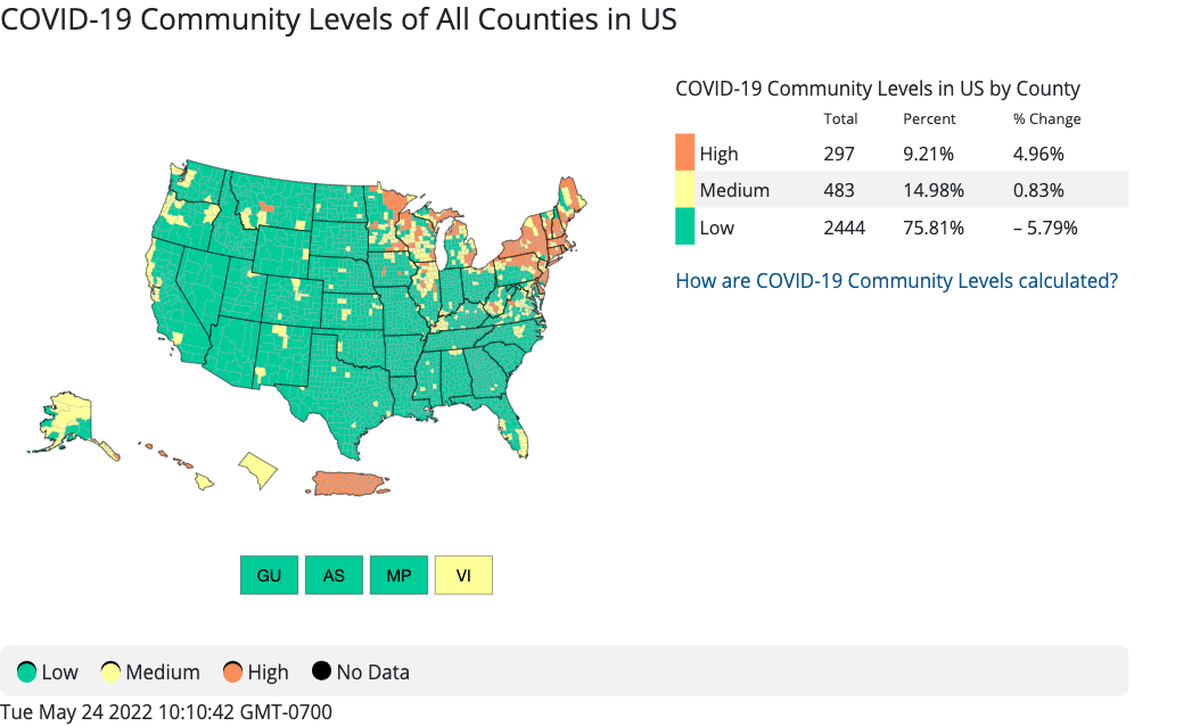
More than 200 new cases per 100,000 moves you into the “medium” category; hospital admissions and inpatient bed use have to rise beyond 10.0 and 10 percent, respectively, to be considered “high”
The CDC offers prevention steps people should take based on their county’s ranking. At medium level, the CDC doesn’t recommend much unless you are at high risk for severe illness. People who are should “talk to your healthcare provider about whether you need to wear a mask and take other precautions.”
Also at medium level, it recommends everyone staying current with vaccines and getting tested if symptoms arise.
The CDC also publishes a Community Transmission Levels map.
It shows Pierce County along with large portions of the country at a high level of transmission.
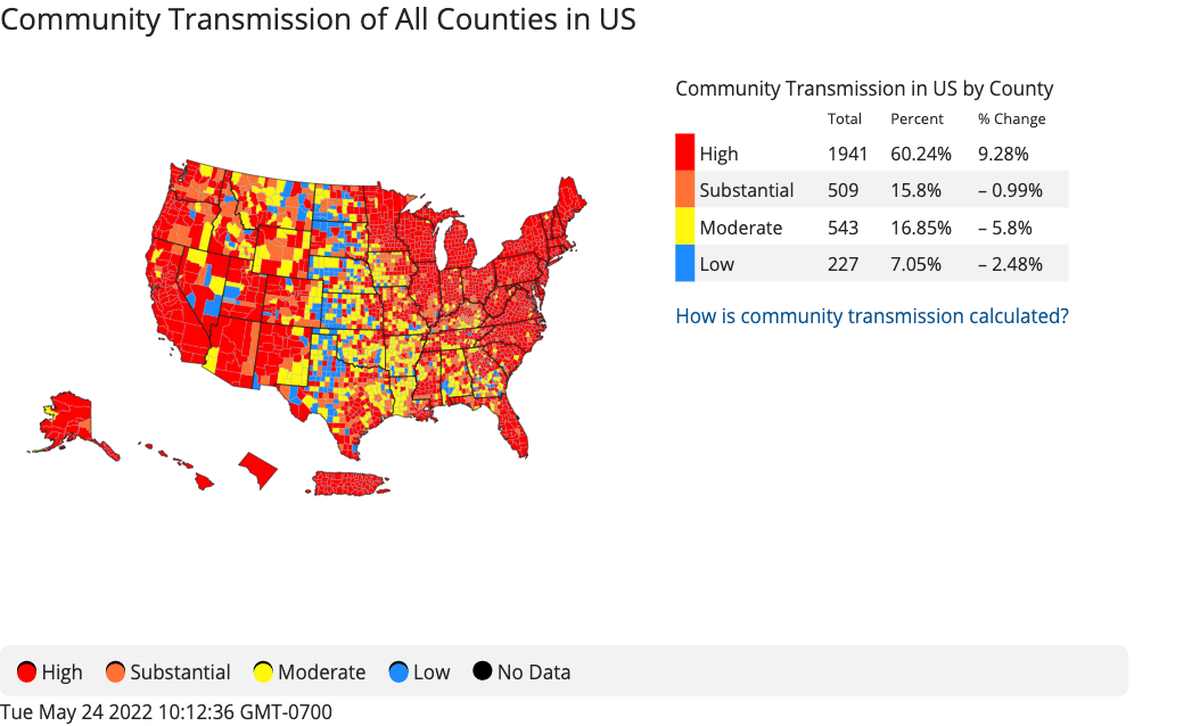
“Functionally, the new map is basically only telling me it looks like there’s still room in the hospitals,” Arijit Chakravarty, a COVID researcher and CEO of Fractal Therapeutics, told Fortune in its recent COVID coverage titled, “The U.S. is in a sixth COVID wave—but it doesn’t look like it on a new CDC map.”
The CDC says it “recommends use of COVID-19 Community Levels to determine the impact of COVID-19 on communities and take action. Community Transmission levels are provided for healthcare facility use only.”
Cases on the transmission map are a first indicator to help facilities brace for a possible influx, while the community level map is measuring essentially the current status of hospital capacity and case rates.
The CDC changed its method of ranking risk Feb. 25. Before it based risk on levels of transmission and percentage of positive tests.
While the CDC has altered its way of measuring, an array of tools is available that last year was not on yet on the market, with anti-viral medication (Paxlovid), pre-exposure medication (Evusheld), wider supply of N-95 masks and tests, and vaccine boosters now also available to a wider age range.
Among all the tools, getting vaccinated and boosted remains the key strategy in helping to keep soaring case numbers from becoming dangerous or deadly for individuals.
“We know that that’s going to protect you from severe illness and keep you out of the hospital,” Wilson said.
“The 5- to 11-year-olds are now eligible for boosters, so that’s a great win I think for families and with younger children in that age group.”
The FDA is now looking at expanding vaccine eligibility for those younger than age 5, with a meeting next month to review both Pfizer and Moderna applications.
Living in a ‘medium’ spread
How careful should people be about gathering for the upcoming weekend, particularly for those vaccinated and boosted? Public Health – Seattle & King County Health Officer Dr. Jeff Duchin offered some perspective at a separate Monday news conference dealing with the area’s first presumptive case of monkeypox.
King County moved into the CDC’s medium community level category for COVID-19 in late April.
“We are recommending people wear a high-quality well-fitting face mask at indoor public spaces and people pay careful attention to ventilation,” he said. “Crowded indoor settings, poorly ventilated settings are high risk.”
He added that “testing also can be very valuable right now. Particularly before gathering with people who are at high risk, (take) rapid tests the day of the gathering as close as possible to the time and help you understand if you have a COVID infection and not spread it to others.”
Wilson also emphasized testing.
“It’s really about getting tested if you have symptoms, so making sure that if you have symptoms, get tested. If you’re in high risk for severe illness, then consider wearing a mask and talking to your health care provider whether or not you need to wear a mask in all settings,” she said. “And of course, getting vaccinated and getting boosted.”
“There is not any single person who hasn’t been impacted (by COVID),” Wilson said Monday. “And what we know that it’s been especially difficult for those who are most vulnerable. COVID is with us, and will be for some time, and we just have to continue to make safe and healthy decisions.”
For more information
▪ Go to tpchd.org/vaxtothefuture or the county’s FindYourCovidShot.com website for information on places offering vaccines and for vaccine registration.
▪ State vaccine locator: vaccinelocator.doh.wa.gov
▪ FDA’s guide to boosters: bit.ly/3wI0l0J
▪ To order free at-home COVID tests covid.gov/tests
▪ Local testing availability: tpchd.org/healthy-people/diseases/covid-19/testing-information
▪ If you’ve been exposed: CDC information on best practices to limit spread: cdc.gov/coronavirus/2019-ncov/your-health/quarantine-isolation.html