
White River sediment endangering Pierce County’s largest industrial park
Every time it rains, which seems to be almost every day this year, Sumner city officials turn a watchful eye toward the White River.
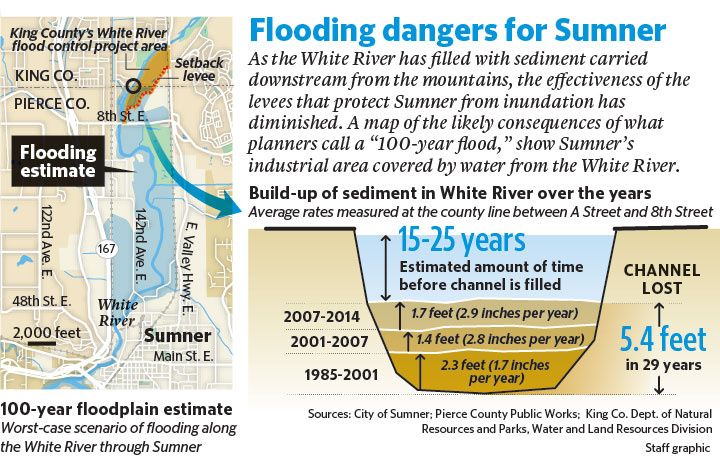
There’s a particularly urgent reason they do so. With each passing year, with each rainy season, with each surge of stormwater, the river is growing shallower. And as the river fills with sediment, with gravel carried downstream from the mountains, the ability of the dikes that protect Sumner from inundation is diminished.
That sediment accumulation means that a river flow that wouldn’t have caused much concern less than a decade ago is now a near-emergency.
Here are the numbers: In 2008, nine years ago, the White River’s channel capacity was 12,000 cubic feet per second. In October last year, thanks to the not-so-gradual accumulation of water-borne soil and rocks, the river’s channel could handle just 5,500 cubic feet per second.
And that shallowing of the river is seemingly happening at an accelerated pace. The White channel lost 1,500 cubic feet per second capacity in just 10 months between December 2015 and October 2016.
River experts say the higher siltation is in part the result of erosion from the river’s glacial origins on Mount Rainier.
So much for figures. What does that statistical story mean for the town of nearly 10,000 residents?
It means that unless the government takes action, flooding could become a normal rainy season event in particularly low-lying parts of Sumner, say city officials.
STOPGAP MEASURES HELP
This year so far, though the winter rains were abnormally high, the city has dodged misfortune. Part of the reason has been the timing of big storms and part of it is a result of protective measures the city has taken to raise the most vulnerable parts of the levee system, said Mike Dahlem, Sumner’s public works director.
Earlier this winter, as weather professionals forecast a soggy season, the city erected a barrier of 1-meter-tall industrial-sized earth-filled rectangular containers called Hescos along the levee south of the Stewart Street bridge. It borrowed those sizable barriers from the Army Corps of Engineers.
On more than one occasion, river water lapped at the bottom of that extra barrier but didn’t spill over into the busy industrial area beyond.
That industrial area, which has grown exponentially in recent years, is now Pierce County’s biggest industrial employment center with nearly 11,500 workers employed there.
Among the major employers in that near-river industrial area are such nationally known names as Amazon, Kellogg’s, Costco, Office Depot, REI, Simmons, Helly Hansen, Brooks, Keurig Green Mountain, GKN Aerospace and Cummins. A score of regional businesses such as Dillanos Coffee Roasters and Manke Lumber have production facilities located near the river, said Sumner spokeswoman Carmen Palmer.
As recently as 2015, the river flooded some of Manke’s facilities in Sumner and turned 24th Street East in the industrial area into a temporary river.
A map of the likely consequences of what planners call a “100-year-flood,” show that industrial area becoming a large lake with multiple businesses submerged and a few islands protruding from the lake where industries have raised and protected their sites. Though those warehouses and production facilities would be protected, the only access to them during a major flood would be by boat.
Dahlem recently told the Sumner City Council that several remedies are available to lessen the flood threat.
Decades ago, the solution would have been to simply dredge the river to deepen the channel and improve capacity. Environmental regulations have ruled out that measure because of potential damage to salmon and other animals.
“Dredging is completely off the table,” said Dahlem.
PROBLEM HAS LONG HISTORY
Early settlers in the valley had more radical methods of controlling flooding of their fields. Before the early part of the last century, the White River joined with the Green River in King County and then joined the Black River to form the Duwamish River. The Duwamish River flows into Seattle’s Elliot Bay.
During one flood, a log jam diverted the White River floodwaters into the nearby Stuck River. The Stuck flowed through Sumner. King County farmers thought the river water redirection was such a good idea they reportedly used dynamite to make the diversion permanent.
That diversion spawned a long-lived lawsuit between King and Pierce counties. That suit was settled in 1913 when King County agreed to pay 60 percent of the cost of flood control measures on the White in Pierce County.
Preliminary studies have identified several modern measures that could protect both the industrial area and Sumner’s residential population.
▪ Setback levees. Moving the existing flood control levees farther from the river channel would give floodwaters more area to cover. King County is building setback levees along the Green River to protect industrial and residential area in South King County from floods. Some of those setback areas serve double duty as parks during drier times.
Pierce County has employed that same solution near Orting where its Calistoga project moved 1 1/2 miles of levees back from 200 to 500 feet from the original levees built in the 1930s. Orting Mayor Joachim Pestinger credits the new levees with saving Orting from a catastrophic flood.
“After the new levees were built, we had a flood that topped the old levees by 3 feet,” the mayor said.
The $17-million project also has opened up new backwaters where juvenile salmon can seek refuge.
Setback levees aren’t without their detractors. Some experts maintain that slowing down floodwaters by spreading them out will simply allow more sediment to be deposited in the river channel and its overflow areas. The slower floodwaters will end the scouring of the channel that happens when heavy volumes of water move swiftly through the channel.
▪ Reconstruction of the Stewart Avenue Bridge. A new higher, wider bridge would remove bottlenecks for floodwaters. The existing bridge has two supporting piers in the river. Logs and other debris can lodge between those piers creating a dam that traps floodwaters upstream where they spread out to the surrounding industrial land.
Plans for a new bridge call for a single supporting pier in the water. The roadway itself will be raised and the bridge approaches will be moved farther from the river. During high water events this year, the river has nearly reached the roadway of the existing bridge.
▪ A sediment trap at Mud Mountain Dam. Mud Mountain Dam opened in 1948 near Enumclaw to control White River floods. Some engineering professionals have proposed that the dam construct a facility to trap sediment flowing down the river at the dam. That sediment would be periodically removed and returned to the land.
The Army Corps of Engineers, which operates the dam, has shown little interest in creating such a sediment trap because of the lack of funds to build and maintain it and because of some doubts about its effectiveness, said the Sumner public works director.
CITY LOOKING FOR MONEY
Any solution would need to be financed. Dahlem hopes to pay for improvements from a variety of sources including federal and county surface water grants and direct appropriations from the Legislature.
The Legislature has provided $850,000 for Sumner to work with other governments and Indian tribes to plot the best solutions to the flooding risk, said Sumner Mayor Dave Enslow.
“There are initial ideas that provide both flood protection and fish habitat,” said the mayor, “but funding is needed to flesh out those ideas and lead toward a plan that can be funded for actual construction.”
Sumner was near the top of the list for grant money, Dahlem said, but dropped lower down when the city itself paid the cost of building flood protection structures around the expanded sewage treatment plant near the confluence of the White and Puyallup rivers.
Harking back to the 1913 King-Pierce lawsuit settlement, Dahlem suggested King County should pay some of the costs.
“In any case, the sooner we can act, the safer we will be,” said the Sumner public works director.
John Gillie: 253-597-8663
This story was originally published April 9, 2017 at 12:57 PM with the headline "White River sediment endangering Pierce County’s largest industrial park."