
The billionaire next door: European supermarket magnate Erivan Haub has maintained a home — and a strong interest — in Pierce County for 35 years
The executive dining room at Tengelmann headquarters in Mulheim, Germany, is all oil paintings, heavy drapery and glass. The table linen is crisp, the china old, the crystal paper-thin.
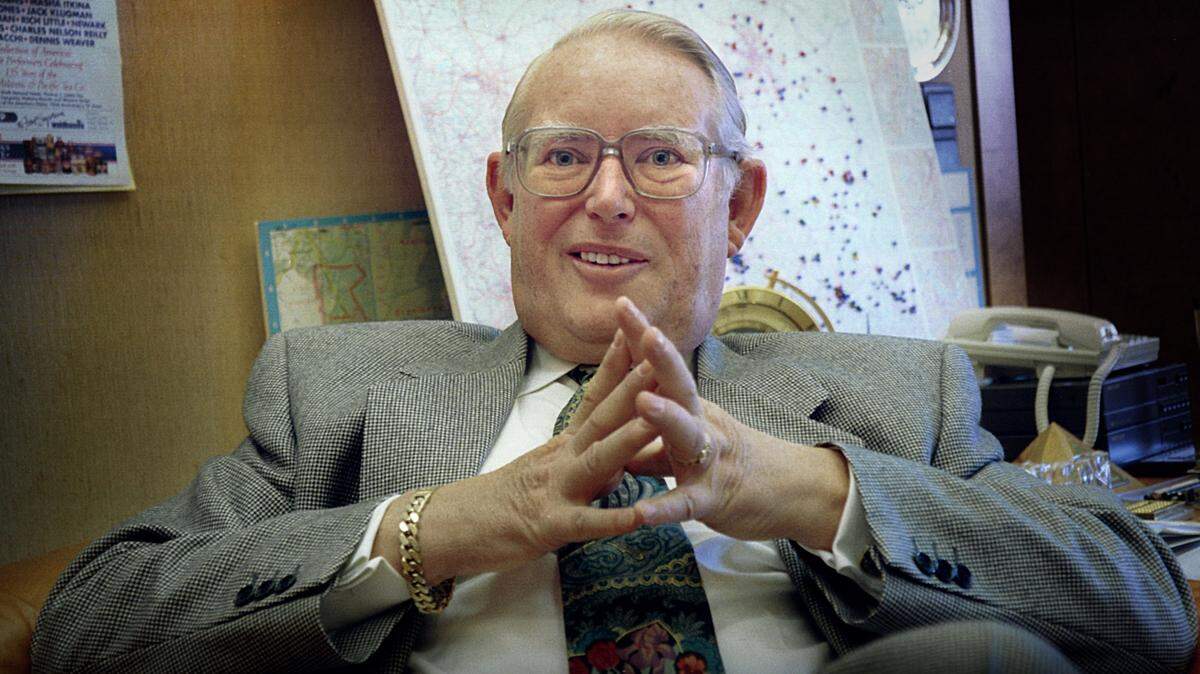
Billionaire Erivan Haub, the man who owns all this, is resplendent in a black-and-white houndstooth jacket and heavy gold bracelet. He takes a glass of chilled Chardonnay from a tray offered by a servant and proposes a toast:
"To Tacoma," he says, flashing a brilliant smile.
Tacoma?
Yes, indeed. Haub, the baron of European supermarkets, a man Forbes magazine ranks as the seventh-richest individual in the world, has been a delighted Pierce County resident for 35 years.
Even though he is a German citizen, his Northwest credentials are impressive: All three of his sons were born at Tacoma General Hospital; he knows Mount Rainier's hiking trails and the intricate waterways of Puget Sound almost as well as he knows supermarkets; he and his family own millions of dollars' worth of Pierce County property.
Haub, 62, has kept a remarkably low profile all this time, scooting in and out of the tiny Tacoma Narrows Airport three or four times a year in his private jet, lying low at his modest waterfront home on the Gig Harbor Peninsula, quietly enjoying the company of a dozen or so close friends and business associates.
In 35 years he's never been quoted in a Washington newspaper, never held a press conference nor granted an interview. He has taken care not to draw attention to himself in any way.
Yet while he protects his privacy, he has exerted influence behind the scenes. On several occasions he has tapped his billions to benefit Tacoma, contributing to projects like fixing up Union Station, getting the Tacoma branch campus of the University of Washington started, supporting the "Train to the Mountain" project and the Chihuly glass museum.
He's also a member of the Executive Council for a Greater Tacoma - a group of successful business leaders who meet regularly to try to come up with ways to jump-start Tacoma's economy.
Now, however, the ties that bind Haub to the Northwest have begun to loosen, his friends and acquaintances say.
That dismays civic boosters, who for years have harbored the hope that the legendary entrepreneur would use his magic (and his money) to revitalize his adopted town.
As they see Haub's visits to the Northwest becoming shorter and less frequent, they have premonitions of the goose flapping off and laying its golden eggs elsewhere.
People who know Haub are vehement about protecting his privacy. When pressed for personal details, they clam up, from his closest friends to clerks at the little mom-and-pop grocery store near his home west of Gig Harbor.
The one thing nearly all of them do say, however, is that Haub doesn't act anything like you'd expect a billionaire to act.
"People have all these stereotypes about very wealthy people, but they're not at all true with him," said John Barline, the Tacoma attorney who handles Haub's personal business in America. "He's really just a very friendly, easygoing person."
"He's not pretentious," said Haub's close friend Robert Stoaks. "He never wants any credit for what he does."
"He's completely down-to-earth," said Wayne Willis, a business associate. "He's not the type of guy who's out there looking for the limelight."
And it's true. While it's not clear how billionaires are supposed to act, it is clear that Haub doesn't act that way.
In person, he is warm and friendly, almost to a point of exuberance. His smile is big and slightly lopsided, making him look like a happy but vulnerable little boy.
His glasses magnify his eyes, giving his face such intensity that a close conversation feels a little bit like being caught in the glare of headlights.
More than anything else, he seems to be having fun.
That's exactly right, he says.
"I love what I do. I like it and I love it and I think that anyone that doesn't like his job should look for something else, because without real dedication you are not going to achieve that which you could achieve."
Part of the reason for his success, Haub suggests, is that he needs only five or six hours of sleep a night. After a full day at his Mulheim office he often continues working at home after dinner.
Barline says it is not at all unusual for him to call at 2 a.m. German time, ready to talk business.
Haub first came to the Pacific Northwest because of a chance meeting at a ski resort.
After World War II, he came to America as an exchange student, then stayed on to learn the American supermarket business, which he correctly foresaw as Europe's retailing future.
While his family already had hundreds of stores in Germany, Haub literally began in the basement of the American grocery trade, stamping prices on cans at a Jewel-Tea supermarket in Chicago.
He was promoted, then later moved to La Habra, Calif., where he worked as a manager for the regional Alpha Beta chain.
In the winter of 1953, Haub took time off to go skiing in Sun Valley, Idaho. One night, at a barn dance, a woman came over to introduce herself, her crew-cut husband following close behind.
"You are German?" she asked.
It was Annelise Stoaks, with her husband, Warder, a Tacoma businessman who made a small fortune with a collection agency he started during the Depression. Annelise was Danish, knew a few words of German and was delighted to find another European in Idaho.
The Stoakses were considerably older than Haub, but even so the three of them immediately hit it off.
"I was at that time a young boy," Haub remembered. "They were 20 years older and took care of me."
They parted, promising to keep in touch.
A year later, Haub and his mother made a transcontinental tour of the United States and Canada, looking for investment possibilities. They wound up in Washington state and dropped in on the Stoakses.
They visited again the following year and, in 1958, Haub invited Warder and Annelise to his wedding in Germany.
"That's how it really started to become a very close friendship." Haub said.
What Haub found in Washington in the 1950s looked to him like paradise. The forests were green and limitless, salmon leaped out of water sparkling in Puget Sound, and Mount Rainier towered above it all like an ethereal vision.
Compared to Germany, which had been bombed to rubble in the war, the little fishing village of Gig Harbor with its ramshackle net shacks and picturesque docks seemed to him like some mythical Shangri-La. He was enchanted.
In 1960 Haub flew his wife, Helga, to Washington to have their first child at Tacoma General Hospital. The medical care was far better than in Germany at the time, he explained, and his son would automatically be an American citizen.
They bought an old waterfront place on Hale Passage, west of Gig Harbor, and named the house "Charley's Success," in honor of their firstborn.
Now, however, Haub does not find Puget Sound to be the paradise that he and his mother discovered 40 years ago.
With trash along roads, drive-by shootings, crowds at Mount Rainier and traffic jams on the Narrows Bridge, it is a changed place.
"Quite simply, it became crowded," Haub said. "It is not as clean anymore as it was. It became ... industrious.
"When we first came there, the whole valley between Tacoma and Seattle was empty. The freeway didn't even exist at that time. Now if you fly over it you see that everything is solid city, from Tacoma to Seattle.
"It was beautiful for us, and it was beautiful for my children when they were small. They learned to swim there and they learned to boat there and they learned to hike. They learned to mountain climb. We love it there, but now it is too full, too full of everything."
Haub spent his boyhood on a remote farm in Germany, where his father moved his family during the war. The experience of growing up close to nature, he says, was invaluable. It shaped his approach to business and to life.
He was able to give a similar experience to his boys in Gig Harbor, he said, and he wants the same for his seven grandchildren.
"I want to have the grandchildren grow up and see animals and see nature, and not people, and not worry about cars and all of that."
And that is not possible in Tacoma and Gig Harbor anymore.
That is why, when the whole family vacations together in America now, they no longer go to Washington. They go to Wyoming, where Haub recently bought a ranch.
The Wyoming place, where he keeps a small herd of buffalo, allows Haub to indulge a lifelong fascination with cowboys and the American West.
And, he hopes, it will give his grandchildren the opportunity to learn how to rope and ride and shoot, sleep under the stars, listen to coyotes and learn about nature.
Haub's time in Pierce County is being squeezed by another project he reluctantly entered into several years back.
As a favor to a dying friend, he agreed to buy Sun Mountain Lodge, outside of Winthrop in Okanogan County. He spent $24 million fixing it up and spends scarce time in Washington dealing with it.
"It's a beautiful place, and I love it," Haub said, "but still, it's a burden to run it."
Haub's personal ties to Pierce County are unraveling as well. Old friends are dying. The last time he visited - in September - he paid what may be his last visit to Warder Stoaks, now in his 80s and extremely ill.
"I feel sorry as a lot of old friends pass away," he said. "Plans change."
Haub says he is not about to abandon Pierce County, but there is less and less for him here. His attention is increasingly being drawn by Tengelmann's advance into Eastern Europe and Russia, which he regards as retailing's new frontier.
He has confidence in Tacoma's future. Its port and its proximity to Asia eventually will make it prosper, he says.
"It will take time, unfortunately, it will take time. But one of these days it is going to happen. The whole downtown area, I think, can be really revived. I've seen it in Baltimore, I've seen it in Boston, I've seen it in a number of cities. Downtown Philadelphia is totally changed."
But as Haub's interests diverge, his role in making that happen is becoming less a matter of the heart than of the bottom line. That almost certainly means his investment decisions will be made not from the perspective of benefactor, but businessman.
And, as one American business writer recently put it, "Erivan Haub didn't become one of the world's richest men by being dumb."
There's rich, and then there's rich
How rich is he?
Erivan Haub's company, the Tengelmann Group, is privately held, so there's no way to know for sure.
Forbes magazine takes a crack at it each year, however, and currently estimates Haub's net worth at $5.8 billion.
That's enough to put him in a seventh-place tie for the world's richest individual, Forbes says - excluding royalty and other heads of state.
Respectable, but well below Microsoft's Bill Gates - another Northwesterner - who ranks first with $9.4 billion.
Two years ago, Forbes listed Haub as third, with an estimated net worth of $6.9 billion - edging out Gates by half a billion.
Haub says the Forbes numbers are way off, but he does not say whether they're too high or too low.
"I have no idea how they come up with those numbers," he said. "They're wrong. But even if they weren't, I can't see what possible purpose they would serve.
"Being rich is not what's in your bank account," Haub said. "The one who is truly rich is the one who is rich at heart."
The Forbes list
Wealth in billions
- Bill Gates USA computers $9.4
- Warren Buffett USA stock market 9.2
- Yoshiaki Tsutsumi Japan land 8.5
- Carlos Slim Helu Mexico conglomerates 6.6
- Lee Shau Kee Hong Kong land 6.5
- John Kluge USA media 5.9
- Erivan Haub Germany supermarkets 5.8
(tie) Li Ka-shingHong Kong land 5.8 - E. Azcarraga Milmo Mexico media 5.4
- Kenneth Thomson Canada publishing 5.2
- Edward Johnson USA investments 5.1
This story was originally published November 27, 1994 at 12:00 AM with the headline "The billionaire next door: European supermarket magnate Erivan Haub has maintained a home — and a strong interest — in Pierce County for 35 years."