
Too many market-rate apartments in Tacoma? It’s complicated.
It’s an issue that persists during the current building boom in Tacoma.
As Tacoma grapples with providing more affordable housing while not stifling growth, some question whether it’s time to reform a program that provides tax exemptions to developers who build apartment complexes, even if those developments don’t include discounted rates for low-income tenants.
The question was raised Tuesday when the City Council approved two new market-rate apartment developments in Tacoma’s Downtown Regional Growth Center, both of which qualified for eight years of tax relief under the multifamily property tax exemption.
The projects made for an awkward approval moment for the same council who last year received the city’s Affordable Housing Action Strategy, which highlights issues surrounding the 8-year exemption.
That plan calls for updating the exemption program to help increase the number of affordable units, which for now remain in short supply.
According to the report: “Removing the 8-year Multifamily Tax Exemption option could immediately increase the supply of income-restricted units.”
At Tuesday’s meeting, Councilwoman Catherine Ushka said she “absolutely believes that we need market-rate housing as much as we need affordable housing.”
Ushka also said she was concerned about the use of tax exemptions.
“Where and when in the Affordable Housing Action Strategy are we going to look at whether or not we’re going to limit the use of the 8-year and 12-year in certain areas of Tacoma,” she asked, “so that we’re getting growth elsewhere.”
8 years vs. 12
Tacoma has two tax exemption programs for developers of multifamily housing: a 12-year version and an 8-year one.
The 12-year version requires that a percentage of the housing units being build qualify as being affordable. The 8-year version does not.
Developers have tended to gravitate toward the 8-year plan. That was the case with the two projects approved Tuesday, including 116 market-rate apartments at 1351 Fawcett Ave. proposed by Ethos Development of Portland.
“We are excited to be working in Tacoma and contributing to its already vibrant urban fabric, and we wouldn’t be able to get this project off the ground without the 8-year property tax abatement program.” Paul del Vecchio, founding principal with Ethos, told The News Tribune via email in response to questions. “We did consider the 12-year program that includes affordable housing, and ultimately the challenge was that the benefit in years 9 through 12 do not help the first year of operations.
“In order to be built, market rate multifamily projects need to make enough money to cover debt service at completion. Even if the tax benefits in future years offset the aggregate rent subsidy in the affordable units, it would penalize the early years and make the project infeasible.”
The two projects combined will bring nearly 300 new market rate apartments to Tacoma but none defined as affordable. The two plans list studio apartments between $1,100 and $1,300 a month, and on the other end of the size spectrum, three-bedroom units between $2,200 and $2,300 a month.
“If the developers only had the 12-year option, these new projects would include close to 60 affordable units,” Molly Nichols, Tacoma outreach coordinator with Futurewise, said at Tuesday’s meeting.
How we got here
The property-tax exemption program was an incentive started in 1995 as a 10-year exemption with no affordability requirement. It is seen as a way to bring density to specific areas.
In 2008, amid the depths of the real estate collapse and the Great Recession, the program evolved into two options: the 8-year version and the 12-year one.
The 8-year version does not include an affordability requirement. The 12-year version requires that 20 percent of a project including units deemed affordable for households earning no more than 80 percent of area median income or home buyers with household incomes no more than 115 percent of AMI.
It exempts property taxes on improvements that create four or more additional housing units.
The action strategy report notes that the 8-year version is in contrast with new goals to provide more affordable housing in Tacoma.
According to the action strategy report: “Modeling suggests a strong financial incentive for developers to choose the current 8-year MFTE option over the 12-year option. This reduces potential development of income-restricted units under the 12-year MFTE option.
“When the 8-year option is removed, modeling suggests many developers would choose the 12-year option, resulting in up to 2,600 income-restricted units affordable to households at 80 percent area median income within the next 10 years.”
It recommended only offering the 12-year option “in areas where the City of Tacoma plans to also implement mandatory inclusionary housing. This change would help produce as many as 3,100 income-restricted units over the next 10 years ... .”
In 2018, the Tacoma Mall neighborhood saw the start of a mandatory inclusionary zoning provision approved by the City Council as part of that neighborhood’s subarea plan. The provision calls for multifamily units to have 10 percent of the units be affordable to renters making 50 percent AMI or less.
So why not just toss out the eight-year plan?
Council member Chris Beale, during the Sept. 25 meeting when the Affordable Housing Action Strategy was presented, urged caution.
“I think the interesting facts from that economic evaluation is we can create more affordable units by getting rid of the 8-year multifamily tax exemption, but in large regard most of those units will be created in communities that have the least amount of need — Downtown, the North End, West End, while the South End, East Side and South Tacoma literally get zero units out of any scenario we looked at.”
He recommended those “advocating for housing, advocating for affordable housing, advocating for the rights of people — and housing being a human right — to continue to channel your efforts toward that long-term vision of having a sustainable funding source for our housing trust fund ... to serve those lowest rungs, while looking at our market economics when it comes to multifamily tax exemptions.”
“I want to be very careful about looking at the tools we have for all housing because all housing affects affordability; it’s a market-based reality that we have to deal with,” Beale said at the time.
WHY AMI MATTERS
The area median income percentage attached to the 12-year exemption is higher than what affordable housing advocates would like to see, given that Tacoma’s greatest need for affordable housing is for households earning 30 percent AMI and below, according to the action strategy.
The action strategy defined assigned categories and income ranges for those in need of more affordable housing:
▪ Extremely low-income — households earning 30 percent of area median income or below ($25,100 for a family of four)
▪ Very low-income — households earning between 31 percent and 50 percent of area median income ($37,300 for a family of four)
▪ Low-income — households earning between 51 percent and 80 percent of area median income ($59,700 for a family of four).
The action strategy said Tacoma has 27 affordable and available units for every 100 extremely low-income households, with 40 percent of Tacoma households paying more than 30 percent of their gross income on housing each month.
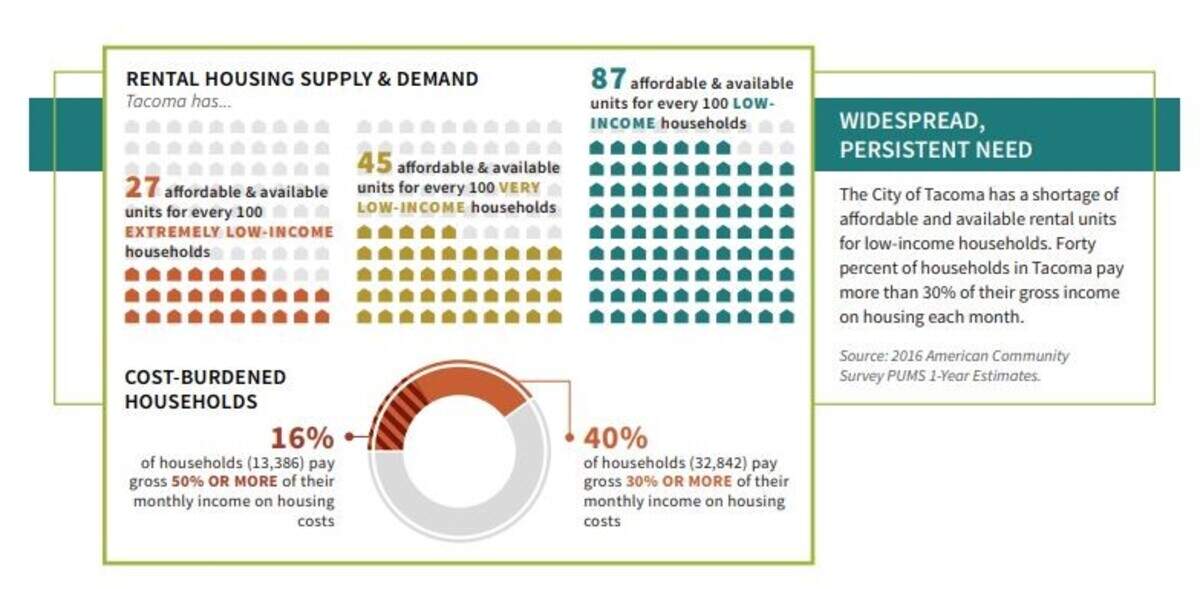
The action strategy’s AMI dollar amounts are based on an income benchmark used by the U.S. Department of Housing and Urban Development. The numbers are based off the HUD Fair Market Rent Area for Pierce County, the same one used for grant funding and public housing programs locally.
“Using this regional standard likely undercounts affordable units within the city limits, as well as overestimates what the average household can afford,” according to the report.
The debate continues
Of the multifamily projects approved in 2018 in Tacoma, nearly half used the 12-year property tax exemption option, according to information from the city. Most of those are smaller projects, ranging from six to 36 units, and in the Tacoma Mall area.
As is frequently the case, the developers whose projects were approved Tuesday told the city they needed the tax exemptions to bring the projects to Tacoma.
Del Vecchio, in his emailed statement to The News Tribune, noted that Ethos offers affordable housing elsewhere.
“We understand the need for affordable housing and are building units to 60 percent of AMI in Portland, our hometown; we also work with nonprofits that are tackling the issue from different angles. The cocktail of construction costs, potential rents, income and sales tax are different in different locations and it makes for different possibilities. I believe the same will work in Tacoma at some point; at the moment we consider providing any new housing at all to be a step toward more affordable housing.”
Nichols expressed concerns.
“I know the city is looking at dropping the 8-year multifamily tax exemption as part of the Affordable Housing Action Strategy and am asking you to move quickly to do so,” she said at Tuesday’s meeting. “The sooner we act on it, the sooner we can secure more affordable units in Tacoma.”
Other residents echoed those sentiments.
“Stop giving tax abatements for housing that is too expensive for any of us to afford,” said one person speaking at Tuesday’s council meeting.
Another said she saw it as “increasing the housing stock ... but without any opportunity at this point to increase housing opportunities for people that I know and that I see surrounding me every day.”
Some council members then expressed a desire to move sooner than later on the action strategy’s recommendations.
“I want to make sure those incentives are being used to drive growth where growth is needed,” Ushka said.
During her State of the City address earlier this month, Mayor Victoria Woodards said finding a way to get the tax exemption right is a priority.
“In the last couple of weeks, the council and I began the process of prioritizing the policy issues associated with the plan,” Woodards said. “Our work moving forward will include streamlining permit review for affordable housing projects, and we will also re-examine the length and usage of the multifamily tax exemption to create more affordable housing units.”
For now, builders keep building, and rents keep rising.
Apartment List, in its monthly review of the Tacoma market, said in its March 1 report that Tacoma’s median two-bedroom rent of $1,560 came in above the national average of $1,170.
Its latest report, embargoed for April 1, shows yet a third month in a row for rent increases in the city.
The two projects
The Tacoma City Council approved two market-rate apartment complexes at its Tuesday, March 26 meeting:
▪ Ethos Fawcett, a branch of Ethos Development, plans to develop 116 apartments at 1351 Fawcett Ave. The bulk of the units (85) will be 300-square-foot studios at $1,100 a month; 18 two-bedroom/one-bath units (615 square feet) will rent for $1,540 a month; and 13 three-bedroom/two bath units (870 square feet) will go for $2,300. The $22 million project is to start construction in September and finish November 2020.
The project includes 20 residential parking spaces and nine nonresidential parking spots. No detailed renderings for this project are in, but examples of previous work done by the architects are at http://www.worksarchitecture.net/
▪ Keppner Group will develop 180 market-rate apartments at 2515 S. Jefferson Ave. The plan calls for 37 studios (450 square feet), renting at $1,300 a month; 103 one-bed/one-bath units (625 square feet) at $1,600 a month; 38 two-bed/one-bath units (900 square feet) at $1,900 a month; and two three-bed/two bath units (1,100 square feet) for $2,200. The project also will contain nearly 4,000 feet of commercial space, 170 residential parking spaces and 80 nonresidential spaces.
The $30 million project is set to start construction in June with completion in December 2020.
Test your ideas
The City of Tacoma’s Housing Market Policy Dashboard, which launched along with the action strategy, allows you to create your own scenarios, including dropping the 8-year incentive or adding mandatory inclusionary zoning at different percentages, to see how it affects potential development in the city based on other market assumptions.
The Affordable Housing Action Strategy report is online at https://bit.ly/2Ohtw5x
This story was originally published March 29, 2019 at 2:07 PM.