Who shot a federally protected bald eagle in Tacoma and left it to die?
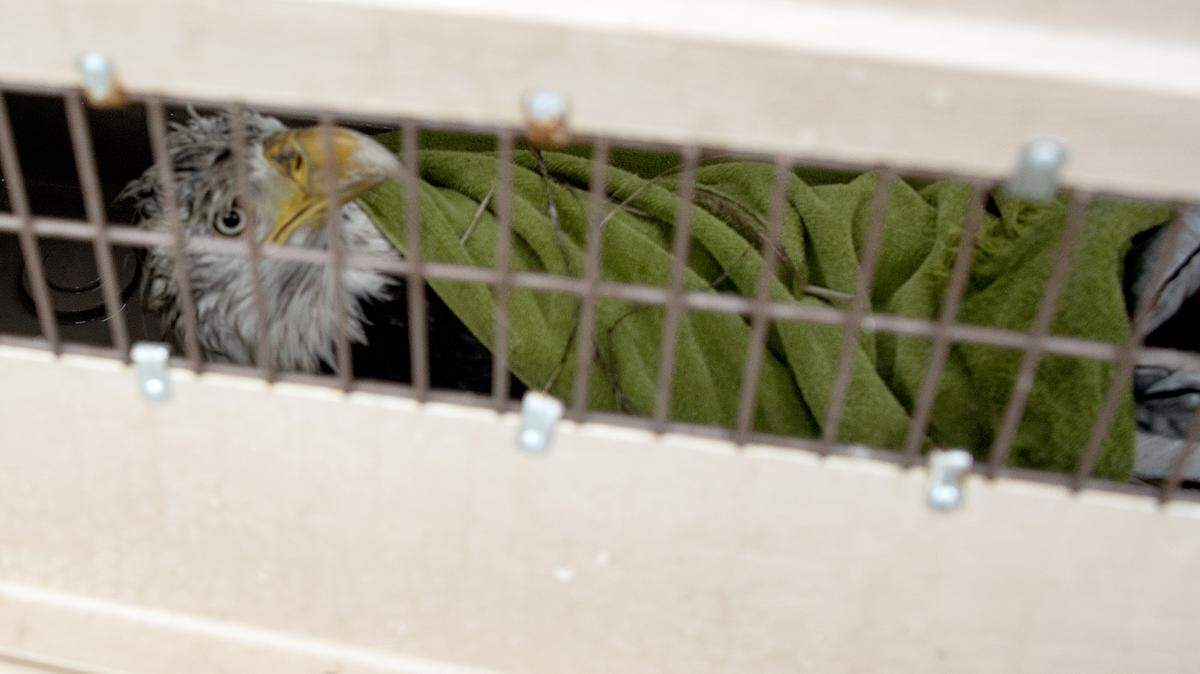
Somebody shot a bald eagle in the Tacoma area, and the perpetrator, if caught, could be prosecuted on federal charges.
The adult eagle was found injured last week at the Port of Tacoma. The animal’s wounds were too severe for recovery, and the bird was euthanized.
The state Department of Fish and Wildlife said it first received a report of an eagle Jan. 9 when it was seen on port property. An initial search failed to locate the bird.
Another report the next day led to the discovery of the bird at the port’s Gog-le-hi-te wetland complex at 1402 Lincoln Ave.
Jenn Stebbings, the port’s biologist, and two Fish and Wildlife biologists approached the bird, which was able to walk but not fly.
As Stebbings distracted the bird, another biologist netted it. They took care to avoid the bird’s talons and beak.
“It is a large killing machine,” Stebbings said. “There are lots of sharp parts on that bird. The talons are about as long as my fingers.”
The male eagle was taken to All Creatures Animal Hospital in Bremerton where it was X-rayed. While there, buckshot fell out of the bird’s wing and on to the X-ray table.
The eagle was then taken to West Sound Wildlife Shelter on Bainbridge Island. Staff, including a veterinarian, reviewed the X-rays. They showed what appeared to be more buckshot in the bird’s wing, said Kerry Klein, a wildlife rehabilitator.
The X-rays also showed a severe fracture to the bird’s wing joint.
“That was not something he was able to recover from and go back to the wild,” Klein said.
Staff decided to humanely euthanize the eagle, she said.
“A necropsy (animal autopsy) will be performed to better identity the cause of the injuries,” said Becky Bennett, spokeswoman for the Department of Fish and Wildlife. “U.S. Fish and Wildlife have been contacted as this is a federally protected species.”
While bald eagles are no longer an endangered species, they are still protected by several laws. Killing the birds is a crime. A felony conviction could lead to a $250,000 fine and two years in prison.
Stebbings said she had never encountered a similar case during her career. She could offer no theories as to why someone would want to shoot an eagle.
“The only positive part of the story is that we were able to capture it and provide it a humane way for it not to be in pain anymore,” Stebbings said.