Termites swarm Key Peninsula. Where’d they come from?
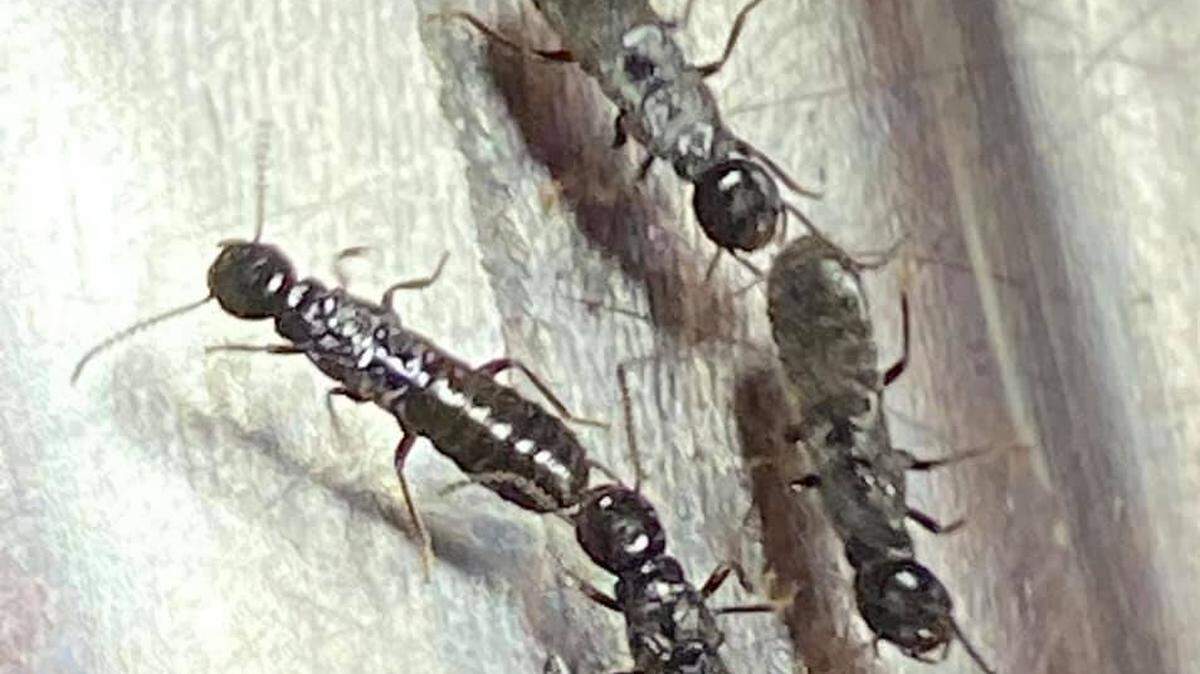
A pronounced swarm of termites descended on residents and some businesses in Key Peninsula and areas of Kitsap Peninsula on Tuesday after something coaxed them from underground.
The swarm started in the early afternoon hours and continued through the afternoon Tuesday.
Nathan McAuley, operator of Green Diamond Pest Control, knew instantly something was up.
“We are a local company, and I got over 25 calls in the last 24 hours,” McAuley told The News Tribune on Wednesday evening in a chat via Facebook Messenger.
“They all started around 3:00 p.m. (Tuesday). Normally I do between two to four subterranean termite calls per year,” he said, describing the influx of calls as “overwhelming.”
He said calls were coming from Gig Harbor, Key Peninsula and Port Orchard area, where people found the insects inside their homes and swarming outdoor work sites..
“I haven’t seen this many calls this fast in my 11 years in the industry here locally,” he added.
So what caused the swarms? Some experts said it was the light rain that fell that day. Others theorized wildfires or the smoke from them stirred up the insects. Others said it was just Mother Nature doing her thing.
McAuley theorized it was a “perfect storm of smoke and humidity.”
“The inspections I’ve done so far, I have not found evidence of active mud tubes,” he said. “I am still doing some research, but after speaking with some colleagues, the consensus seems to be we had the perfect storm of smoke/humidity from the rain causing the termites to swarm.”
‘It was just really weird’
Joyce Shinn, who lives in Lakebay in Key Peninsula, was one of the people who called McAuley.
Shinn told The News Tribune in a phone interview that she’d gotten up from a nap at about 1:30 p.m. Tuesday and discovered them in her bathroom. “I looked down at the floor, and there’s these little black bugs crawling all over the floor, and they were a little bit bigger than a sugar ant, they had a longer body, and I thought, ‘Well, gosh, I’ve never seen anything like that before.’
“They were all over the floor.”
She soon found them in her kitchen.
“I went into the kitchen, and, sure enough, there were some crawling on the floor,” Shinn said. “And they seem to be in pairs, by two together. It was just really weird.”
She posted photos of the insects on social media. Her post on a local community page drew more than 50 comments from others saying they, too, had seen the bugs suddenly appear at about the same time.
“It was really eerie,” she said. “It didn’t feel right that they should be here. They just showed up, and then after they showed up, we didn’t see anymore.”
Another resident recounted a similar experience at her home.
“It was such a strange thing to have so many mysteriously show up that one day, and in so many different homes on the Key Pen, and then nothing the next day,” said Amy Fessler VanderDoes.
Later Tuesday, Shinn said her son told her that he’d experienced them swarming at his work site in Key Peninsula as he worked outside.
“He said at work ... about the same time that I found these bugs, they were all over him. He wears protective gear because he has to do some sanding outside,” she said. “He said they were crawling all over him.”
DeeDee Emmett, postmaster at the Key Center post office, said she thought it was strange when she found the bugs suddenly covering the floor in the back of the post office Tuesday afternoon.
“Everywhere you found one you found two together. It was just weird,” she said. “And then the next morning, they were gone.”
Experts weigh in
So, just how unusual was this? Turns out, not that much maybe, but perhaps more noticeable because of more people staying close to home during the coronavirus pandemic.
Chris Looney, entomologist with the Washington state Department of Agriculture, said they appeared to be Reticulitermes hesperus — the western subterranean termite — after reviewing Shinn’s photos of the bugs, according to a spokeswoman for the department.
The insects can swarm as part of their normal colony cycle, notably just after rain.
WSU extension noted they reported more calls than usual, too.
Would the extra-smoky environment have triggered this? State officials didn’t know.
“We don’t know whether this could be climate/smoke related,” Karla Salp, public engagement specialist with the Department of Agriculture, told The News Tribune via email.
Allan Felsot, professor of Entomology & Environmental Toxicology at Washington State University in Richland, told The News Tribune via email it didn’t seem likely that smoky air was the cause.
“Unless there was a specific chemical in the smoke that triggered swarming, I’m skeptical that the smoke has anything to do with the termites. Consider the termite colonies are not directly exposed to the atmosphere, so perhaps skepticism is warranted,” Felsot said.
“Insect populations are highly dynamic over time, so seeing more swarms is not necessarily unusual. Perhaps more people are home to notice these things.”
Becky Maguire, entomologist with the WSU Puyallup Research and Extension Center, told The News Tribune via email:
“I contacted two pest control operators today, and they both have seen big subterranean termite swarms this week. It is normal. The little bit of rain caused them to swarm. Natural life cycle.”
Vernard Lewis, retired professor of entomology with University of California, Berkeley, said, “Some of these swarms can be incredible. I mean I’ve seen some in California, hundreds of thousands ... it’s like snowing termites.”
Lewis said the intensity of a Pacific Northwest version of subterranean termite swarm “is not as great as found in California.”
He noted, “I have seen increased subterranean termite activity in trees from forest fires in California.”
“Subterranean termites are very common throughout North America. They were here first,” he told The News Tribune in a phone interview Thursday. “After the rain, they swarm. ... The rain softens the ground.
“They just need a little bit of soaking. And then you have a nice warm day, hopefully the wind isn’t blowing too strong, and then they come out and you see, they look like little helicopters all over the place.
“Homeowners will call me after a rain and say, ‘What’s up with all these things flying around my house?’ I ask them if it’s inside or outside. If it’s outside, that’s Mother Nature at work. If it’s In the bathroom, you’ve got a problem. The water is their clue to swarm.
“They drop their wings and you notice they’re running in tandem, that’s the male and female, and then they find a little indentation in the soil or wet piece of log or wood or your house. And they go from there.”
He also noted that fires don’t seem to deter them. Once when he went through a forest in California that still had smoldering trees after a fire, he made a surprising discovery.
“There were subterranean termites working on those smoking hot trees,” he recalled. “It was the most incredible thing I’d ever seen.”
He said that while some might wonder if the swarms, including Tuesday’s event, are tied to global warming or drought, “It’s hard to prove that.”
“You guys are seeing something now because of all this fire. Depending upon what happens in the winter months, we could see even bigger swarms next year because normally nature is a little delayed.
“You may be doing this story again next year,” he added.
What to do?
McAuley said he was recommending a conservative approach.
“At this point we are recommending calling a professional for an inspection and following their advice. ... We are doing inspections and will recommend treatment if mud tubes or other evidence is found,” he said.
Mud tubes would mean termites are making themselves at home in your home.
“If no evidence is found other than the insects, we are recommending vacuuming them up and monitoring” the situation, he said.
Felsot offered similar advice.
“They may want to have their property checked out to make sure they personally don’t have an infestation,” Felsot said. “Any old wood that is damp near the house could also be harboring the Pacific dampwood termite colony.
“Probably the first thing they should do is police their property and kick over that old wood .... I live in the Tri-Cities area and years ago on my property I had some old wood lying around, but it was nowhere near my house. I turned over the wood to find beaucoup termites. I sprayed the wood with a pyrethroid insecticide,” available at hardware stores.
“Proper sanitation will take care of a lot of these urban pests,” he added.
Unfortunately, it’s not just termite swarms you need to be on the lookout for, according to another local pest control specialist.
Wayne Boudreau Jr., general manager of Sentinel Pest Control, told The News Tribune that calls for bedbug infestations have increased rapidly.
“Over the last eight years or so it’s just been worse and worse,” Boudreau said. “Our phones have been just really crazy ... whether it’s residential homes, hotels or motels.”
In the meantime, McAuley offered his own take on the season of swarms:
“Another crazy thing for 2020.”
This story was originally published September 18, 2020 at 10:53 AM.