6-story apartment building planned for Tacoma’s Proctor district sparks cry for reform
A court battle against a planned apartment building in the Proctor district has pitted the county’s assessor-treasurer and some of his neighbors against the City of Tacoma.
Opponents of the development said the fight highlights land-use policies and processes established years ago that are on a collision course with Tacoma’s need to provide more housing while respecting established residents’ rights.
They also contend the process that sends challenging such developments to Superior Court limits who can mount a fight against developers.
Those fighting the Proctor project see the case as their last shot at getting the city and developers to rethink not just this project but potentially how future ones are handled, especially when it comes to reducing the size of such projects or increasing the buffer between similar developments and single-family homes.
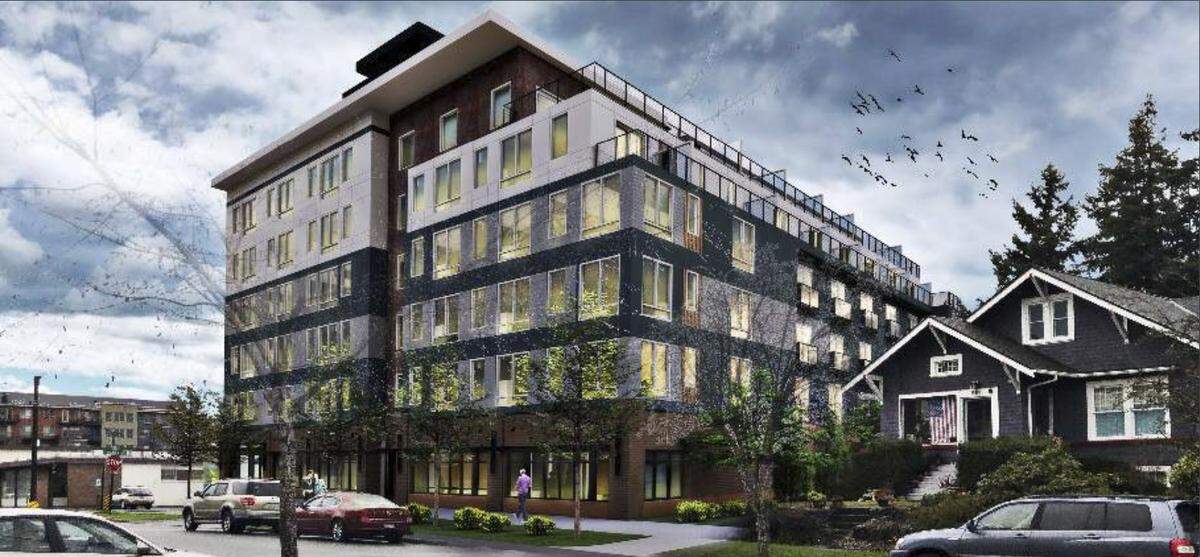
The project, known as Proctor III, is spread over two parcels and would replace Cooper’s Collision Corner as well as a house now used as a parts storage building, and a separate, single-family home.
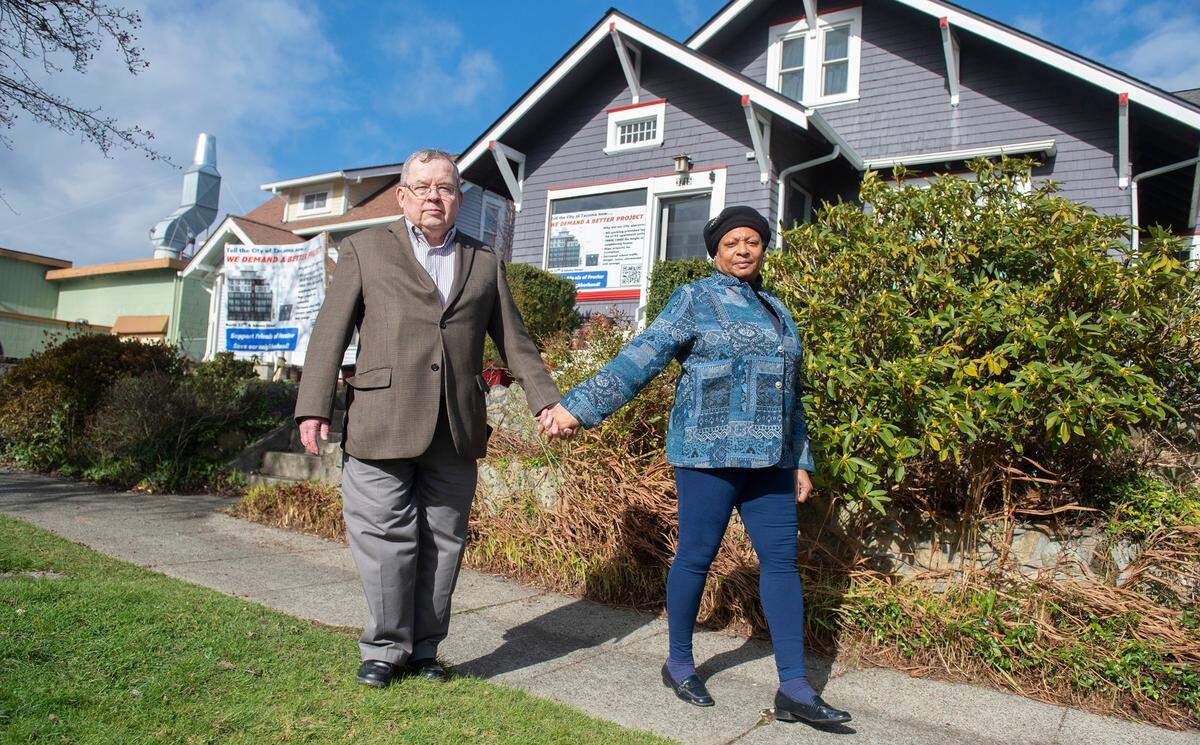
On the other side of that house is the home of Pierce County Assessor-Treasurer Mike Lonergan, who has resided there for 37 years.
“We know these are 100-year-old houses that people have bought and invested in in good faith, raising their families there, and you’re going to put six stories with balconies overlooking their backyards,” said Lonergan.
“Their privacy is gone.”
Proponents of more housing in Tacoma see court challenges like this, if they succeed, as denying other people the opportunity to live in one of the city’s iconic neighborhoods, desirable for its walkability and services.
“It’s such a great place to be at and live in, play, go to the farmers market,” said Anaid Yerena, assistant professor with the University of Washington Tacoma’s School of Urban Studies. “All those things will only thrive the more people that are welcomed into that area.”
In a statement provided to The News Tribune via email in response to questions, Rush Development said their work is building on the success of two previous sites.
“Rush has developed two projects in the Proctor area (Proctor Station and Madison25) both larger than the one proposed here,” the developer said. “We are proud of both and believe they meet an important housing need in this great community and provide a density that is needed to allow the shops and restaurants in the area to thrive.”
Court fight
Proctor III is planned with 95 market-rate units, some commercial space and a parking garage at the base of the building with up to 45 stalls at North 27th and North Adams streets.
Lonergan told The News Tribune in an interview in January the lack of transition between a high-density housing site next to a residential property, such as in this case, is a concern not just for his house, but in other neighborhoods in the city where bonus heights could be attained near homes abutting a Neighborhood Commercial Mixed-Use District. That would include Hilltop, the Lincoln District and the Narrows neighborhood off Sixth Avenue.
“I think the city’s goal really intended for there to be some sort of transition between the mixed-use centers and the surrounding neighborhood, but we just don’t have it in this case,” said Nicholas Bond, a Proctor resident and another party in the case.
A simple fix, they argue, would be to change the zoning code.
Bond suggested that clarifying language barring height bonuses on any portion of properties within 100 feet of any single-family residential zoned lot or two-family dwelling zoned lot, would prevent situations like this from happening to other residents in the city.
Rush, in its emailed statement, told The News Tribune: “The city has adopted very specific standards for the number of units, the allowed height and size of the building and required parking. Those rules were established to meet Growth Management Act requirement after a great deal of public input and review. Property owners like Rush must be able to rely on the rules and the city must follow them.”
“We believe the project as designed does comply with the design standards for the neighborhood that has been established for years.”
In an order issued Jan. 15, the developers saw their Land Use Petition case against the City of Tacoma challenging the SEPA findings combined with the case filed by Lonergan, Bond and unnamed parties labeled Friends of Proctor.
The reason for combining cases is both have issues stemming from the city’s Oct. 16 SEPA determination of nonsignificance, an environmental review step in the building permit process and involve “common questions of law and fact,” according to the court order.
Rush, in its statement, told The News Tribune: “We are appealing one technical issue regarding the site cleanup. We will still clean up the lead and arsenic contamination to the adopted state standards but want to clarify that the city can approve the cleanup when it is complete versus being tied to an Ecology response whose timing is not predictable.”
KVPP PROCTOR 3, an LLC representing the developers, is challenging a part of the city’s decision requiring it to enter into the Department of Ecology’s Voluntary Cleanup Program as a result of the site being within the Asarco Smelter Plume boundaries.
Under the program, projects within the plume face Department of Ecology cleanup oversight to deal with arsenic and lead contamination in the soil.
Lonergan and the other opponents, in their court filing, seek a “fully-informed, accurate, and complete review of Proctor III’s impacts to traffic, pedestrian safety, noise, aesthetics, light, energy and natural resources, plants, surface water, parking, public health, and the built environment to inform (the city’s) decision-making process.”
According to their filing, the city “unlawfully segmented its review of the project by looking at the demolition permits in isolation, without adequately analyzing the impacts of the entire project.”
Among the other issues: noise, concerns over pedestrian safety with nearby schools, the effects of sunlight blockage by the building on surrounding neighbors’ yards and solar panels, and the added burden on an “already overburdened sewage treatment plant,” the city’s North End Treatment Plant No. 3.
Another complaint: No sidewalks on the Adams side of the project. The city determined the addition “would be disproportionate to the benefit received and to the impact caused by the development,” as noted in the city’s Oct. 16 report explaining its SEPA determination.
Limited options for challenge
Lonergan and Bond note that having to take the case to Superior Court sets too high of a bar for anyone disputing a project.
As per city code, the sole avenue for appealing the final SEPA determination on the proposed project is through the State Land Use Petition Act (LUPA) which goes through Superior Court, costing tens of thousands of dollars.
As assessor, Lonergan noted those seeking property tax appeals have low to no-cost options to have their appeal heard.
“We don’t have that option here,” he said.
The SEPA appeals process “makes it extremely expensive to question their determination of nonsignificance and the project as a whole,” he said.
Asked why the process was set up that way, Megan Snow, media representative for the city, emailed the following response:
“Tacoma Municipal Code does not, and has not for approximately 20 years, included the opportunity to appeal a SEPA Determination to the Hearing Examiner when the determination is not part of a land use permit like a building permit,” she wrote.
“In circumstances where a determination is part of a building permit, it cannot be appealed to the Hearing Examiner. In the circumstances of this matter, no Hearing Examiner appeal is available, and State law prescribes that Superior Court is the sole venue for appeals under Land Use Petition Act.”
Sending it through a court process, noted former Tacoma Mayor Bill Baarsma, is a way to keep development decisions from playing out in a political forum.
“The council at one time heard decisions on land use zoning and variance issues from the hearing examiner. We were always instructed to ‘put on our black robes’ and act as judges in a quasi-judicial process,” Baarsma recalled via email in response to questions from The News Tribune.
“A number of highly controversial land use decisions came before the council with packed chambers with citizens expecting that their elected leaders could simply overturn examiner decisions,” he wrote.
“We were advised by city attorneys that we could not substitute our opinion for that of the examiner, and we had to find specific errors in the record to overturn final decisions.”
He noted, “A wrong or ‘political’ decision by the council could lead to costly court appeals and penalties.”
“It was decided collectively that this was not a proper or appropriate role for council members,” he added.
That eventually led to the challenges moving to Superior Court.
So far, opponents to Proctor III have raised more than $11,000 through a GoFundMe campaign and direct donations to their legal team to help cover court costs, far short, they contend, of what they will ultimately need.
“I can’t imagine an average family or anyone who is below the poverty line having any ability to receive due process in this instance,” Bond told The News Tribune.
Established neighborhoods vs. new housing
At an October 2019 City Council meeting when Proctor III was granted an 8-year multifamily tax exemption, Mayor Victoria Woodards said projects like it are much-needed.
“Frankly, we need as much housing as we can get,” Woodards said. “We don’t have 50 cranes in the sky building housing in Tacoma.”
That need persists, as evidenced recently when Redfin announced that in January homes were selling in Tacoma at the fastest pace in the nation — a title the city also claimed last January.
Further, according to the Home in Tacoma Project, part of the Tacoma Affordable Housing Action Strategy, “Tacoma is planning for about 60,000 new housing units by 2040. The City plans for most of that growth (about 80%) to be Downtown and in other Centers and Corridors and about 20% to be in other neighborhoods.”
The city’s Municipal Code includes the development standards for Mixed-Use districts, including height limits and allowed bonus height. The Proctor III site is in an NCX — Neighborhood Commercial Mixed-Use District — where the base height limit is 45 feet and the bonus height limit is 65 feet.
NCX areas can be found across Tacoma, with Proctor, Lincoln, Sixth Avenue, McKinley and Narrows accommodating the maximum 65 feet.
In other locales, they can go higher. Stadium and South Tacoma Way and some areas of HIlltop, for example, have bonus height options up to 85 feet.
The city allows height bonuses on these types of properties within 100 feet of various settings, including single-family dwellings, as long as the property incorporates one or more of the listed features called for in the city’s municipal code.
According to the code, the bonuses are “designed to encourage new growth and foster economic vitality within the centers, consistent with the State Growth Management Act and the City’s Comprehensive Plan, while balancing taller buildings and greater density with public amenities that help achieve the community’s vision for the centers, with improved livability, enhanced pedestrian and transit orientation, and a quality built environment, and realize other citywide goals.”
Different features earn different bonuses to a building’s height.
Those features, listed in the Land Use Regulatory Code online, include ground-floor retail or restaurant, which will earn 5 feet, or public art, “A feature worth 1% of the value of the building ...”
A vegetated roof or proven energy efficiency described as designed “to reduce energy usage beyond the prerequisite standards by at least 20% for new structures and 10% for existing structures or existing portions of structures,” can add 10 feet of bonus height.
In Proctor III’s case, the self-contained parking garage with 45 stalls allowed developers to get the building to 65 feet.
“All of the required parking for the project is contained within the building footprint,” Snow of the City of Tacoma told The News Tribune via email. “(Per code) a project with 100% structured parking qualifies for a 20 foot height bonus.”
The city SEPA report states: “The peak parking demand generated by the project is from 10 p.m. to 7 a.m. when on-street parking is readily available. At the most constrained hours, this project is expected to add additional demand for 17 on-street stalls on weekdays and 25 on-street stalls on Saturdays.”
The report lists a mitigation of a loading zone on Adams to ease curbside parking, which Lonergan said isn’t nearly enough, nor are the parking estimates realistic.
“It’s death by 1,000 cuts,” Lonergan said of the parking issues already in Proctor.
“You say, ‘Well, I guess the post office can have their 20 employees parking on the street,’ then you say, ‘Well, I guess the school can have their 30 employees parked on the street.’ Then you say, ‘Well, we’ll have 45 parking spaces for 95 units,” he said. “If the others do have a car by chance, or somebody has more than one car, or somebody comes to visit, well, they’ll find a place to park on the street.’
“And so, you know what, by now we’re talking over 100 more cars on the street. And it’s already full.”
Though public comment to the city during its review period on the project offered plenty of critiques, not everyone in the neighborhood was opposed.
“I believe that our businesses have become more vibrant and upscale since the increased density in Proctor,” wrote Ryan Meacham in an email to the city as part of public comment offered to the city on the project. “I also believe that there have been welcome additions of youthful tenants as well as older tenants that prefer to rent than own.
“Even with possible Washington Elementary parking and drop-off issues, I believe that the increased housing supply and better local business support as a result of increased density is a must. Parking and drop-offs to the local elementary school will simply have to accommodate the change,” he wrote.
The city’s response to concerns over the building’s size was the following in its Oct. 16 report: “The proposed building is and/or will be within all building envelope standards (height, setbacks, and density) as set forth in the zoning code. The applicant has stated their intention to meet the height limitations of the zone district and this will be verified at the building permit stage.
“The building will be located the required 10 feet from the east property line and four feet from the north property line. There are additional step-backs on the upper levels along the east and north property lines to keep the building from intercepting a 45-degree plan inclined into the residential zone district.”
Future development
The city is looking at other alternatives to future developments beyond high rises.
Home in Tacoma Project’s recent “Missing Middle Survey,” an offspring of work tied to Tacoma’s Affordable Housing Action Strategy, sought input from residents on the types of housing they’d like to see.
As the Home in Tacoma Project website explains, “Many of Tacoma’s most walkable and sought after neighborhoods were built before single-family zoning and minimum lot sizes existed. In 1953, Tacoma put a Zoning Code in place that set aside most of the City for single-family houses. The traditional neighborhood patterns were no longer allowed for new construction.”
The project seeks input on what types of housing people want to see in the city, since there is little space left in the city limits for new single-family housing developments.
In this case, what space there is has led to apartments growing Proctor’s skyline up, not out.
The (Proctor III) site and areas to the west and south were originally zoned C-2 General Commercial in 1953, with a height limit of 45 feet, according to information listed in the Oct. 16 report.
That limit within the core of the Proctor Mixed Use Center was modified by Council in 2009, with the height bonus program allowing up to 65 feet if the project included specific public benefits.
“This decision was made after two-plus years of community discussion about the pros and cons of changing the regulations, which included more than 50 public meetings and hearings and substantial community input,” the city noted in the report.
“As is still the case, not all agreed with the changes, but the Council made the policy decision to allow for the increased height to encourage the growth and development that had been envisioned for the centers but had largely not happened.
The city added: “The mixed-use centers were reviewed again in 2015; while policy changes were made at that time, no substantive changes to development requirements were made.”
When asked if any changes are anticipated, Snow with the city responded: “Further review of these regulations is not on the current work plan of Planning and Development Services.”
Indeed, the Home in Tacoma Project’s website lists its goals as to increase housing supply, increase housing affordability and increase housing choice “to meet household needs and preferences across Tacoma’s neighborhoods.”
Bond noted that code amendments, unlike total rezones, draw little attention. But, in the final twist in this case, the height bonus debate is a subject Lonergan has some direct history with even before it played out next door to his own home.
As council member in the 2000s, he recalled assuring individuals from the McKinley neighborhood that situations like what he is facing now wouldn’t occur.
“We as council members were advised by planning that we could assure them that they would always have a step down and a respect for existing single family houses, and that they had nothing to fear,” he told The News Tribune. “And we have several of the comments from people who have lived in this neighborhood a long time saying that they received the same assurances ...”
He says now he believes he was wrong to offer assurances.
“I believed what the city told me at that time, and I shared that information, but it’s not true,” Lonergan told The News Tribune.
“The presentation was always there that it would be somehow used with discretion. When you think about it, that doesn’t really work. Because the NCX zone comes right up to my driveway in the middle of a block. They have never been able to tell me exactly why that is accepted.”
“And so here we are taking something that I think should be hearing examiner material before a Superior Court judge.”
Beyond Proctor III
Once this case is resolved, Proctor development debates are set to roll on.
The nonprofit Historic Tacoma on March 2 shared on social media an addition to its “threatened” places.
The site: The retail center at the corner of 26th Street and North Proctor currently housing the Goodwill Blue store and the UPS store that could eventually become mixed use with more apartments.
“The buildings are some of the oldest commercial buildings in the Proctor District,” the group noted on its website, “built about 1909 ... at the important intersection where A.C. Mason’s Point Defiance streetcar turned from North 26th Street on to North Proctor.”
Not everyone wants to hang on to that past.
“Please do not list these buildings as historic,” wrote one respondent on Twitter. “There is nothing of special civic or historic significance about these. ... We need to be able to grow and change.”
Yerena of UWT sees development that allows more people to live in Proctor as the ultimate equalizer.
“It’s not like there can’t be something better, not that there couldn’t be improvements, more impact fees, more community based agreements, like so many things that could be done with every single project,” she said acknowledging the neighbors’ fight.
“But at the same time, if any area of our city has access to great infrastructure, whether it’s access to walkable recreation, the schools in the area; that particular part of our city is a great place to live,” she added. “And it’s demonstrated by the commitment that the neighbors have to the area.
“So then the way I see it as an equitable approach to development is, let’s get more people to be able to live in that area. And developing multifamily units is a way to do that,” she said.
For now, the Proctor III fight continues. On the opponents’ fundraising page, the last update in February noted they had hired expert witnesses to help evaluate the project. Neighbors, including Lonergan, have erected yard signs opposed to the project.
According to the update: “We have not yet paid our expert witnesses and we have many thousands in attorney fees that will be billed in the coming months. ... There is still much work to do.”
This story was originally published March 9, 2021 at 5:05 AM.