Is Tacoma any closer to modifying tax exemptions for developers of multifamily housing?

When we last left the city of Tacoma’s debate over making changes to a popular tax exemption for developers, the measure was tabled until more information was available on how well the project was working.
Fast forward three months, and the city has done more analysis concerning apartment developments, trends and affordability.
A presentation made Tuesday to the city’s Government Performance and Finance Committee made clear a growing distance between current metrics defining affordability as a percentage of a person’s income and real-world household budgets.
Questions remain as to how much the incentives work citywide when some areas have seen a glut of new developments and other neighborhoods few to none.
Additionally, new rules from the state offering more flexibility in MFTE terms have left the city with a full array of decisions to make to help steer development in new directions.
There are two versions of the program used now in Tacoma, 8-year and 12-year, which offer property tax exemptions to developers. The 12-year version requires a percentage of units in a project to be affordable. The 8-year is simply for market-rate development.
Tacoma has seen 103 projects completed and finished with their exemptions since the first project was launched in 1998 under the 8-year program, according to Tuesday’s presentation. Currently, 26 projects are in the 8-year program and 26 are in the 12-year version. About 58 are currently either in permitting or under construction.
The state Legislature this year approved changes to allow developers using either the 8- or 12-year version to renew the exemption, if they agree to reserve a percentage of units as affordable. For example, if an 8-year period is set to expire, a developer can continue on the program for another 12 years, but only if rents are reduced on 20 percent of the units to whatever limit the individual city sets.
The state changes also added a 20-year exemption for permanently affordable housing.
Debbie Bingham, project manager with the city of Tacoma’s Economic Development Services Department, told the GPFC in its Tuesday meeting that the state allows for flexibility.
“We cannot change as a city, the length of the exemption,” she said. “We can’t say if you get deeper affordability, we’ll give you 15 years. We can’t change the minimum number of units below four, so we can’t start giving an exemption to single family housing development. But, honestly, outside of that, we have at the city level a lot of authority as to what can change,” she said.
“So far we have always tied the program to our standard land use and building code requirements. We could implement stricter requirements in any of those areas,” she said.
Parking requirements and design standards were examples she offered as possible elements Tacoma could choose to change for projects to meet the city’s qualifications, along with expanding or altering development areas, such as was proposed in a measure this summer.
In June a proposal that would have ended the use of the 8-year multifamily tax exemption in two mixed-use centers, Proctor District and Point Ruston, was put on hold by the council until more information was gathered.
The proposal focused on residential target areas designated “very high” opportunity based on the City’s Equity Index, of which Proctor and Point Ruston were the only two fitting the qualifications.
Jessie Gamble is interim executive officer and government affairs director with the Master Builders Association of Pierce County. Gamble told The News Tribune on Wednesday that she and a group of developers met with council members John Hines and Kristina Walker, co-sponsors of the measure, as part of a stakeholder discussion a few weeks ago.
Restricting the program from specific areas, Gamble said, “is not something we would recommend at this time, particularly since the city is experiencing a housing crisis and attainable housing crisis. All new units are needed in Tacoma.
“I think the general concept that we like with the MFTE is the fact that it’s brought a lot of housing units online in Tacoma that the city desperately needs.”
The 2021 proposal followed a previous one in 2019, tabled in December that year, which sought to add an affordability requirement to the 8-year version, lower the percentage of area median income to more reflect Tacoma’s median income, and add employment, apprenticeship and equity in contracting guidelines to help give back more to the local economy.
A legislative audit over the statewide MFTE program that was finalized in December 2019 declared that there were no clear indications how well the program was working toward a net increase in development, with a lack of consistency in the reporting process from city to city.
The state in its changes increased reporting requirements to the state Department of Commerce, according to Bingham in a better attempt at tracking effectiveness.
The council in June tasked the GPFC to revisit the history and current status of the MFTE program.
Council member Robert Thoms has previously offered pushback to proposed changes without the council doing further analysis.
“I’m trying to figure out what the problem statement is here,” Thoms said during Tuesday’s meeting. “Are we trying to solve the problem of increasing additional housing? Are we trying to solve the problem of raising more taxes? Or are we trying to solve the problem of impacts associated with new development?”
In her presentation, Bingham noted: “If it is still going to be an economic development tool, how many layers do you want to put on it until it just makes it too hard to use? But ... you really do have a lot of leeway in what we could change as a city.”
Hines, who co-sponsored the June 2021 proposal and serves as chairman of the GPFC, later responded that he wants to see the discussion he entered into this year and what the council tried to launch in 2019 come to some sort of resolution.
“I feel like we owe the public at least to have that conversation out to its conclusion to at least tell them here’s where we are, and here’s where the MFTE policy is, and we feel confident in this policy based on the conversations ... we’ve had to kind of close the loop on the conversation.
“So that’s, in my mind, the problem statement, is that we have a conversation that’s been unfinished.”
He added, “I think a second problem statement is that historically I’ve heard the reason behind the MFTE is that the rents in Tacoma are not sufficient to allow projects to get built. So that was the logic.”
He added that if the logic has shifted, “I just want to feel better clearly articulate that to the public as a council and as a city,” Hines said.
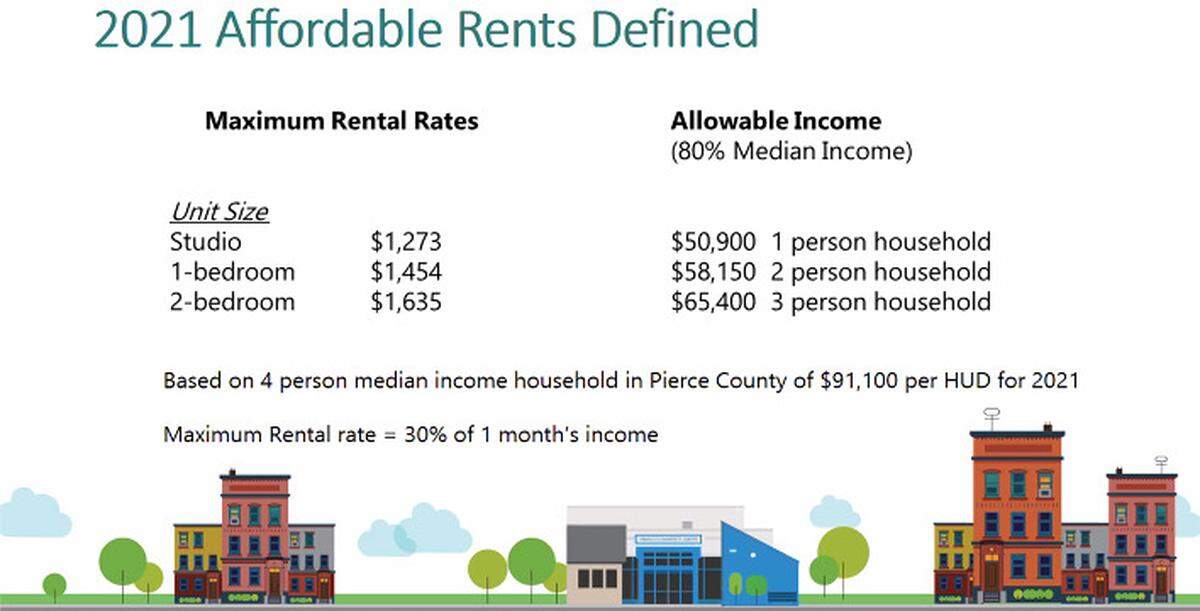
Affordability was a focus of discussion at Tuesday’s meeting. Bingham’s slide deck included a chart that showed the monetary definitions of “affordable” rents based on the formula used by the city.
That formula says that no more than 30% of a household income is used on housing. Bingham told the committee that the state defines low income as families earning at or below 80% of the area median income and moderate income to be households earning between 80% and 115% of the area median income.
“The city of Tacoma has always defined our program to focus on households earning at or below 80% of the Pierce County area median income,” she said. “The median income for Pierce County for a four person household is $91,100.”
Jacques Colon, the city’s strategic manager in the City Manager’s Office for its 2025 vision and plans, told the committee that while incomes are rising, housing costs are rising faster.
“Incomes have been growing, like I said, not even close to the rate at which housing prices have grown,” Colon told the committee.
“One of the things that’s allowing those rates to go higher is comps and comps continue to rise. And one of the things that we struggle with ... is the percentage of people’s income that’s being paid to housing is growing, too. So it’s not just the income that’s rising, it’s also the percentage of people’s income that is being put toward housing.”
He noted, “We’re increasingly seeing 30 percent going to housing becoming less and less realistic for most families, and that’s creeping toward 40 percent, 50 percent.”
The committee will continue its discussion with its Oct. 5 and Oct. 19 meetings. It will meet with what it described as “key multifamily property stakeholders” Oct. 5 and will consider policy options Oct. 19 with an aim toward final recommendations either at that time or a later date.