Tacoma community hub acknowledges ancestral land of Puyallup Tribe with these changes
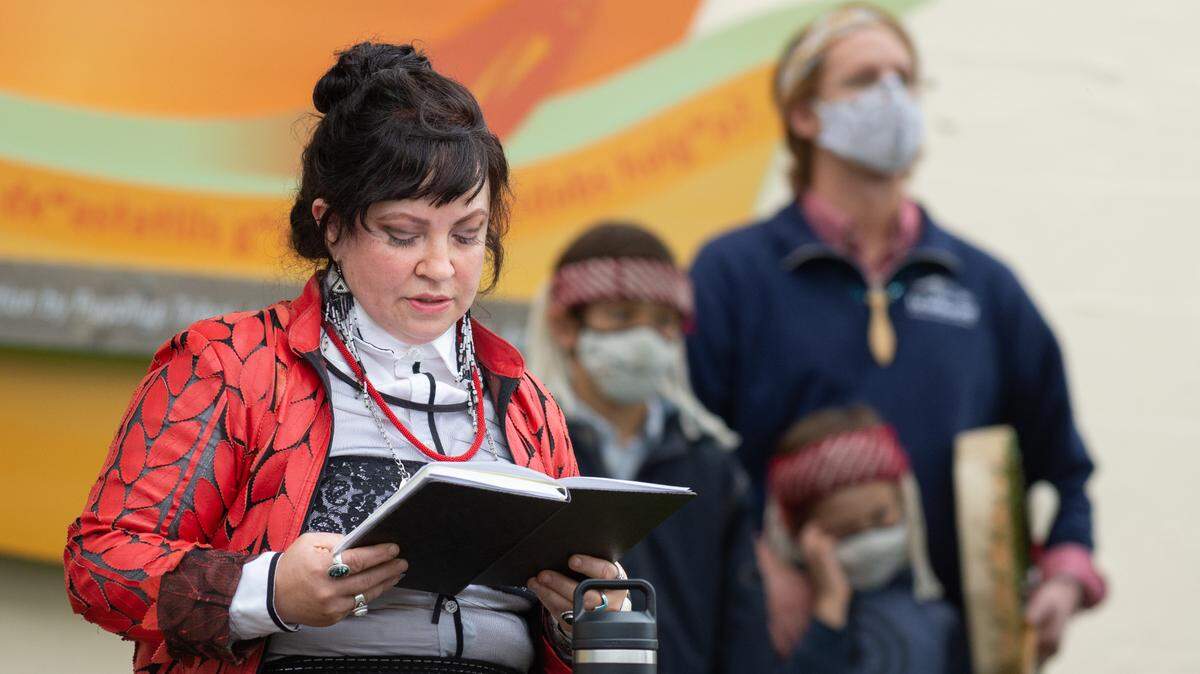
Community hub Alma Mater in downtown Tacoma unveiled a permanent land acknowledgment installation by Salish artist Paige Pettibon Wednesday, Sept. 29. Written in the Lushootseed language, the acknowledgment recognizes the Puyallup ancestral lands and was developed alongside the Tribe’s language department.
Pettibon said she was contacted by Alma Mater’s Executive Director Lisa Fruichantie, who had a clear vision for the piece. It was fabricated by a local metal working shop from a digital image.
“We wanted Coast Salish salmon literally facing the water. (Fruichantie) wanted it to not be confined to a standard rectangular or circular sign, so we did a cut-out of a wave to provide a fluid movement. And we knew the Lushootseed had to be the prominent feature,” Pettibon said.
Pettibon has studied Lushootseed — the language spoken by 13 Tribes in the Puget Sound region, according to the Puyallup Language Department — for about five years. She said the Lushootseed words for the land acknowledgment were workshopped with Puyallup Language Department Director Amber Hayward.
The acknowledgment, on both the installation and Alma Mater’s website, reads:
“ʔuk’ʷədiitəb ʔuhigʷətəb čəɫ txʷəl tiiɫ ʔa čəɫ ʔal tə swatxʷixʷtxʷəd ʔə tiiɫ puyaləpabš dxʷəsɫaɫlils gʷəl ʔutxʷəlšucidəbs həlgʷəʔ.”
“We gratefully acknowledge that we rest on the traditional lands of the Puyallup People where they make their home and speak the Lushootseed language.”
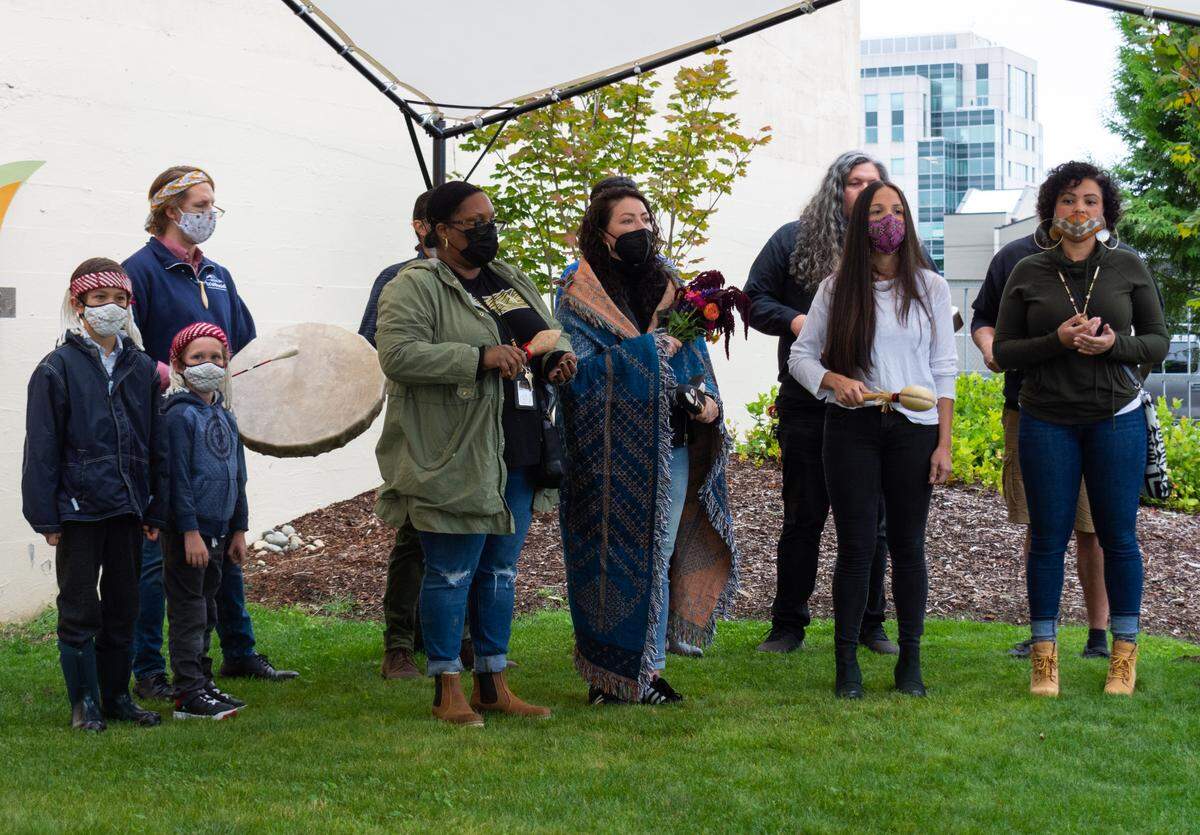
Hayward and the department led two songs at the ceremony, where Fruichantie presented Pettibon with a blanket.
Fruichantie, a citizen of the Seminole Nation of Oklahoma, said the land acknowledgment was important to her as both an Indigenous woman and a business operator on Puyallup land.
“Being a non-Puyallup Native, I wanted to honor them while putting my own personal reflections into it,” she said.
In her speech, Fruichantie shared a realization she made when she watched the hit TV show “Reservation Dogs,” a series following four Indigenous teenagers in rural Oklahoma. The show, which recently completed its first season, was a seismic move for Indigenous representation both in front of and behind the camera.
“I remember in the first episode, the guy on the radio station said a few words in Creek — our Muscogee language — and it really impacted me. So I’ve been thinking about what it would be like to have an opportunity to be Puyallup and see your language showcased in this way,” she said.
Fruichantie shared that her grandmother was the last fluent speaker of Muscogee in her family. When she was growing up, language revitalization “wasn’t even a concept.”
“Language is what connects all of us. Seeing that as what’s the basis of our communities, I wanted to ensure that I had a personal connection to myself and my own story,” she said.
Under Fruichantie’s leadership, Alma Mater’s restaurant, The Patio, is shifting to include new seasonal additions in an effort to enrich the philosophy, awareness and advocacy concerns surrounding Indigenous food ways.
“On this day of land acknowledgment, my hope is the contributions I have send a message that it’s not necessarily about what we eat and how we eat, but how it’s foraged and shared,” said The Patio’s Executive Chef Ramon Shiloh, who is of Creek and Cherokee heritage.
The Patio has begun to serve a few of these dishes on its afternoon menu, including sweet and savory frybread, a bison burger and bison stew.
BEHIND THE STORY
MOREPlease help support this reporting
Natasha Brennan covers Washington state tribes’ impact on our local communities, environment and politics, as well as traditions, culture and equity issues, for McClatchy media companies in Bellingham, Olympia, Tacoma and Tri-Cities.
She joins us in partnership with Report for America, which pays a portion of reporters’ salaries. You can help support this reporting at bellinghamherald.com/donate. Donations are tax-deductible through Journalism Funding Partners.
You can sign up for her weekly newsletter here.