New Clover Park School Board member compares himself to Virginia’s Glenn Youngkin

A Clover Park School Board race has become an epitome of board elections across the country: a longtime member losing to a dark horse candidate with political backing.
The board’s seven-year president, Marty Schafer, was voted out last month by 88 votes, replaced by a newcomer who has never held public office.
Board member David Anderson, the school board’s newest addition, was sworn in to office on Dec. 13 after months of rigorous campaigning and more than $10,000 spent.
The Washington Association of School Administrators’ Executive Director Joel Aune said he fears the increased politicization of school boards.
“We have seen a disturbing trend of increasing numbers of individuals getting onto school boards, and bringing some of that lack of civility that’s coming on to the board now with a higher degree of frequency than what we’ve seen,” he told The News Tribune. “It’s got our attention, and it is concerning.”
The pandemic’s impact on students learning — first remotely, then in masks — has divided communities. Anderson acknowledges that politics have helped his campaign. He said voters wanted to know his political allegiances more than his solutions to concerns.
In an interview with The News Tribune, Anderson compared his run to Virginia’s gubernatorial race, where Republican Glenn Youngkin narrowly won — largely on his education platform to promise more parental control of education.
Youngkin’s competitor, Terry McAuliffe, told Virginia he didn’t “believe parents should be telling schools what they should teach” on the campaign trail, which became a focal point of negative ads by Youngkin.
“It’s a tremendous help to know that parents and the people want control of their child’s education,” Anderson said. “If we don’t respect people for their decisions there is a huge pushback and Terry McAuliffe paid that price. He said parents don’t have a role in their education, that’s why he lost.”
University of Washington Political Science professor Mark Smith said this isn’t the first time a vocal minority has rallied against school boards. He recalled Christian coalitions in the 70s, and 80s pushing school boards to teach creationism instead of evolution. With not many tuned in to school board politics, Smith said a campaign doesn’t have to have the majority to be effective.
“It doesn’t take that many people to shift things when there aren’t that many people paying attention. An energized minority can really affect the board politics,” he said.
Schafer was on the board for 16 years. He worries that this race is part of a larger trend in school board races. Schafer, who identified himself as a conservative, said school boards are not the place for politics.
“When you start ceding public schools to politicization, public education is in the balance,” Schafer said.
The campaign
Anderson’s supporters put in hundreds of hours of work to unseat the president of the school board.
Anderson and his volunteers say they knocked on 10,000 doors, while sharing his “ABC” platform. As a school board member, he wants to “advocate” for listening sessions between school directors, parents and teachers, “bring” discussions about best practices from schools across the country, and “challenge” the status quo through informed discussions and encouraging debates.
“It’s not just their vote. I go door to door to hear their voice,” Anderson said. “ People would say their number one concern is [the board members] don’t listen, and that’s why I am here.”
He joins a board with varying levels of experience. President Alyssa Anderson Pearson has four years on the board, Vice President Carole Jacobs has 22 years, Paul Wagemann has 12 years, and Anthony Veliz has two years of experience on the board.
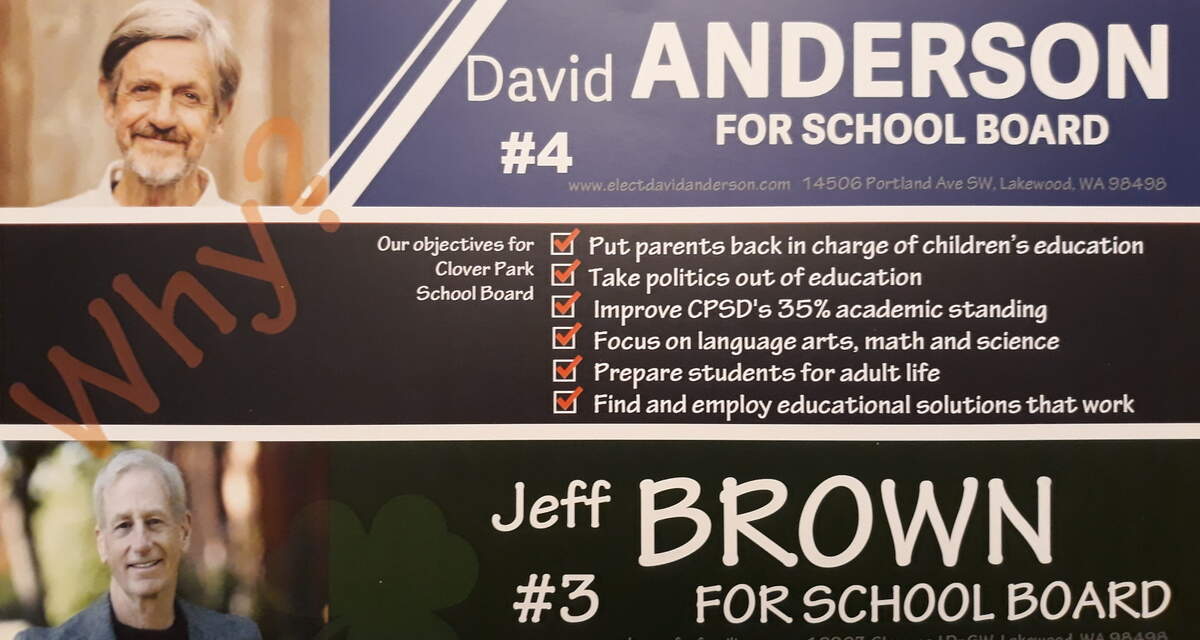
Anderson reported collecting more than $10,000 for the school board campaign, most of which was spent on flyers, according to his campaign expenditures with the Public Disclosure Commission.
Schafer did not report his campaign finances, declaring that his campaign fell under the “mini reporting” requirements. The state allows for campaigns that collect fewer than $5,000 to be exempt from campaign filing reports.
Looking back, he regrets his decision.
“We weren’t prepared for this fight,” Schafer said.
Mailers and flyers were the biggest source of Anderson’s expenses, according to PDC filings.
One of the mailers claimed that Clover Park was in the lowest third of Washington schools according to a privately-owned school ranking site based on test scores. The Office of the Superintendent of Public Instruction records student assessment for all districts across the state, but does not rank them.
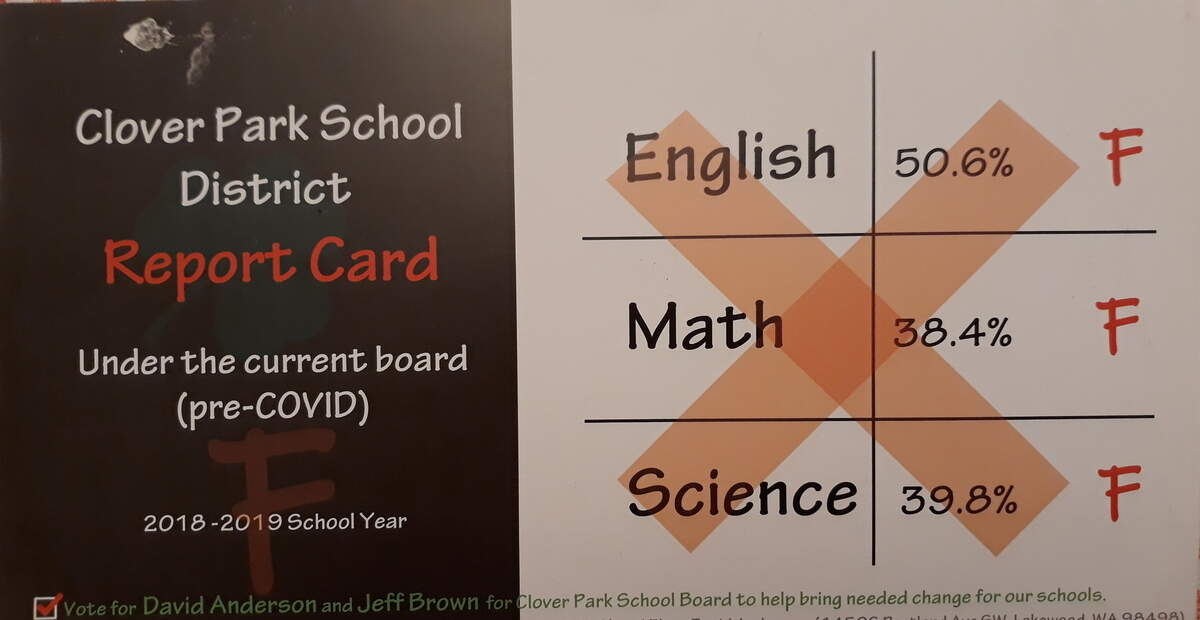
Another mailer used test results reported by the state to give Clover Park an “F” in English, math and science with 50.6 percent, 38.4 percent and 39.8 percent, respectively, of students meeting standards. According to the state assessment, Clover Park’s English, math and science assessments in 2019 were ten points or less under the state average, receiving about the same test results as Tacoma Public Schools.
To improve lower test scores, Anderson said the district should hold parent-district meetings and offer more “school choice.” School choice would offer families public vouchers to wherever they choose to be educated — charter, public private or home school.
He also wants to see schools promote more alternatives to college after graduation, through more programs in middle and high school to encourage professions in trades and services.
The district’s graduation percentage rates increased from the mid-60s to the high-80s during Schafer’s tenure. He disagrees with school choice being a solution for a school board. If all students receive the same amount of funds, that allows for equality, not equity.
“Some people need more help than others,” he said.
Schafer believes Clover Park students’ needs are different than most other districts across Washington. The district holds a much higher rate — 20.4 percent — of low income students than the state average, and slightly higher rates — about 2 percent — of English as a second language learners and students with disabilities. Almost a third of Clover Park students come from military families, the Office of the Superintendent of Public Instruction data said.
One of Anderson’s biggest concerns on the campaign trail was the “lack of transparency” of the board. He wants more than just three minutes of public comment per person at each monthly meeting. He believes that the board should hold monthly listening sessions with parents.
The district has created engagement groups and programs in the last few years to increase communication.
About six years ago, the district started the Parent Connections Council to open communication between parents and the district. Parents meet quarterly to discuss concerns, district spokesperson Leanna Albrecht said.
“As a district, we are committed to listening to and working with our staff, students, families and community to support each student’s academic growth and social and emotional well-being,” Albrecht said in an email.
Superintendent Ron Banner holds meetings with five to six students from each of the high schools every other month to discuss topics students want. The school board has also formed a Community Engagement Leadership Team, which is a coalition of community organizations focused on supporting students.
The district has also expanded its engagement with minority groups, like listening sessions on curriculum which introduced the idea of ethnic studies that piloted this fall, Albrecht said.
Political involvement
Anderson’s blog has drawn attention from conservative groups across the country. Several national outlets, including The New York Times, The Washington Post, and USA Today, have reported on nationwide trends of conservative efforts using mask and vaccine mandates and critical race theory to win nonpartisan school board seats.
Before announcing his run for the school board, Anderson wrote a blog post about his friend on the board, Wagemann, using the phrase “crack the whip.” Other board members reprimanded him. Several months later, he was censured by the board for an email calling equity officers “race pimps.”
National, right-wing outlets picked up Anderson’s blog post, including Breitbart News, Washington Free Beacon and Clarion News.
Anderson told The News Tribune he has been attending conferences and webinars of conservative think tanks like Washington Police Center, and the Christian coalition Family Policy Institute of Washington. Volunteers from these groups helped to doorbell for Anderson.
Anderson said he had sought funding from the 1776 Project, a conservative political action committee created in response to The New York Times’ “1619 Project” that addressed times in American history of oppression and racism. He did not receive funds from the PAC, he told the newspaper.
“We are committed to abolishing critical race theory and ‘The 1619 Project’ from the public school curriculum,” the 1776 Project’s about page said.
Typically taught in graduate level courses, critical race theory has become a focal point for many school board races across the country. The theory is an academic movement of civil rights scholars to examine and challenge mainstream approaches to racial inequities and the place of the law in racial justice. Clover Park School District’s former president said the district has not implemented critical race theory.
The new board member differs from many other conservative school board candidates running this year on mask and vaccine mandates.
Anderson says that while he wants personal liberty for all and the freedom of choice for masks and vaccines, he places a higher priority on students returning to the classroom.
“To exist within the law and Governor (Jay) Inslee mandates and OSPI and health recommendations handed down, we are obligated as per my swearing in to uphold those laws,” Anderson said. “I don’t come down on the ‘no mask no vaccine’ point of view so extreme that it lacks the ability to address the fact that people die. At what risk do we want to put our children, our staff, teachers and administration?”
Anderson sees the newly-approved Equity, Diversity and Inclusion Policy as a stepping stone to critical race theory, and he thinks people who share his views have been shut out of the discussion.
“In my opinion, there should have been an open debate for people who believe what I believe and that is intolerable,” Anderson said. “What are students supposed to learn when there is only one-sided information and no debate?”
Clover Park School District’s characteristics are much more diverse than the state average, according to state statistics. The district’s largest demographic is Hispanic/Latino with 35.2 percent, followed by 27.5 percent reported as white and 12.1 percent reported as Black. Statewide, 51.1 percent of students are white, 24.7 percent are Hispanic/Latino, followed by 8.3 percent of students reported are Asian.
Anderson said he would support the policy if there were more clear benchmarks that would create hard targets for successful implementation, like holding a certain number of meetings a year with students on inclusionary practices.
Schafer said it’s hard to create goals on issues that are more about a meaningful impact with students.
The policy includes commitments like to “implement strategies to elevate and empower diverse voices made up of CPSD families, the community of Lakewood and Joint Base Lewis-McChord” and “prioritize partnerships with community-based organizations that are owned, operated by, and/or serves historically marginalized groups.”
While on the board, Anderson said he hopes to provide Wagemann a second vote to move topics forward for discussion. The pair don’t have enough to overrule the three other board members to pass measures, but they can second each other’s ideas to start a discussion.
“I don’t care if the idea is stupid or not, but we should at least have a discussion,” he said.
Wagemann sharing his idea in a board meeting and no other board member seconding is considered listening, even if there isn’t a discussion, Schafer said.
“It’s OK to have a rogue voice on the board. I don’t believe in X, Y or Z, but we have heard you and no one agrees with you. That’s a healthy democratic board,” he told The News Tribune.
The conservative think tanks pushing campaigns to prioritize parental voice and transparency have been successful, because UW’s Smith said those are things most people agree with.
“Most people want to be told that your voice matters. In some ways, this is the expert versus the common person divide. There is that common thought that resonates with a lot of Americans that anyone can become an expert and no one is better than anyone else,” he said.
Despite some of the district’s efforts to encourage more engagement with families, Smith said newcomer candidates can call their efforts “window dressing.”
“It’s more a battle of values and perception and people are constricting idea of what they think is happening in schools rather than what is actually happening, like with critical race theory,” Smith said.
Potential impacts
The Washington Association of School Administrators has been tracking the average tenure of superintendents across the state’s 295 school districts. Over the last five years, the average duration of a superintendent at a district has fallen from 5.2 years in 2016 to 3.9 in 2021.
“That’s a fairly significant shift drop for 295 people,” Aune said.
A superintendent oversees schools in a school district and implements a board’s agenda. Aune, who was a superintendent himself for 20 years, said the job is tough, but it’s become more difficult in recent years due largely to the politicization of the school board and the world.
When more polarized members are voted in, Aune said that can scare superintendents. A school board decides to hire and fire the superintendent.
“So in the blink of an eye, a superintendent’s professional life could change, based on one or two board members that come on, have a specific agenda, good or bad, a specific agenda,” Aune said.
Throughout the pandemic, many superintendents have faced increased backlash over decisions to follow state mandates on mask-wearing, contact tracing, and remote learning. Aune said that has been another factor in the high turnover rates.
“That constant pounding and everyday threats, that starts to weigh on superintendents over time,” Aune said.
Clover Park’s superintendent Banner has not received any threats, but has been the subject of negative social media comments, Albrecht said.
There are consequences for a politicized board, Aune said. Frequent leadership turnover can be hurtful for a school.
“Generally, a lack of continuity and churn does have a negative impact on schools and students in the school,” the WASA Executive Director said. “That’s not in the best interest in students.”
There also could be increased difficulty in hiring new superintendents and principals. When a superintendent is fired or let go, Aune said a board might struggle to find a replacement of the same caliber.
“What we know from those leadership positions is that continuity is a factor in the success of schools,” he said. “If there has been a lot of upheaval that does most definitely make a difference.”
Just as the education debate became a focal point for the Virginia gubernatorial race, Smith, the UW professor, predicts these issues will reach state and local government races.
“There has been a trend of people running for local races to take stances on national issues that are in question and might not have authority over,” Smith said. “Youngkin’s playbook was successful and other candidates see that and want to follow it.”