Millions of dollars and 3,000 blocks later, how has voter-approved streets initiative fared in Tacoma?
In 2015, voters in Tacoma approved a 10-year package of taxes to raise $175 million to fix city streets.
At the time, the goal was to have 5,600 blocks of Tacoma streets be either re-paved or have maintenance treatments, out of a total of about 8,000 blocks.
Now, more than halfway through the initiative’s 10-year timeline, what has the city accomplished?
According to the streets initiative website, nearly 3,000 blocks in Tacoma have had improvements.
In an interview with The News Tribune in December, city of Tacoma pavement manager Erik Sloan said that the city is on track to its 5,600-block goal, but not without some challenges, like the COVID-19 pandemic.
“2020 was a bit of a setback, and we’re playing catch up,” Sloan said. “But even so, we’re still a little more than halfway there with the block counts.”
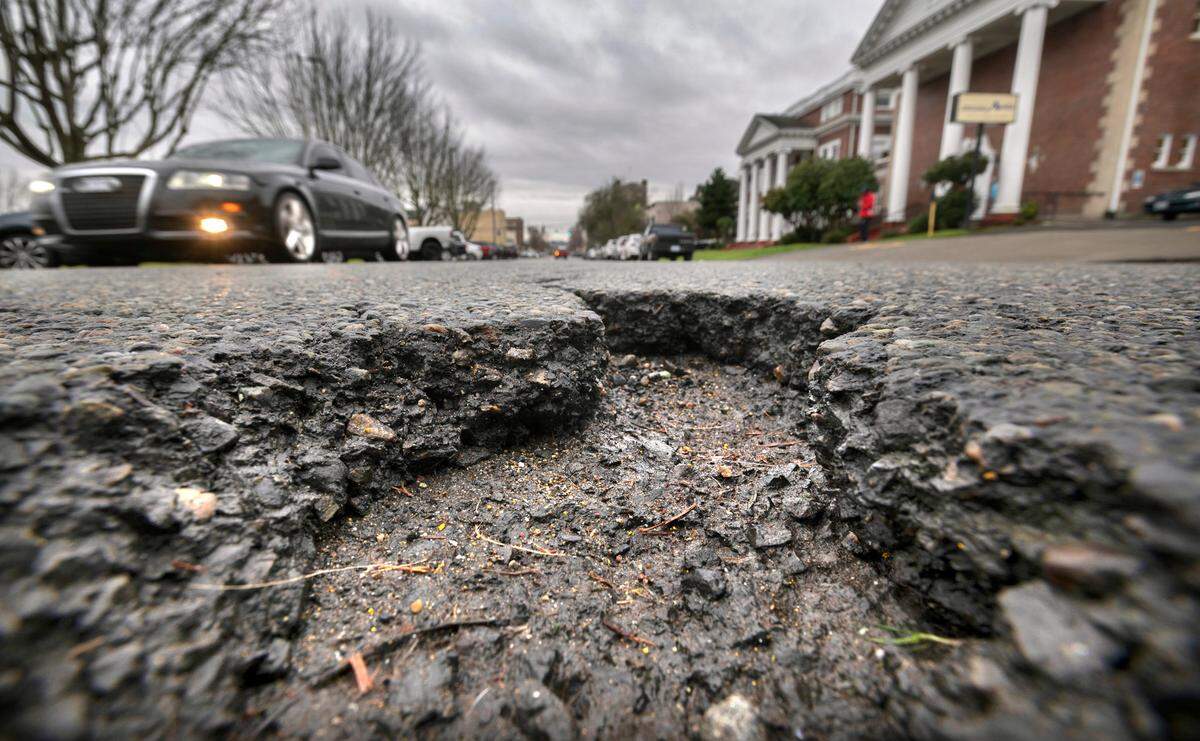
Despite the work so far, there’s still more to be done. Potholes can always form after bad weather and general wear-and-tear on a well-used road.
Some Tacoma residents who voted in favor of the streets initiative in the hopes of getting their roads fixed feel their expectations have fallen short and are considering whether to vote for a similar initiative in the future if the city decides to run one again.
Mixed results
The street outside Mitch Robinson’s home in Tacoma’s North End looks a bit like Swiss cheese.
According to Robinson, North 5th Street has looked like that for some time.
“As I understand it — and I’m not an engineer — but this street has failed,” Robinson told The News Tribune outside his home in February. “There’s no integrity to it, which means it’s not really about potholes. You can kind of fill in a pothole quickly, but that’ll fall apart too.”
Robinson said that generally, the city is quick to respond when it comes to potholes. If you need to report one, you can do so through the city’s 311 system for non-emergencies.
“I had some, put in a request last week — they came out the same day. So that’s fantastic,” Robinson said.
City staff credit that quickness to the streets initiative funding. Rae Bailey, Tacoma’s street operations manager, told The News Tribune’s Craig Sailor in January that overall, Tacoma’s pothole landscape is shrinking, lessening the number of potholes by half. The city filled 9,700 potholes in 2021, compared to 22,500 in 2017.
Aside from potholes, when it comes to the plans and timelines for renovations of entire streets, Robinson said the city lacks transparency. For one, city staff have not updated the map and project list on its streets initiative website (tacomastreetsinitiative.org), Robinson said, and he can’t see which projects have been completed and which are coming up.
“I have no sense of hope that this street will ever be fixed — and I’ve been here 22 years driving on it,” Robinson said. “When will there be some hope for residents that haven’t had things done yet?”
City staff say work to improve the Streets Initiative Dashboard is underway, and it will be updated soon. The performance and financial information on the top of the website is current as of December 2021 and has been updated on a quarterly basis.
Kim Knox, another longtime resident of Tacoma, was driving along North 30th Street in December in the pouring rain when she hit a pothole at Huson Street.
“This happened in the evening when it was dark and raining. I never saw it until it was too late,” Knox said.
Like Robinson, Knox noticed the city was quick to fix the pothole but said it reappeared several weeks later.
Knox filed a claim with the city for a bent rim, and the city ended up covering about half of her $340 bill. People can file a claim for damages against the city through the city clerk’s office by filling out a form online or calling 253-591-5505.
Knox said that since voters passed the streets initiative, she hasn’t noticed too much of a difference and that there are still many North End streets that need repairs. Knox pointed to the intersection of North 26th Street and North Orchard Street in Tacoma as having a pothole problem. The city of Tacoma knew it to, and sent out a team in January to fill it.
In an interview with The News Tribune, Sloan said there are a number of factors that go into deciding which streets get improvements, and when.
One of those is funding: How much improvements to a street will cost, and how much funding the city has available. Another factor is the life cycle of the road: Crews want to make sure they maximize the investment of a road before repaving it. But waiting too long could mean it costs more money to fix. Roads might jump the priority list if the city receives grant funding to be used in a specific time period.
It also depends on where crews are already working, Sloan said.
“Maybe the life cycle (of a street) is telling us that it’s going to be another two years before it needs a sealcoat but we’re working on one block away — might as well catch it now,” Sloan said.
The city also coordinates with Tacoma Public Utilities for major roadwork projects, so as not to have TPU dig up a road to replace a pipe after it’s just been repaved.
Speaking specifically about the roads near Robinson’s home in the North End, Sloan said there is utility work that needs to be done there first.
“North L Street was initially slated to be repaved as a part of an earlier Streets Initiative project but there were some utility issues that had to be resolved first,” Sloan said in a statement. “Those improvements are still pending so paving is on hold for now. A good portion of North M Street in this neighborhood is concrete and repairs have been made on some sections as a part of Streets Initiative projects. Asphalt sections will be reviewed again as future projects arise.”
City staff also consider the condition of the road and the type of work needed in deciding which roads to tackle. The city provides three different improvements: surface treatment, preventative maintenance and overlays. treatment, maintenance or overlays.
So far, the city has given:
1,261 blocks the “surface treatment,” where a layer of hot liquid asphalt is laid down with a layer of gravel that is then rolled into the asphalt. According to the city’s website, “this treatment is used on streets that are showing signs of wear and is used to seal and even out cracked surfaces and provide a wearing surface.”
866 blocks “preventative maintenance,” where cracks in the street are cleaned and filled with an elastic rubber-based material to prevent moisture penetration.
825.5 blocks overlays, meaning that an existing street surface is ground down and a 2 to 3 inch layer of asphalt is laid down. According to the city, “overlays are performed on streets that have outlived their serviceable life and typically require continuous pothole repairs.” These usually take a longer amount of time to complete - weeks as opposed to days.
Right now, the city is looking at conducting a new pavement management assessment, which measures the distress of roads in Tacoma. The last one was completed right before the streets initiative was passed in 2015.
“Our goal is to bring a consultant on board to survey the streets this summer,” Sloan said. “The survey itself doesn’t take long but validating the data and uploading it into the pavement management system takes a few months. We don’t anticipate having new data until sometime around fall/winter of this year.”
Along with work on the city website and the new pavement assessment, staff wants to be more intentional about where street projects are being completed and take into account the city’s equity index, which shows areas in Tacoma that historically have had low equity opportunities, including the South End and Eastside neighborhoods. A quick glimpse on the city’s online map shows a fairly equal street project distribution among neighborhoods, but the city intends to show those statistics more clearly, Sloan said..
Sloan understands people’s frustrations with wanting specific roads fixed, but that he doesn’t want to give anyone the impression that they’ll be able to fix every single residential street in 10 years.
“There’s always more need than there is funding,” Sloan said.
Looking ahead
It’s possible that at the end of the 10-year streets initiative, the city will return to voters to pass another.
“The intent is to kind of take what we’ve done here and build on it, and go back out to voters and kind of show them what we do, or what we’ve done. And, you know, kind of ask for their support, again, to, to continue on with our programs,” Sloan said.
The question is, would it pass?
Voters approved two propositions for funding street improvements in 2015. Proposition 3 collects funds through an increase in property and utility gross earnings tax, while Proposition A collects funds through an increase in sales tax.
At the time, the propositions didn’t have overwhelming support. While Proposition A passed with 57 percent of voters, Proposition 3 barely passed with 50.03 percent of voters saying yes. Fewer than 30 votes out of 35,000 separated a “yes” from a “no.”
Sloan hopes he’ll be able to continue the work, but there’s no guarantee.
“My job as pavement manager is just to try and do as much good with the funding that we have while we have it as we possibly can,” Sloan said.
Knox said that she supported the streets initiative and probably would again, with the hopes that the streets she wants to see fixed will be in the future. Robinson was also a supporter of the streets initiative measures when they went to voters in 2015. When asked if he would vote on it again, he said it depends on whether the city can do a better job communicating what it’s done so far.
“I’m very happy with some of the things that have been done in the city. It’s been a huge improvement. But at the same time, if your street, wherever you are in Tacoma, hasn’t been touched, you’re not communicated with, that makes you feel like, is the money being well spent?”
This story was originally published March 1, 2022 at 5:00 AM.