New mapping shows I-5 through Lakewood could be inundated by flooding of Clover Creek
New maps estimate a 100-year flood could put Lakewood’s section of Interstate 5 under three feet of water and submerge some neighborhoods.
The City of Lakewood published a new floodplain map Wednesday after staff questioned the accuracy of previous flooding predictions by the federal government. A 100-year flood of Clover Creek, or a flood that has a 1 percent chance of happening every year, could spill into the northwest and southeast areas of the city, according to Lakewood.
“If a major flood event were to occur, property and infrastructure damage is likely in identified areas,” according to a Lakewood press release.
Clover Creek flows from Frederickson through Spanaway and Parkland into Lakewood and out to Lake Steilacoom. As the last stop before reaching its output, floodwaters from Clover Creek would impact Lakewood the most.
“Downstream, the worst effects would be felt here,” communications manager Jim Kopriva said.
The city hired a consultant for $49,786 in 2019 to review and update the Federal Emergency Management Agency (FEMA) flood maps based on data from the early 2000s.
The new map estimates much of the water would pool in a rectangle shape around Interstate 5. The highway between Bridgeport Way and 47th Avenue Southwest could see two to three feet of water during a 100-year flood.
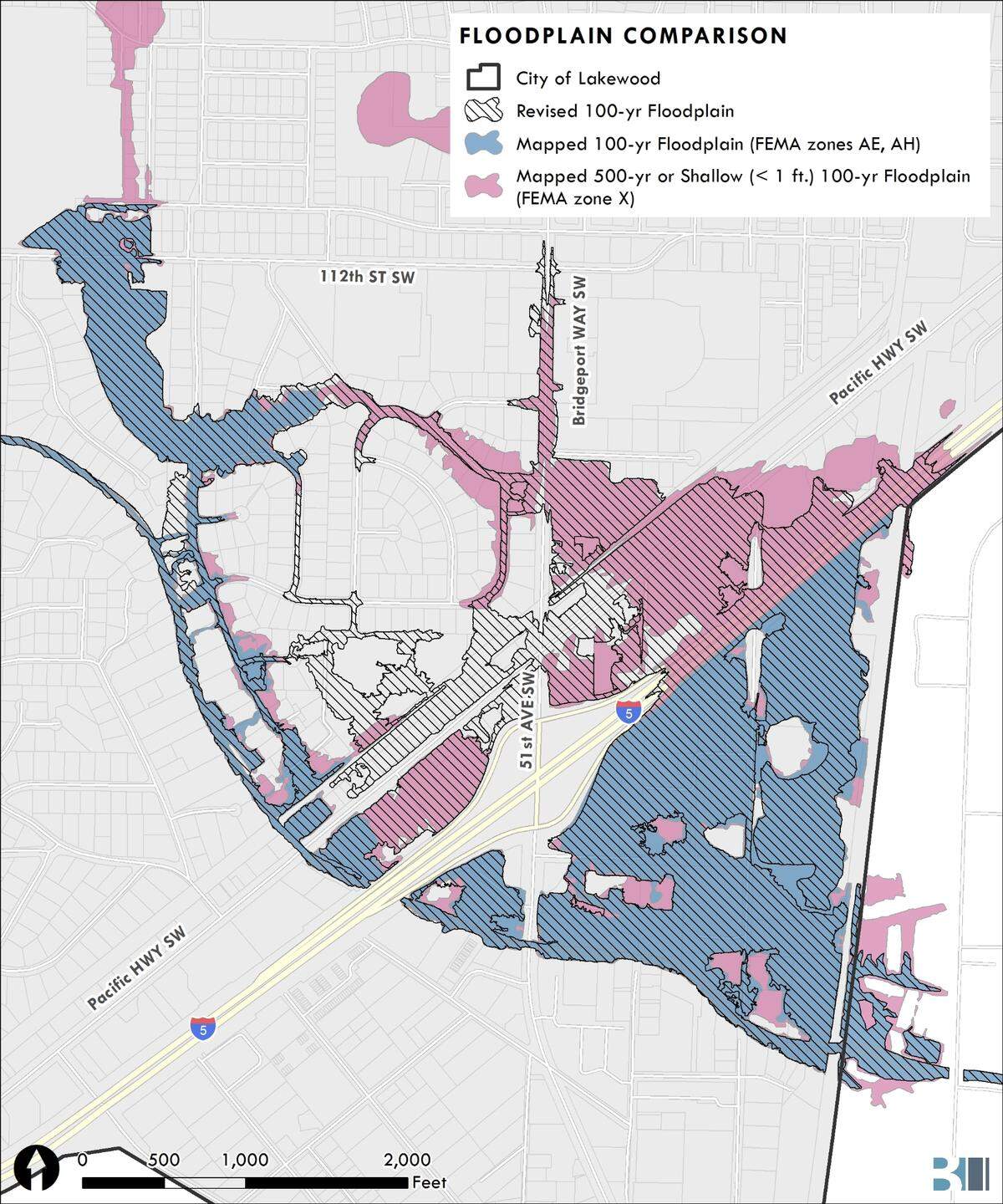
Nearby neighborhoods of Springbrook and Hillside likely would see more water — between four and seven feet spilling from the Clover Creek. Lakewood plans to notify about 570 residences and businesses in those neighborhoods by mail, Kopriva said.
A handful of areas in the floodplain map could see more than 10 feet of water, but Kopriva said most are parking lots or industrial areas.
He told The News Tribune that the city’s public works staff noticed that FEMA flood maps labeled the floodplain as stopping right along Interstate 5.
“It stopped conveniently along I-5 before, but we have no flood wall and no protections right now. It made no sense,” Kopriva said.
The federal emergency agency said it has no current mapping study in Lakewood and looks forward to working with the city.
“Our role would be reviewing what the city submits and making sure it meets FEMA standards,” the agency said.
The highway does not have proper stormwater drainage for feet of water, Kopriva said.
“We need to improve infiltration and prepare I-5 to reduce risk of flooding,” he said. “Our streets are not prepared for the exodus of traffic. We don’t have a convenient bypass to I-5.”
The highway is under the Washington State Department of Transportation’s jurisdiction. Spokesperson Cara Mitchell said that area of Interstate 5 is not known to be prone to flooding, but WSDOT is aware of and tracks its inclusion in the FEMA 500-year floodplain.
“The most recent study FEMA performed was in 2017 where the area north of the Bridgeport Way interchange is predicted to be inundated by 1 foot or less in the 500-year storm event,” she said in an email.
WSDOT is prepared to handle flooding, Mitchell said.
“If flooding were to happen, our crews would close the interstate for life safety measures until the water recedes,” she said. “We would reopen the roadway once we know that water levels are receding. The roadway would be inspected prior to reopening.”
The city has recommended that the owners of homes and businesses in flood-prone areas purchase flood insurance. Many insurance companies do not offer flood insurance, so the federal government offers the National Flood Insurance Program. Most of Washington is eligible for flood insurance, according to FEMA. Federal law requires areas listed in identified flood zones to purchase flood insurance.
Lakewood is starting to form a coalition of stakeholders, including the WSDOT, FEMA, Pierce County and neighboring communities.
“Lakewood alone can’t solve this. It would take days to clear,” Kopriva said. “It affects more than just Lakewood.”