WA state, federal officials urge a quick response to I-5’s Nisqually River flood risk
Finding $4.2 billion to overhaul the Interstate 5 bridge across the Nisqually River has become a new priority, Washington state and federal officials told reporters Monday.
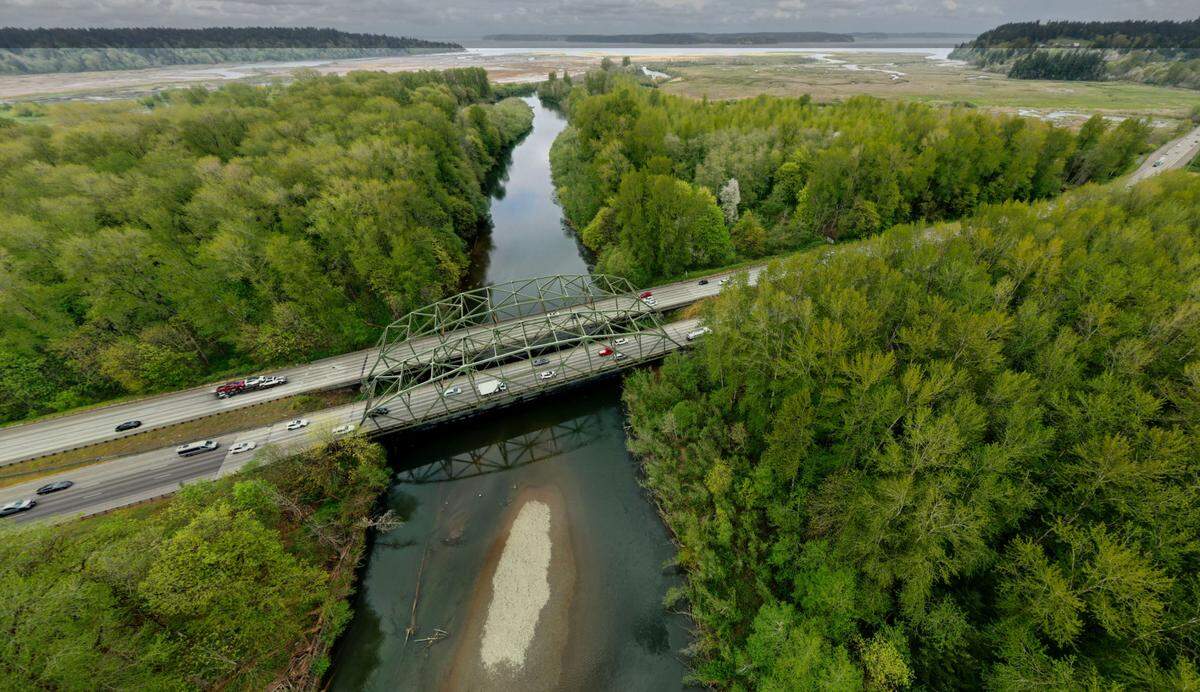
A decision 60 years ago to fill beneath most of the bridge with dirt, rocks and concrete has combined with climate change effects to put a 2.5-mile stretch of highway and the Nisqually Valley at flood risk.
Gov. Jay Inslee told reporters the ramifications of a choked river pose safety concerns for commuters, national security risks by constricting access to Joint Base Lewis-McChord, and environmental concerns to salmon recovery.
“It is necessary that we do this now,” Inslee said in the Wa-He-Lute Indian School parking lot. “We are racing the river here.”
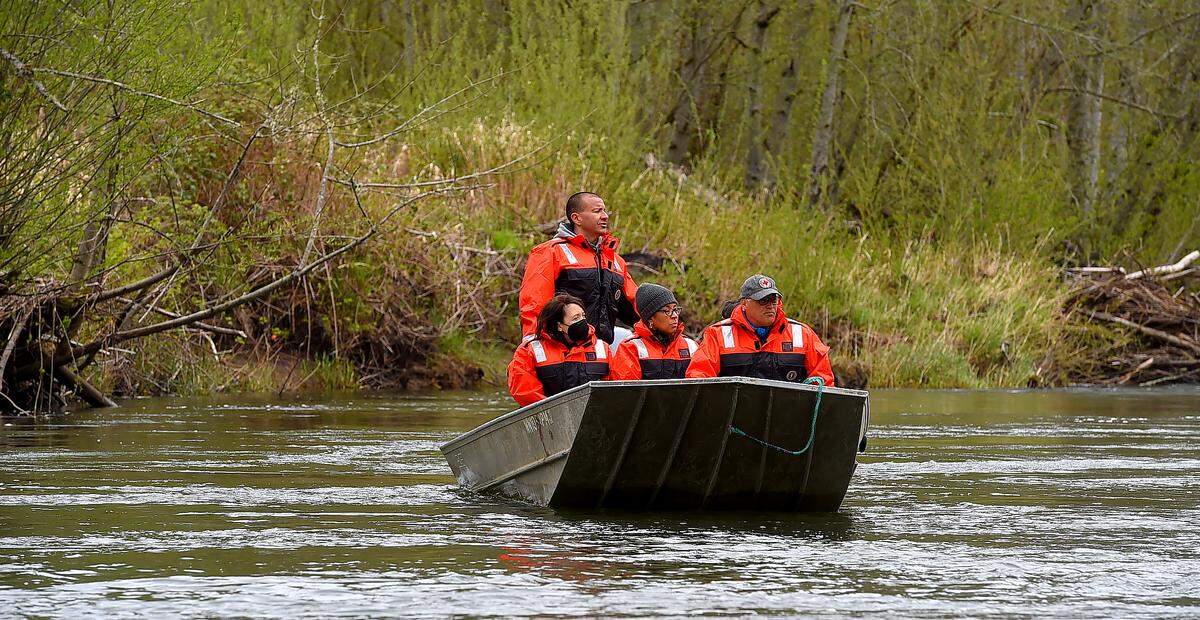
Nisqually Tribal Council, including Chairman Willie Frank III, took Inslee, U.S. Sen. Maria Cantwell and U.S. Rep. Marilyn Strickland (WA-10) on a boat ride on the Nisqually River on Monday, detailing the impacts of the highway bridge and climate change on the river’s path.
The bridge has altered the course of the river over the last five decades and magnified the risk of water spilling onto Washington’s vital highway. Initial models by the U.S. Geological Survey predict a flood could occur within 20 years.
“The timing and extent that I-5 is likely to become vulnerable to the projected changes in sea-level rise and stream flows were evaluated in terms of water levels that will disrupt access to the highway and potentially cause danger to human safety,” USGS scientist Eric Grossman told The News Tribune in September.
Addressing the concerns could become one of Washington’s most expensive transportation projects ever. A preliminary estimate from the Nisqually Tribe of Indians and South Sound Military & Communities Partnership priced the project at $4.2 billion.
The state Legislature this year allocated $75 million to provide another cost estimate and start designing and engineering a new bridge.
The tribe asked the state for $120 million, Nisqually Tribe’s Natural Resource Director David Troutt said.
“It’s less than what we’d hoped for, but we’ll make it work,” Troutt said.
Without the additional $45 million, restoration work of the area surrounding the bridge will have to wait.
“We are still looking to do that, but it will have to be in the future,” Troutt told elected officials.
Inslee and Strickland recognized the cost would be expensive.
“I know these are big numbers, but there is no choice. We have to maintain the I-5 corridor,” Inslee said.
“There is a lot larger cost to do nothing,” Strickland told reporters.
Cantwell said state and federal government need to work together to pay for the project.
Cantwell said she believes some of Washington’s allocated dollars in the 2021 federal infrastructure package can help. The package included money for salmon-recovery projects, bridge repairs and “major projects that are too large or complex” for traditional funding programs, a U.S. Department of Transportation press release said.
“We are hoping to get a game plan together,” Cantwell said.
In December, The News Tribune published a three-part series on traffic, environmental and military concerns tied to potential flooding of the Nisqually.
With no alternative for that stretch of highway, a flood on Interstate 5 would delay traffic for hours and jeopardize access to Joint Base Lewis-McChord. A flooded highway would prevent about 40 percent of military personnel who live south of the bridge from getting to the base, causing a “national security risk.”
The current bridge has also accelerated impacts to the environment. Gabe Madel, the district biologist for the Washington state Department of Fish & Wildlife who oversees the Puyallup and Nisqually rivers, spoke to The News Tribune of the Nisqually River’s importance for the fish.
“It’s the only intact estuary in the Puget Sound,” Madel said. “They head south then turn around and migrate north on their typical journey out to the actual Pacific. Just from that standpoint alone, it’s a pretty important habitat in South Puget Sound.”
If the state does not proactively respond, Troutt said the U.S. Army Corps of Engineers would oversee restoration in the aftermath of a flood.
“They would just add riprap and not address the real problems here,” he told elected officials.
This story was originally published April 11, 2022 at 3:36 PM.