Tacoma students use pens and robots to raise 100,000 fishy research subjects
Some kids have a goldfish to teach them about responsibility. The kids at Tacoma’s Science and Math Institute (SAMI) have 100,000 chinook salmon to care for as they learn about water quality, fisheries and science.
The 5-inch-long chinook fingerlings swimming in a floating net pet anchored off a dock at Point Defiance Park aren’t pets. They’re destined to be released into Puget Sound in late June.
While some of the fish will be enthusiastically caught by fishermen or eaten by orcas, some will make it back upstream to spawn. Just how many is one of the questions this joint research project between SAMI, the Puyallup Tribe, Metro Parks Tacoma, the state Department of Fish and Wildlife and others aims to answer.
Puyallup Tribe
Half of the juvenile fish came from Fish and Wildlife’s Voight Creek hatchery. The others came from the Puyallup Tribe’s hatchery on Clarks Creek, according to Blake Smith, a fish biologist for the tribe.
That’s where another group of students — these from Chief Leschi Schools — worked to harvest the salmon eggs and ready them for rearing.
Normally, fish are released directly into rivers from the hatcheries where they were reared. The chinook at Point Defiance are getting a 6-mile head start. Whether that gives them an advantage or disadvantage is yet to be determined.
“They’re just getting acclimated to the saltwater,” Smith said. “We’re doubling them in size and then letting them go.”
The chinook have been tagged along with another 100,000 chinook which will be released from the Puyallup hatchery as a comparison group. As adult fish from both groups swim back in coming years to their spawning grounds, the survival rates for the two groups will be compared.
The first chinooks will return in 2024. Most will take 3-5 years to return — if they make it at all.
“Everybody loves salmon — the orcas, the birds, the seals, people,” Smith said. “They do have a perilous life.”
In the intervening years they’ll range from southern Oregon to Alaskan waters.
Student caretakers
Chief Leschi students harvested the eggs in September. The eggs hatched in December and in early May, when they were about 4 inches long, the juvenile chinook were put in the net pen at Point Defiance.
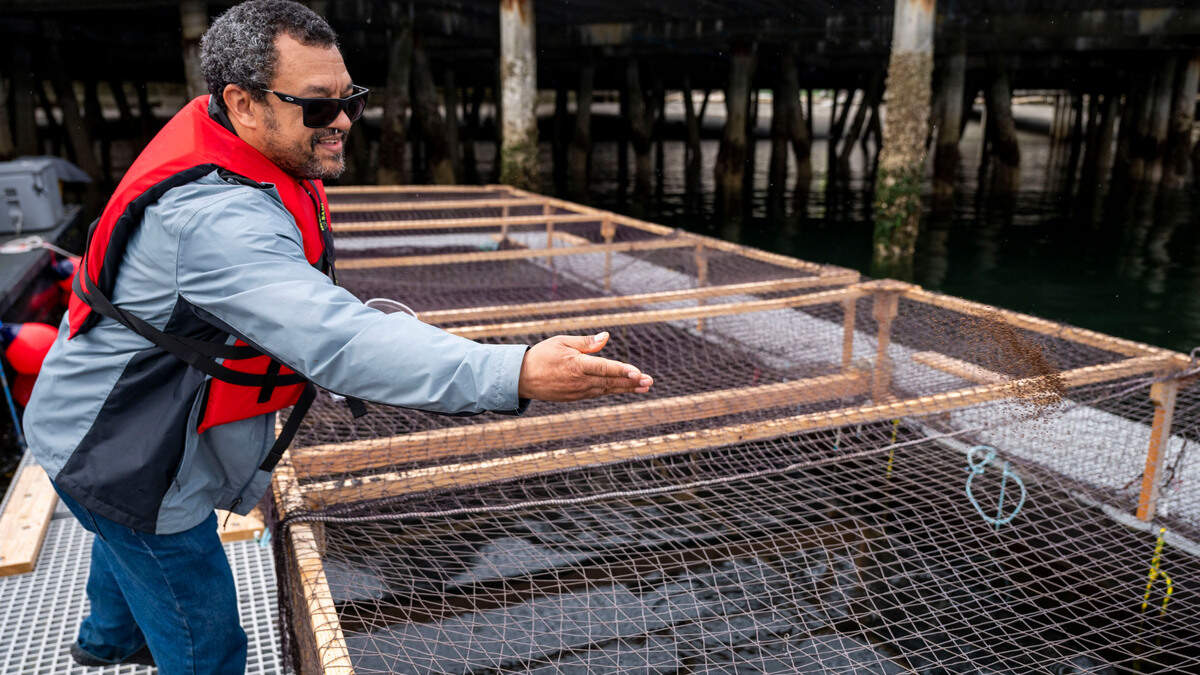
Three times a day, SAMI students and volunteers feed the fish. The water boils when the pellet-sized salty fish food is tossed in the pen.
Matt Lonsdale, a SAMI instructor, said net-pen rearing avoids the usual estuary resting waters that hatchery fish loiter in before heading to the ocean. While that estuary stopover is natural for the fish, it is also a killing ground for many young fish.
“What if we take out that section from the hatchery to the Sound, and we bring them here and raise them in the net pen instead?” he said.
The caretaker students come from Lonsdale’s fisheries class. About 30 students are studying watersheds, pollutants, fishery management and the larger ecosystem. Close to 100 SAMI students have been involved in the fish project in some form, he said.
Few, if any, of his students will go on to have careers in fisheries. Instead, Lonsdale said, the project teaches science, data gathering and analysis and other disciplines.
“Here’s everything that we are learning in class,” Lonsdale said while overlooking the net pen. “Here’s how it actually applies to real life in the real world.”
Water quality important to salmon
Water quality is one of the biggest issues affecting fish populations, Smith said.
“It’s just amazing, the stuff that’s coming into our waterways,” he said of pollutants. Some is from storm runoff and sewage treatment plants. “The pollutants lowers those fishes’ immune system, and it makes them more vulnerable to infections.”
Earlier in the term, students were testing runoff in the park for pollutants. Point Defiance has a new storm water retention system near the park’s entrance that catches oil, nitrates and even caffeine.
Now, students like Isabella Brown and Anthony Haynes are getting to know the animals that are affected by what’s in that water.
“All this stuff that is killing our wildlife,” Brown said.
The students also learn about the role salmon plays in the food chain and their importance to the health of the ocean.
“They are all important to us because we’re one whole ecosystem, and we balance each other out,” Haynes said.
Lonsdale said he’s seen students become increasingly environmentally aware over the last decade. Science, in turn, has been increasing its perspectives, especially the use of Native American knowledge.
“We hope to grow science and include more genders, more sexes, more races, just open science to a more plethora of opportunities,” said student-teacher Andrew Paquin. “Science is best when multiple minds are thinking together. Some of the most important societal issues we face have been solved by not one person, but many.”
Underwater robot
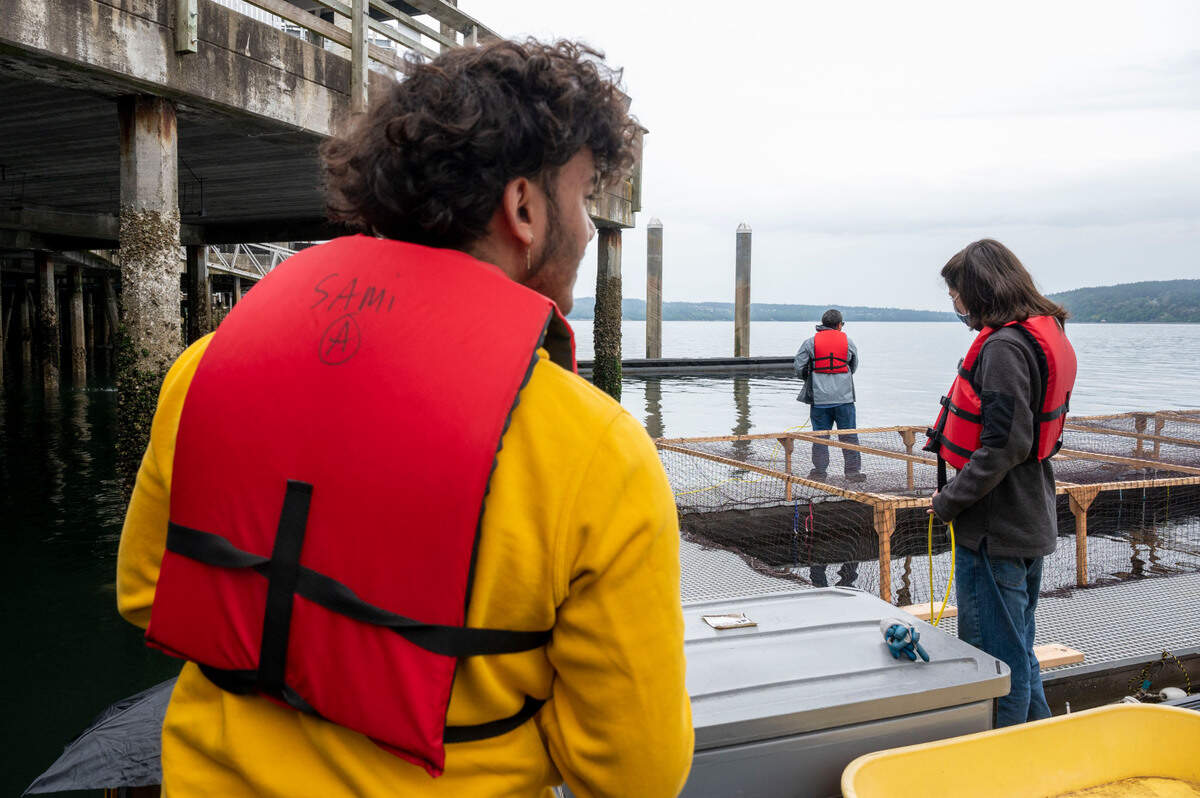
A fine mesh lining keeps the fish inside the 15-foot-deep pen, and a tougher outer net keep predators out.
On a recent semi-dry day, SAMI student Herminio Cabiya, 18, was hunkered down on the floating dock next to the pen, watching a laptop screen. Using video game-style hand controls, Cabiya was operating an underwater robot to check the pen’s integrity.
Nets can be torn by floating debris or, in at least one situation Cabiya saw, an outside fish determined to get inside the net for a tasty salmon lunch.
Water currents and visibility issues make operating the robot challenging. Cabiya often gets the robot stuck.
“It’s kind of hard to steer around. Trying to get clear footage is also an issue,” Cabiya said. “Since the robot is moving, being really close to the net isn’t gonna give good images and being far from the net isn’t gonna get good images, so you’d have to be in a Goldilocks spot.”
Cabiya, a future University of Washington engineering student, has been building robots since his freshman year at SAMI, but he’s been working with his hands long before that.
“I was the type of kid who would destroy toys and then try fixing them,” he said.
This is the first time his class has used an underwater ‘bot, according to instructor Alexis Beard.
“When students learn how to design, build and power ROVs (remotely operated vehicles), they know how we can use technology for specific goals,” Beard said. “In this case, how do we monitor net pens? In the future, we’ll be able to have ROVs that have manipulators on them be able to repair net pens or retrieve objects from them.”
The SAMI students aren’t the only ones interested in salmon.
“We saw a seal swim by earlier while chasing a bunch of salmon so that was pretty cool,” Cabiya said.
The fish will be released into Puget Sound on June 24. Data on the project won’t be complete until 2028, Smith said.
This story was originally published June 7, 2022 at 5:00 AM.