Some Tacoma businesses want electric fences to combat property crime. Will they get them?
The May 17 Tacoma Planning Commission meeting offered a surprise recommendation.
In a process that typically leans toward approving proposals, the commission recommended that the City Council deny approval of a measure expanding areas where businesses could use electric fences without seeking a permit variance.
The proposal is one of two that received a thumbs down from the commission as it considered measures in the city’s Annual Amendment to the One Tacoma Comprehensive Plan and Land Use Regulatory Code.
The recommendations are part of the vetting process before a public hearing June 27, followed by a final council decision on the first and second reading of the 2023 amendment package in July and August.
The other proposal to receive a recommendation of denial was a land use designation change application from the parent company of Mor Furniture For Less.
The fence measure seemed as if it was on its way to getting a green light from the commission, until it wasn’t.
“They were very concerned about safety. So possibly, I shouldn’t have been surprised, but I was,” Jana Magoon, the city’s planning manager, told The News Tribune in a recent interview about the code amendment recommendations.
Steve Atkinson is principal planner with the city and was interviewed alongside Magoon. He also was asked whether the commission’s recommendation came as a surprise.
“You just don’t always know until it’s time to actually vote,” Atkinson said.
How we got here
Magoon said the fences would be “a departure from the direction the city has been going with fence regulations for quite a few years.”
For example, she noted, “chain link or cyclone fences are currently prohibited in between the building and the street in most districts. And the ask was that electric fences be allowed in those locations.”
According to the current code for commercial, mixed-use and downtown districts, barbed and razor wire are allowed only when not visible to public street or adjacent residential use; chain link is prohibited between a building front and public street, “except when necessary to protect a critical area or around a recreational use.”
The Planning Commission’s final recommendation to council came after months of tweaking the electric-fence measure and more than a year after it was introduced for consideration by former councilman Robert Thoms.
“Throughout our city, businesses have raised concerns about increasing safety issues related to their businesses outside of the industrial area,” Thoms said at a November 2021 council meeting.
Fast forward to May 17, 2023, and a different picture emerged from the commission.
In the commission’s recommendation letter to the council, Commission Chairman Christopher Karnes wrote, “During the process, local businesses who could testify as to the need and effectiveness of electric fences were noticeably absent. Having no such testimony, it was difficult for the Commission to evaluate the inadequacies of currently allowed fencing and security measures versus the efficacy of electric fences and their stated public benefits.“
He continued, “The Commission concluded that public safety was of paramount importance and that the introduction of these fences into commercial and mixed-use residential areas was inconsistent with established policies in the One Tacoma Plan.”
After making a motion at the May 17 meeting to recommend the council deny approval, Commission Vice Chairman Andrew Strobel was blunt in his assessment and the Planning Commission’s role in the process.
“I know sometimes the Planning Commission is sort of seen as the JV League, if you will, to the City Council and how we are engaged, even though we do a lot of the work here to do the code and ... really go in depth on the discussion of these topics,” Strobel said at the meeting.
Strobel continued that the commission was “not really hearing robust discussion coming back from the business community and why existing security measures that are allowed throughout the city don’t fulfill some of their current needs, and how these fences somehow supplement or include additional security, that that is going to be a net change for preventing crime or property.”
A wider expansion of electric-fence use also raised what Atkinson described as “compatibility concerns” for the commission.
“All these districts that we are looking at expanding allowances for electric fences are mixed-use districts,” he said. “They allow a very broad range of uses ... from mid- to high-density residential, multifamily, parks and recreation facilities.”
The challenge, he noted, became a question of “how to integrate in electric fences to help respond to existing businesses that are being impacted, while still ensuring that as those neighborhoods and those areas change and grow ... with the expectation you have a lot of people on the streets and will have a lot of people living in those districts next to these uses.”
In the end, “there was a lot of concern with that,” he said.
In the recommendations packet submitted to the city, the commission notes that it “finds that the code does not adequately address public safety and that a disproportionate number of fences would be located in already overburdened neighborhoods.”
Business feedback
Strobel, at the May 17 commission meeting, also stated, “I have never really engaged in a process where largely, we’re developing a code based off of the involvement of a company that wants to sell more of their product in the city. And I find that troubling.”
When asked about that, Atkinson told The News Tribune, “They’d been primarily hearing from folks really sort of lobbying on behalf of a company that manufactures the product and is looking to expand the ability to sell that product to different customers.”
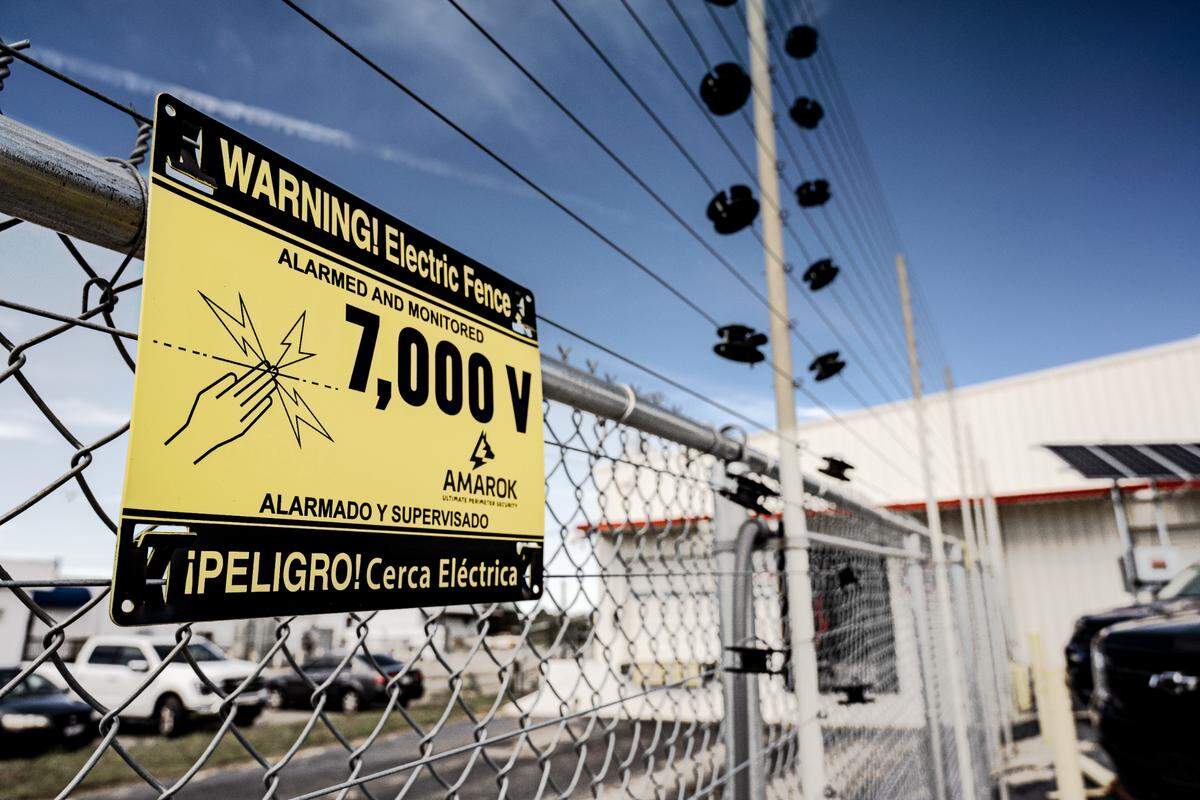
That company, AMAROK, is based in South Carolina and supplies electric fences for businesses. Nathan Leaphart is chief financial officer and senior vice president of government relations for the company.
In response to questions about the commission’s decision, Leaphart said via email, “We were surprised and disappointed by the recommendation of the Planning Commission during the May meeting.”
He added, “In contrast to the statements in the Planning Commission’s recommendations, local businesses have been actively requesting this amendment. During the April Planning Commission meeting, two local businesses attended and spoke in support of the amendment. A third local business sent a letter in support of the amendment. Notably, nobody has spoken in opposition to this amendment.”
Randy Ehli, CEO of Ehli Auctions in Tacoma, was one of the speakers at the April commission meeting where a public hearing was held on the different proposals in the code amendment package. In his testimony, he said his business near 94th Street and Pacific Avenue had experienced “significant losses” in the 12 months it had taken the city to consider the measure.
He told the commission that his business suffered “over $45,000 in theft and damages.”
“They steal trucks. They run through our gates ...We didn’t have a fence when we started leasing there in 2008, not even a cyclone, and we hardly had any issues,” Ehli said. “However, since the city’s lack of focus on tackling property theft, we have no choice but to request use of commercially available electric fences.”
A representative for Aqua Rec’s Fireside Hearth N’ Home in Tacoma told The News Tribune that she credits electric fencing for dramatically curtailing crime at the Puyallup Avenue business.
The business was able to get fencing for their property through the city’s current permit regulations and worked with AMAROK.
The city is aware of Aqua Rec’s fence, using a photo of it as an illustrative example in the discussion packet with the commission.
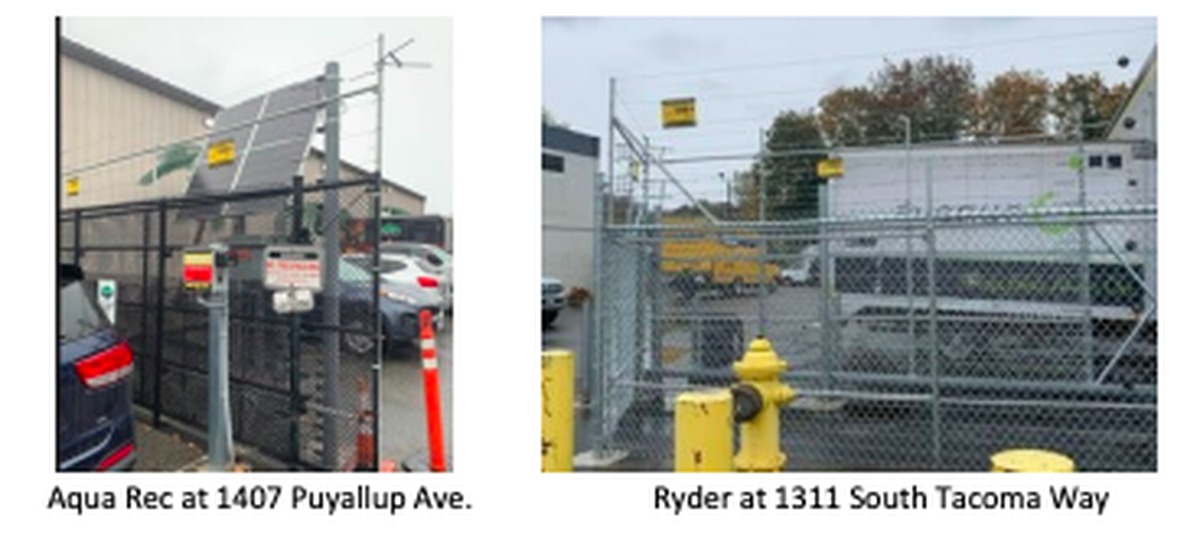
The fence “has cut down 100, no 200% of the crime from our business,” said Jamie Rasmussen, financial controller for the business.
Before the fence, “From our business, we lost 18 catalytic converters, which is $1,000 deductible on our auto insurance,” she noted, adding that the company didn’t file a claim “because that would have probably canceled our insurance.”
“So that’s at least $2,000 to $5,000 apiece, per vehicle to have those replaced,” she said. Previously, “they were going over the fence from the railroad tracks. They were breaking into our warehouse.”
Now, she said, “They don’t do that anymore. We have zero crime coming in here anymore.”
“They should not deny it,” Rasmussen said about the proposal and the upcoming council decision. “They should allow every single business owner that wants it to have it, because something’s got to stop all the crime.”
“They don’t allow the police the authority that they should. So they’ve got to allow the business owners to protect their assets,” she said. “And I just sent a letter back to our electric fence company with the same sentiment, saying they need to allow that, and (the letter) is to the Tacoma City Council.”
‘Permit pathway’ still exists
If the council agrees with the commission’s recommendation, Atkinson said, there will still be a “permit pathway” for those seeking electric fencing.
“It would really just go back to the status quo, which is electric fences are allowed in industrial districts and by variance,” he said. “But there is with a variance, more cost and time and more uncertainty around the outcomes of that request.”
If the council rejects the recommendation and moves along with allowing the proposal, Magoon noted there’s a draft code ready to go.
“There is a complete and well thought-out code. The Planning Commission went through a robust analysis process and had us making little changes, big changes, right up until the very end, based on public testimony, based on benchmarking,” Magoon said.
So, should the council move forward with the draft code, “It is all there,” she added.
For more information
Online: Visit City of Tacoma’s 2023 amendment page, which includes supporting documents.
The public hearing for the 2023 Annual Amendment to the One Tacoma Comprehensive Plan and Land Use Regulatory Code is set for the June 27 City Council meeting. The hearing will occur after the regular meeting agenda is completed.
▪ To attend in person: The meeting will be held in the Council Chambers, on the first floor of the Tacoma Municipal Building, 747 Market St.
▪ To attend remotely: Call 253-215-8782 or go through Zoom at www.zoom.us/j/84834233126 and enter meeting ID 848 3423 3126 and passcode 349099 when prompted.
Oral comments will be taken during the council meeting.
Written comments can be submitted by email to the City Clerk’s Office at cityclerk@cityoftacoma.org or by mail to 733 Market St., Room 11, Tacoma, WA 98402. Written comments must be submitted by 5 p.m., June 26.
Council is expected to consider the 2023 amendment package in a first and second reading at council meetings July 25 and Aug. 1.
This story was originally published June 22, 2023 at 5:00 AM.