Barren to bodacious: Sound End block party celebrates beautification of once trashy street
For the last several years, residents living on South D Street’s west side faced a wall of tents, garbage and spoils of petty crime on the street’s east side. The area just south of South 72nd Street got so bad one family decided to sell.
“For the past three years, it’s just been unlivable,” said South End Neighborhood Council vice-chair Rachel Wilkie. “It was a trash space, it was a dumping space. People were living here, off and on. It was accumulating all sorts of unsavory behavior. And it was just becoming untenable. The neighbors were really frustrated.”
On Saturday, residents turned out for a block party on that same street, now lined with trees, murals and curbs to prevent parking. The community event with free food and entertainment was to celebrate the transformation of the street from blight to beauty.
That family that almost sold? They’ve now decided to stay, Wilkie said.
Andrea Haug, South End Neighborhood Council chair, said residents were sympathetic to the plight of the homeless, offering them water, clothing and garbage containers. But, their needs were overwhelming and their problems too great for ordinary citizens to solve. Residents, she said, weren’t getting anywhere with pleas to the city and other agencies.
“The neighborhood just really felt forgotten and not heard at all,” Wilkie said.
A plan
Last year, Wilkie and Haug were surveying the scene when they decided a community-led effort might bring lasting relief.
“Litter cleanups, we found, are really easy to do,” Wilkie said. “But, they’re not a permanent solution. You really have to start developing a space and putting things into it to transform it into something that’s for everyone.”
The neighborhood council contacted Tacoma City Council member Joe Bushnell, applied for grants and partnered with a wide array of non-profits that could both help the homeless living there and create what is now essentially one of Tacoma’s skinniest parks.
“When SENCO had these ideas and applied for these grants, I couldn’t wait to jump on and see what I can do on the city council and have the city to support the project,” Bushnell said.
A formerly trash-strewn and graffiti-sprayed landscape is now planted with 31 trees and decorated with colorful murals. Bushnell found $12,000 in funding for the curb stops which prevent parking on the strip of land. Fred Meyer, which abuts the the linear park and was the victim of shoplifting, donated $2,500 for the block party, Haug said.
Block Party
On Saturday, The Fun Police, a self-described genre-defying Tacoma band, was performing for the crowd. Nearby, artist Cheryl Rux of Bell Street Creative was busy painting planting boxes that will soon be planted with flowers. The Pierce Conservation District was taking a survey on what other trees, shrubs and flowers should be added to the landscaping.
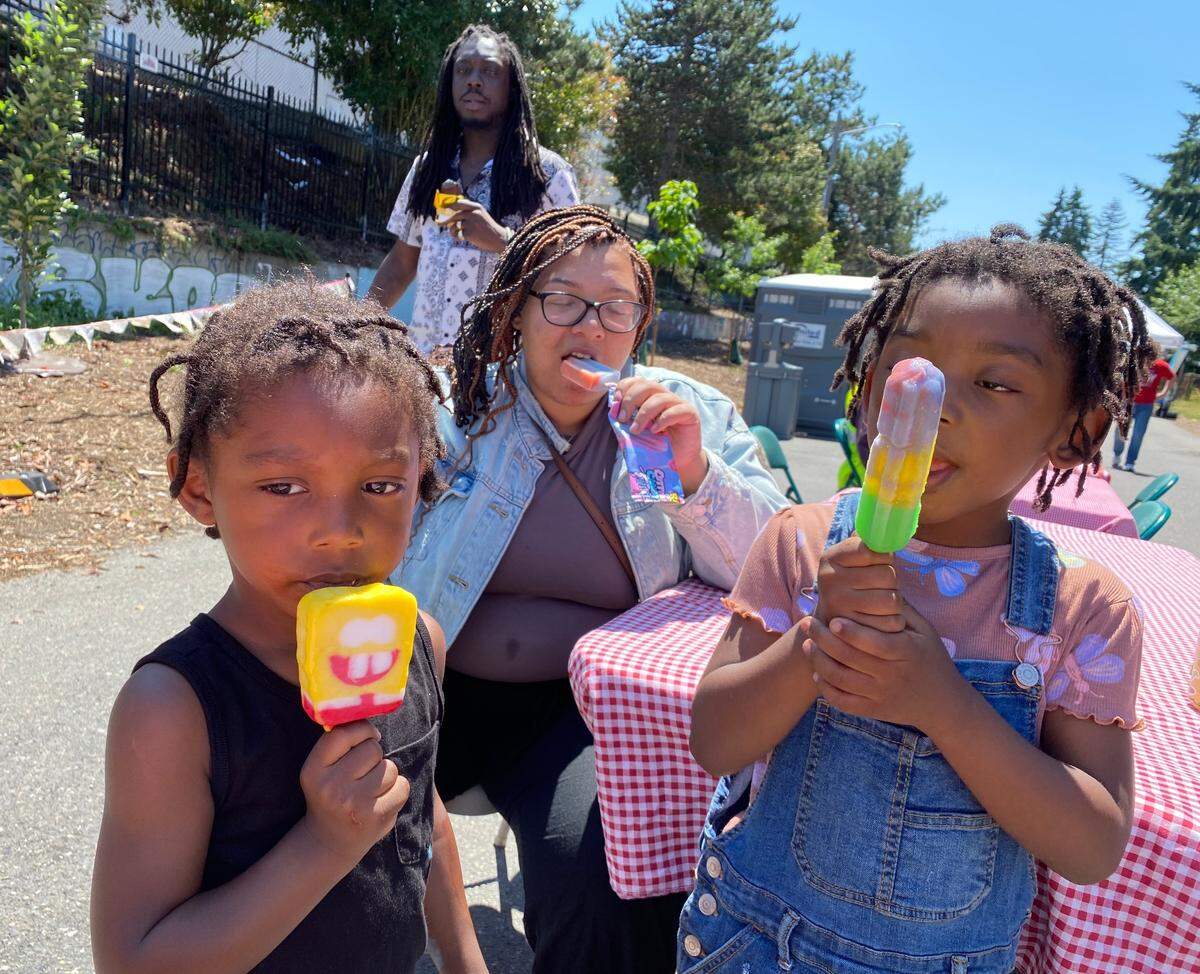
At one end of the block party, Shawn Harris, Alexis Malik and their two children were doing their best to consume popsicles before the treats melted onto D Street’s pavement. The family doesn’t live in the neighborhood but Harris works at Holiday Inn, one of the project’s many sponsors.
He’s well aware of the street and its visual reputation.
“This street used to have cinder blocks, used to have homeless people,” Harris said. “There used to be tents here before there were tents on Hosmer. Stuff like this (block party) is what brings kids and more community to the neighborhood.”
Team effort
Grants for the project came from the Tacoma Arts Commission, Pierce Conservation District and other agencies. The city’s Grit City Trees program provided the trees.
The trees, which ranged from oaks to caltapas with dinner plate-sized leaves and white flowers, are taller than an NBA player and looked green and healthy on Saturday. Neighbors have been taking care of them, Haug said.
Bushnell said the model used for the transformation isn’t new or unique. It’s just about putting in the effort.
“Everybody has the tools to access these things,” he said. “But sometimes it’s just the leadership and the folks that are willing to put in the work, it really makes those connections happen.”
Haug agreed. No one understands the problems and needs of a neighborhood better than its residents.
“You can scream at the top of your lungs, you want to see all of the change in the world and you want everyone else to do it for you,” Haug said. “But you really got to go outside, pick up that paper plate on the ground, say ‘hi’ to your neighbor. Otherwise, things don’t always work out the way you want them to.”
This story was originally published June 25, 2023 at 5:00 AM.