The telegram that forever put Tacoma on the map arrived 150 years ago Friday
It was age of steam, sweat, untold riches and dashed hopes.
Friday, July 14, marked the 150th anniversary of the arrival in Tacoma of a telegram with life-changing news for city residents.
The Northern Pacific Railroad had chosen Tacoma over Seattle as the terminus for its transcontinental line to Washington Territory. For pioneers, it meant money and opportunities. For the region’s native population, it was the harbinger of doom.
Two complementary exhibits at Tacoma museums highlight the era’s artifacts, documents and turning points.
“End of the Line: The 150th Anniversary of the Northern Pacific Railroad in Tacoma” at the Washington State History Museum (WSHM) features a selection of original documents, photographs and objects from the museum’s collection.
“Being the terminus meant that a city was going to see an uptick in trade and travel and immigration, all of those things that the railroad symbolizes to the majority of American people at that time,” said lead WSHM curator Gwen Whiting.
Meanwhile, “Dreams & Dispossessions: The Railway Comes to Tacoma” is on display in the museum of the Tacoma Historical Society (THS) in Tacoma.
“Everything about Tacoma changed because of the railroad: Where the city was placed, who was living here, what kind of businesses were flourishing,” said THS curator Elizabeth Korsmo. Without the railroad, “We wouldn’t have the city that we have today.”
WSHM also has a permanent exhibit on the railroad, including one of the “golden spikes” that ceremoniously connected the east with the west as well as the original “U” from the exterior of neighboring Union Station.
Lincoln’s order
The joining of the west and east coasts of the United States was the moonshot of its era.
“Literally, while the Battle of Gettysburg is going on, Abraham Lincoln signs the congressional act establishing a northern transcontinental railroad,” said Korsmo.
Long settled by native tribes, the region’s growing immigrant communities competed fiercely to be the railroad’s terminus.
“The cities made all kinds of offers,” Whiting said. “Seattle, Bellingham, Olympia — if it was a settlement of significant size in Washington, they wanted the train.”
The railroad wanted cheap land to build its terminus, a port and associated businesses. Tacoma’s Commencement Bay was a major draw for the railroad.
“Goods from overseas, particularly Asia, could reach not only the West, but it could also reach the East, and in return, people and goods and ideas also traveled from east to west,” Whiting said.
Old Town, New Town
When white pioneer Job Carr selected what is now Old Town for his cabin on Christmas day in 1864, he set into motion what would create, for a time, two Tacomas. He was lured to the area by the possibility of a railroad terminus.
In a letter to a daughter, Carr wrote, “In the spring of 1864 heard of the passage of the Northern Pacific Railroad charter and immediately resolved to go to Puget Sound and locate at western terminus of said road.”
He first arrived in the region in Olympia.
“I’m seeing the place then in a very dilapidated condition. I was convinced no sane company would ever locate the terminus of the transcontinental railroad there if there was any other place to go,” Carr recounted.
The push from Kalama
With work from Chinese laborers, the railroad pushed north from Kalama in 1873.
By July, the Northern Pacific had reached Tenino after turning north from the Columbia River. Financial setbacks and labor disruptions slowed its progress.
“They were in danger of forfeiture for the western lands, because they did not expand quickly enough out here because of mismanagement and bribery,” Whiting said.
The railroad had only six months to finish before financing collapsed. That they got there at all is a minor miracle. The era was marked by railroad collapses, bank failures, purchases and mergers.
By then, Carr and his two sons owned 1,000 acres in Old Town. But the Carrs had bet on the wrong location. The railroad did chose Tacoma, but an area two miles from Old Town.
“The city we know today wouldn’t have been here,” Korsmo said. “Downtown is the railroad invention.”
“Within the last few weeks, they raced from Lakewood down the easiest way they can where the Prairie Line is today,” historian Michael Sullivan told The News Tribune in 2014. The Prairie Line cut through what is now Tacoma’s brewery district and the University of Washington Tacoma campus to the Foss Waterway.
For practical reasons, they weren’t going to lay extra tracks to Old Town. Sweetening the deal were the automatic land grants to unclaimed land the railroad received in “New Tacoma.”
Passenger service began in early 1874.
Puyallup tribe
Long before white explorers and settlers came to what is now Puget Sound, Puyallup tribal members lived in the area as their descendants do today. In the late 1800s, Puyallup leader Peter Stanup worked to maintain tribal sovereignty in the face of increasing hostility and land grabs by railroads. He even traveled to Washington D.C. to lobby for native land rights.
Tribal member Frank Ross constructed a rail right-of-way on the Puyallup reservation until he was shut down by the Army in 1893. Three days later, Stanup’s body was found in the Puyallup River, his cause of death labeled inconclusive. In 1906, Standup’s 13-year-old daughter had her land allotment seized by the Chicago, Milwaukee, St. Paul and Pacific Railway.
Perhaps the biggest blow to native land rights came in 1886 with the passage of the Dawes Act. The intent was to create divisions in tribes and eliminate their social cohesion. Allotments of native land were sold to non-tribal members and businesses.
“The allotment process also allowed the government to claw-back parcels of land from the (Puyallup) Tribe,” THS states in its exhibit. “Railroad companies were a major beneficiary.”
Details
THS’ “Dreams & Dispossessions” show takes a more intimate view of the railroad with personal effects of both railroad workers and the people who arrived in the city via rail.
Like so many Tacomans, curator Korsmo has a personal connection to the railroad. Her great-grandfather was a railroad section boss in Buffalo, North Dakota.
“He had a little farm and then he was also responsible for maintaining the tracks between their station and the next one down the line,” she said.
The show has telegraph receivers and transmitters, railroad tools and other personal items. Hoops on display were used to pass messages from stations to passing trains.
“The most terrifying story we came across was about ... a telegrapher who got a message about a stalled train ahead, too late to get the message prepared,” Korsmo said. “And so she jumped onto the moving train, in order to inform the brakeman so that they could stop the train before it crashed.”
Immigrants
The railroad increased immigration to Tacoma and its surroundings. The comfort and speed of rail travel was light years ahead of the arduous months-long trips on wagon trains.
Tacoma’s current apartment building boom might seem like the city is changing overnight, but it pales in comparison to the 1880s. Tacoma’s population went from just over 1,000 people in 1880 to 36,000 a decade later.
A wicker case sits prominently in the THS exhibit. “Shie Colin, K. Street No. 1613, New Tacoma. Wash Terri, Etats - Unis” is painted on it.
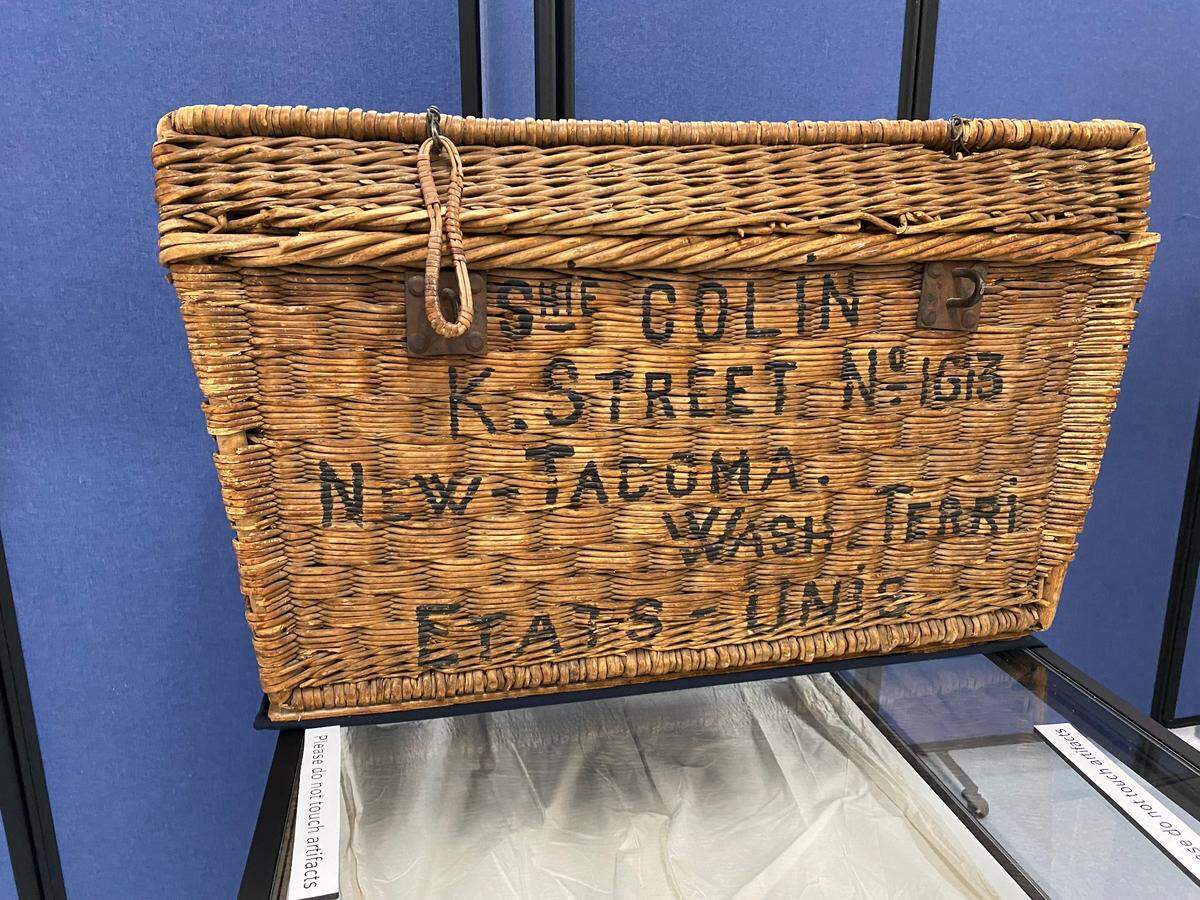
The case belonged to Sophie Collin, a 29-year-old Swiss immigrant who arrived Jun 24, 1889, in New York City from Le Havre, France, according to the THS exhibit. She soon took the train to Tacoma to meet up with her fiance, Alcide Perrenoud. The couple’s descendants still live in Tacoma.
Boom town
Along with immigrants and travelers, the railroad brought businesses to Tacoma. Janet Elder Steele opened the city’s first hotel in Old Town in 1869. She was surpassed by Alice Blackwell, dubbed the first woman to reach Tacoma by train, according to THS.
Blackwell opened the first downtown hotel in 1874, built by Northern Pacific.
A large reproduction of an 1880s birds-eye view of Tacoma in the WSHM exhibit shows the grand Tacoma Hotel and other early landmarks. The exhibit also has a page from the Daily Pacific Tribune, dated Aug. 26, 1873, and headlined “Ready for the Rush!”
.jpg "IMG_4315 (1).jpg")
“M. D. Harris has taken and opened the the Tacoma Restaurant,” the ad reads. “Having refitted and improved it, has made it equal if not superior to any other eating house in this city.”
The ad states that no Chinese are employed there.
“Come on, now, everybody!”, the ad continues. “The terminus has been located, and we are ready for you. If you want a square meal, got up in good style by a white woman, go the ‘Tacoma Restaurant’ and get it.”
Expulsion
The early days of Tacoma railroading played a part in what is arguably the city’s most shameful period — the expulsion of Chinese immigrants. Brought to the western United States to build the railroad, the Chinese settled in several communities across the West, including Tacoma.
On Nov. 3, 1885, a mob led by city leaders, including Mayor Jacob Weisbach and a couple of future mayors, forced the Chinese to Lakeview, an area near today’s Interstate 5 and Bridgeport Way Southwest, and loaded them onto trains. Those who couldn’t afford tickets were put into boxcars.
“The tracks the sojourners had laid — Tacoma’s pride and joy — had become the vehicle used to erase them from the city,” THS states.
In the days that followed, Tacoma’s two Chinatowns were burned — one near Old Town and the other near today’s grain terminal on Schuster Parkway. Tacoma banker and post master John C. Weatherred lay the blame on agitators. They, in turn, blamed the few remaining Chinese.
“The Tacoma Method” was so heinously successful, it was adopted by other cities which wanted to expel their Chinese populations.
Seattle fades, then shines
While July 14, 1873, was a joyful day for Tacoma, it turned sour for residents of a young Seattle. A crowd gathered to hear Arthur Denny read a telegram regarding the railroad’s terminus.
“We have located the terminus on Commencement Bay,” Denny read to the residents’ disappointment.
For a decade, Tacoma was Puget Sound’s leading city.
It wasn’t to last.
Northern Pacific relocated their terminus to Seattle around 1883. In 1887, Seattle became connected to the transcontinental railroad via a switchback over Snoqualmie Pass.
Then, in 1893, Tacoma was hard hit by a depression and began to shed residents.
“It pretty much just kills Tacoma,” said THS registrar Ben Inokuchi. “Almost every bank of Tacoma shut its doors. And the city had all of its money in those banks.”
When gold fever hit Seattle with the arrival of the Klondike Gold Rush in 1897, that city began to eclipse Tacoma by increasingly wider margins of population and commerce. By 1909, a railroad was crossing Snoqualmie Pass via tunnel and Tacoma’s Second City status was sealed.
“The Seattle line becomes more popular and with the Gold Rush and puts Tacoma in decline,” Whiting said.
Today
Rail still plays a major part in both freight and passenger service to and from Tacoma. Freight trains take the water route underneath Ruston and past the Narrows Bridge. Passenger service — Sounder commuter rail, regional Cascades trains and Amtrak’s Coast Starlight — follow most of the original Prairie Line route south.
While the last bit of the Prairie Line through downtown Tacoma was retired several years ago by Burlington Northern Santa Fe Railway, a mile of the route and a few sections of rail have been turned into a linear park that runs through the University of Washington Tacoma campus, past Tacoma Art Museum and to the waterfront.
Visitors can walk the rails, view art and exhibits and imagine life in the heady days of a young Tacoma.
If you go
What: “End of the Line: The 150th Anniversary of the Northern Pacific Railroad in Tacoma”
Where: Washington State History Museum, 1911 Pacific Ave., Tacoma.
When: Through 2023.
Information: washingtonhistory.org/
What: “Dreams & Dispossessions: The Railway Comes to Tacoma”
When: Through 2023.
Where: Tacoma Historical Society, 406 Tacoma Ave. South.
Information: tacomahistory.org/
This story was originally published July 14, 2023 at 9:24 AM.