Rapid bus line on Pacific Ave. to start later, deliver less, cost a lot more. Here’s why
A new bus line that operates like light rail was supposed to be whisking Pierce Transit riders between downtown Tacoma and Spanaway in 2022. Today, it’s not even out of the planning stages, won’t begin operating until 2027 at the earliest, will cost $37 million more than original estimates and deliver a scaled-down version of its original plan.
The delay of the Pacific Avenue Bus Rapid Transit (BRT) project comes as another blow to Pierce County commuters, still stung from Sound Transit project delays that pushed back the opening of the Hilltop Link extension to later this summer and the arrival of light rail from Seattle to 2035.
“I remain very frustrated at the expense of this planning effort with little to show for it and the pace of our progress,” Pierce Transit board member and Pierce Council member Ryan Mello wrote to Pierce Transit CEO Mike Griffus on Wednesday following a study session on Monday when the new reduced plan was presented by Pierce Transit staff.
While asking for more time to study the slimmed-down version of the BRT project, Mello and the other Pierce Transit board of directors on Monday turned toward a new enhanced bus service for Pacific Avenue that would operate until BRT is up and running.
What happened?
Like so many other infrastructure projects, Pierce Transit’s BRT project was hit by inflation. Prices for buses alone have risen 15 percent annually in the last several years, the agency said. Other factors also drove up costs and pushed back construction. Initially a $150 million project, it ballooned to more than $300 million by this year.
The various agencies that have jurisdiction along the 14-mile-long route — the state Department of Transportation, the city of Tacoma, Pierce County — have competing interests that didn’t always align with Pierce Transit’s and required more time to work through. The resulting studies and delays also added to the cost increases, according to Pierce Transit.
Then, there were the unhappy business and home owners who stood to lose property and access along the route. That alone sent planners back to the drawing board more than once.
In 2017, only 1 percent of the project had been designed, according to Pierce Transit manager Sean Robertson.
“We didn’t have anything surveyed,” Robertson said. “We didn’t have any traffic impact analyses done at that time. The city of Tacoma and Washington State Department of Transportation were clear with us at that time that further study needed to be done before they could verify all the requirements down the corridor.”
Now, the BRT project is 60 percent designed and a clearer picture of the opportunities and roadblocks have emerged.
“I think 100 percent of the changes are due to our reaction to what we’ve heard from the community and the jurisdictions that have authority down this corridor,” he said.
What is Bus Rapid Transit?
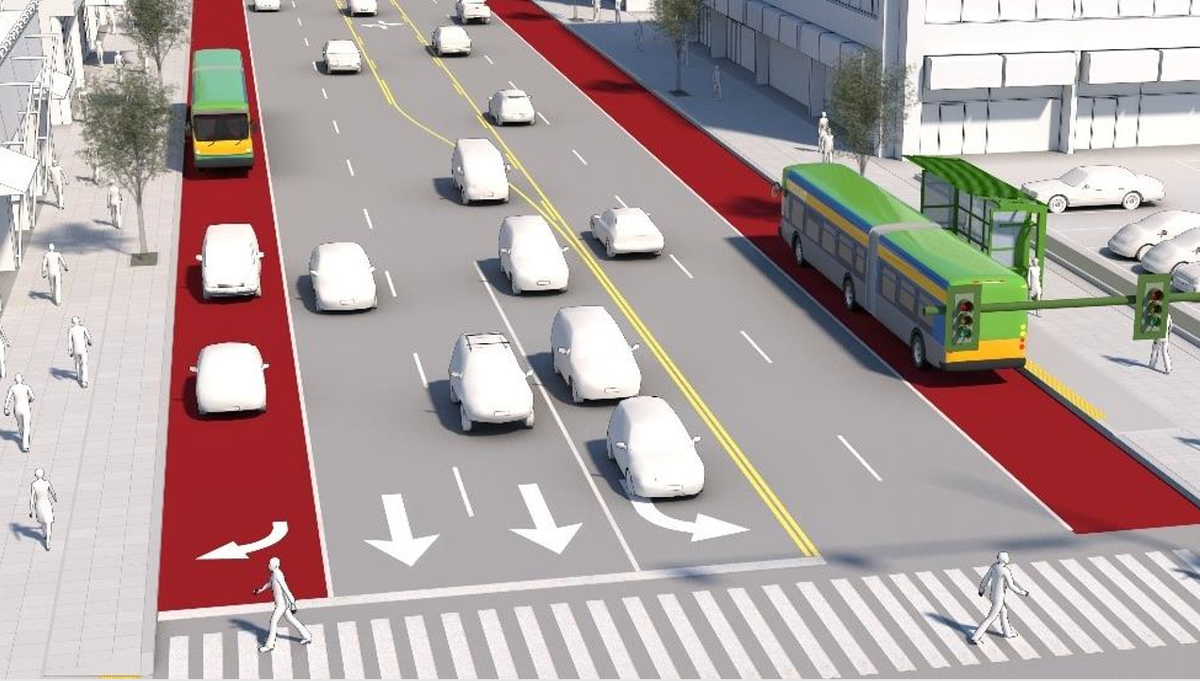
BRT uses dedicated lanes, stations that allow level (without stairs) bus boarding and high-frequency service. When planning began, the project would have built 28 pairs of stations along with bus lanes on 14.4 miles of Pacific Avenue between Commerce Street in Tacoma and state Route 7 in Spanaway.
When and if it begins operating, BRT buses would run every 10 minutes during morning and evening commutes and 15 minutes in off hours. As with light rail, electronic reader boards would countdown the minutes until the next bus arrives. Checking bus schedules isn’t necessary as it is on other routes when buses might run only once an hour, according to Pierce Transit.
The BRT buses would have multiple doors for boarding, and passengers would purchase tickets before entry (or use a fare card.) Those features eliminate the sometimes minutes-long line to get on a bus that plagues traditional systems. Wheelchair and walker users, along with bike riders, would be able to roll on without waiting for a lift. Buses would hold green lights for faster travel times through clogged intersections.
Money woes
In its earliest phase, Pierce Transit estimated it needed $150 million to build the project. That figure didn’t include several expensive additions.
Four planned roundabouts came in at $4-5 million each because Pierce Transit said it learned the details of WSDOT’s requirements for implementing them only after initial planning began.
Pierce Transit said it partners’ requirements for traffic mitigation went beyond its initial estimates, adding to the cost.
Lastly, Pierce Transit’s initial cost estimates showed a significantly fewer number of impacted properties. As design progressed, that number increased which required the purchase of additional property.
In 2020, with 30 percent of the project designed, costs had increased to $170 million. In 2021, costs had risen to $222 million. The next year: $241 million.
This year, the cost to complete the project stood at $311 million.
Pierce Transit’s funding stands at $197 million. Of that, $89 million comes from the Federal Transit Administration (FTA), $60 million from Sound Transit, $26 million from state funds and $22 million from Pierce Transit’s general fund.
“Currently, estimated project costs are beyond what the agency can afford,” said spokesperson Rebecca Japhet. “In order to deliver a rapid transit project that is within budget, Pierce Transit is looking at alternatives that would bring down the cost but still deliver an elevated transit experience to our community.”
The changes in the BRT plan have put the project’s FTA rating at risk, Pierce Transit staff said Monday. Projects must receive and maintain a “medium” or better overall rating based on several factors in order to be eligible for funding.
Sound Transit’s $60 million is safe, said spokesperson David Jackson, adding that several financial firewalls protect the funds from diversion to other projects.
“Under Sound Transit policy, voter-approved dollars for Pierce County projects stay in Pierce County,” Jackson said Thursday.
In late May, Pierce Transit began working on a “value engineered” version of the plan with its city, county and state partners. Value engineering basically means coming up with a less-expensive design.
“The reason why we did this was just, initially, to look at a simplified design that could come in with the budget that we currently have for the project,”project manager Robertson said at Monday’s study session with the Pierce Transit board. That meant squeezing a $300 million project in to a $200 million budget.
The current cost estimate is $187 million, leaving a $10 million cushion.
A new vision
The latest svelte version of BRT formulated in May takes away the middle-of-the-road stations planned for the route and pushes them to either side of the road. Stations built in the median would have required widening of the route on either side.
It also eliminated the 3.3 miles of bus-only lanes and axed all the roundabouts. In addition, 13 of the 28 stations will not have off-board payment.
Where once 317 private property parcels were impacted, now only 67 are affected.
In addition, less underground utility work will be required.
The good and the bad
Public transportation advocacy group Tacoma Downtown on the Go accepts that the BRT project can’t become the project that was initially envisioned.
“It’s just not financially feasible,” said Laura Svancarek, the nonprofit’s commute trip reduction and advocacy manager. “We understand that there’s need for scope reduction in this.”
Downtown on the Go is still supportive of the project as it stands but has some reservations.
“Our concerns are ensuring that we have a final product that prioritizes rider experience, that actually speeds up movement for transit riders through the corridor,” she said.
BAT lanes
Downtown on the Go is squarely behind BAT (Business Access and Transit) lanes that are used only by buses and private vehicle drivers making right turns into businesses and onto other streets. With the median used for left turns, that would leave only one lane of travel for private vehicle drivers along the route.
The BRT design has never included the reduction of general purpose traffic lanes and doesn’t now, Japhet said. The current plans call for only a two block-long northbound BAT lane near the SR-512/SR-7 interchange.
Having only one general purpose lane open would slow down private vehicle traffic, Svancarek said, but that’s kind of the point.
“We need people sitting in traffic to see the bus moving through and say, ‘Hey, I guess that could be me. I don’t have to be sitting here in my car,’” Svancarek said.
Downtown on the Go also would like to see dedicated bus-only traffic signals that allow buses to “jump the queue” at intersections to keep them moving rapidly.
“We want to see a BRT that is not stuck in traffic,” Svancarek said.
Japhet said BRT would have traffic signal priority which extends a green light signal for 5-10 seconds when the bus is within half a block to allow it and other traffic to get through before the light turns red.
There are positives about the project’s shrinkage, Svancarek said. Those include a reduced need for utility relocation and right of way acquisition. Utility relocation and its resulting problems were a major factor pushing back the opening of the Tacoma Link’s Hilltop extension, now scheduled for late August or early September from its original 2022 completion date.
Miscommunications
“Where exactly is the bottleneck?,” Mello asked Wednesday in an interview with The News Tribune. “How do we move through it? That’s not entirely clear to me ... Is it the City of Tacoma? Is it Pierce Transit?”
Tacoma, Pierce County and WSDOT had little to say this week about the scaled down project.
In 2019, Tacoma’s transportation commission was supportive of the project as it then stood.
“The Transportation Commission has been monitoring the progress of the project and remains supportive of BRT implementation along the Pacific Avenue corridor,” the commission said in a statement emailed to The News Tribune Monday.
“The Washington State Department of Transportation is committed to creating and maintaining a multimodal transportation system that has equitable access for all,” WSDOT said in a statement to the newspaper on Monday. “As we have in the past, we remain committed in supporting Pierce Transit’s effort in bringing bus rapid transit to the State Route 7 corridor and elsewhere in Pierce County.”
Sarah Grice, Pierce County’s traffic engineering manager, said in an emailed statement, “We are excited to see BRT continue to move forward in Pierce County.“
Mello, a former Tacoma city council member, wants better cooperation between the various governments and agencies.
“I think the City of Tacoma needs to be of more assistance to facilitate the successful delivery of this project, because it’s essential to the growth of the region, people being able to move around here and afford to live here,” he said.
Pierce Transit board chair and deputy Tacoma Mayor Kristina Walker echoed Mello’s comments.
“I am just as frustrated as everyone that it’s taking so long,” Walker said. Both the city and Pierce Transit have the same goals, she said.
“My understanding in talking to staff from both the city and Pierce Transit is that they’re in a good place now and moving forward,” Walker told The News Tribune Thursday. “I think there were some miscommunications out of the gates, but I don’t think either agency has a different goal.”
Increased safety is coming
At Monday’s planning session, WSDOT administrator Steve Roark said that the BRT route falls under that agency’s Complete Streets program. The program is designed to reduce stress for non-motorized users. That usually means increasing safety for pedestrians and bike riders.
WSDOT plans to install new, safer streets crossings at nine locations between 112th Street and the Roy Y, Roark said.
The nine existing rapid flashing pedestrian signals at pedestrian crossings would be replaced with full mast arm signals that span across all travel lanes, WSDOT spokesperson Cara Mitchell said. Drivers would see overhead traffic signals that would turn red when a pedestrian activates them to cross the street.
Enhanced bus service
While Pierce Transit continues work on the BRT, it would most likely implement its enhanced bus concept for Pacific Avenue. According to Pierce Transit, the service is cost effective, adds capacity, reduces travel time and is consistent with local and regional plans.
On Monday, planners estimated the service, which would run between the Tacoma Dome and the Spanaway transit center, could be running by March. When it does, Route 1 service — the system’s busiest — isn’t going away.
The enhanced service would feature 14 stations, take advantage of timed traffic signals and run more frequently during morning and afternoon peak commute times.
Depending on bus frequency, the service would cost $2.3-4.4 million to operate annually. Final approval for the project rests with the board.
This story was originally published July 14, 2023 at 5:00 AM.