Tacoma needs more trees, but efforts to plant them lag. How can T-town get greener?
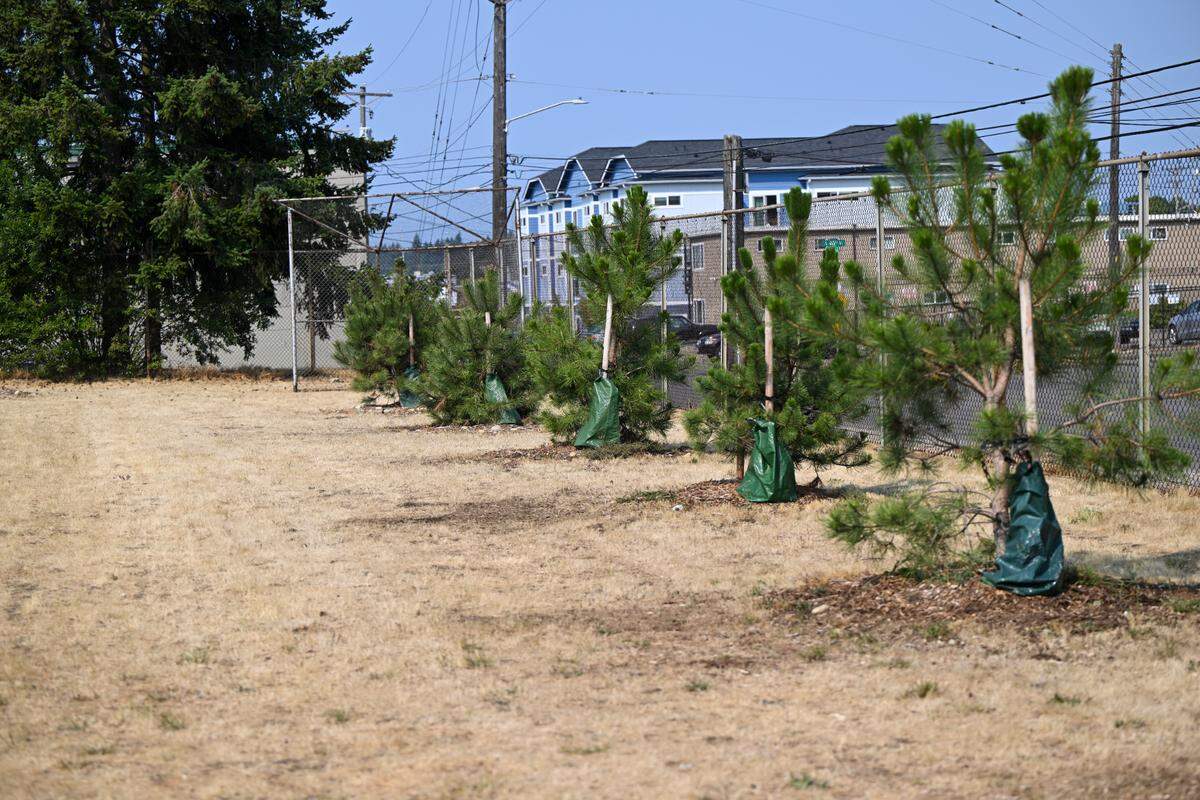
Lowell Wyse walked across the parking lot of South Tacoma’s Madison School one recent overcast morning, looking out across the blacktop from beneath the bill of a baseball cap that read, “Tacoma Tree Foundation.” As he rounded the corner of the property, he was greeted with the sight of more than 50 young trees.
Barely two blocks away on South 38th Street, cement, storefronts and a massive yellow sign for the McDonald’s golden arches quickly replaced that sight.
“You don’t have to go far to see what the neighborhood looked like in the past,” he said.
Wyse is the executive director of the Tacoma Tree Foundation, and one of a handful of people working to equitably increase urban canopy cover in Tacoma. The new grove of trees at the Madison School is a testament to the transformation that’s possible through those efforts.
It’s also a tiny slice of the work needed to meet Tacoma’s tree cover goals.
The Tacoma City Council recently approved $100,000 in annual funding for a new Community Tree Program aimed at increasing community engagement through a formal partnership between the city and the Tacoma Tree Foundation. That program emerges in the face of disparities in Tacoma’s tree cover.
According to the most recent data available, Tacoma has the lowest percentage of urban tree canopy cover of any city surveyed in the region. In many low-opportunity neighborhoods, canopy-cover levels are half the city average, if not lower.
Research shows that increased tree cover contributes to better community health outcomes and climate resilience. While the benefits of trees are clear, the path toward bringing them to Tacoma’s highest-priority neighborhoods remains less so.
The city’s urban forestry team has committed to a goal of increasing Tacoma’s urban canopy cover to 30% by 2030 – but funding, staffing and policy hurdles make that goal an uphill battle. As the city and Tacoma Tree Foundation navigate those hurdles, they seek new ways to bring trees to the neighborhoods that need them most.
Overcoming a legacy of disinvestment
When Tacoma resident Kevin Le graduated from the University of Puget Sound and moved to South Tacoma, it didn’t take long for him to notice a change in the scenery.
“If you’ve ever been on the campus, it’s beautiful: tons of trees everywhere, tons of green, red brick,” Le said. “You move to South Tacoma, that’s non-existent. You just see black asphalt. Yeah, there are trees, but there’s no consistency.”
Le quickly discovered how different Tacoma’s tree cover could look from one street to the next.
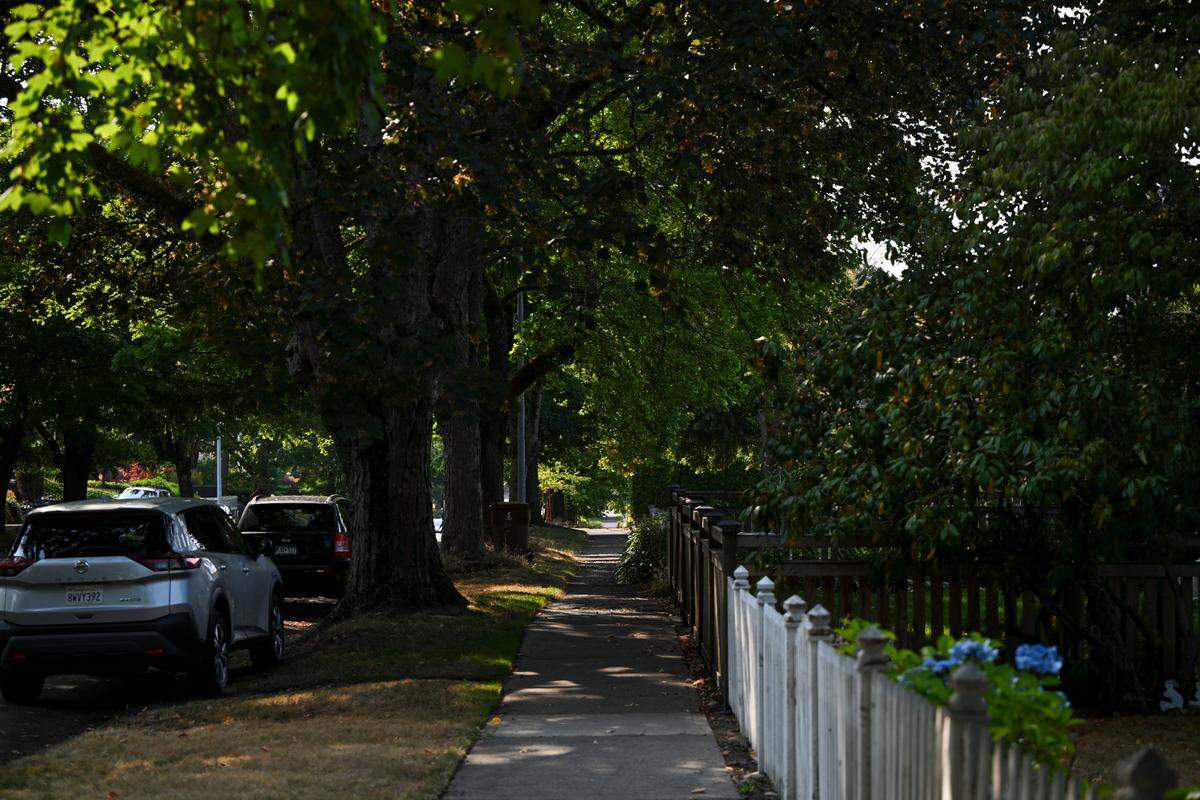
A drive along North 30th Street in Tacoma’s Proctor Business District is shaded by lush arches of leaves, branching out from trees on either side of the roadway. On McKinley Avenue near East 34th Street, a fraction of those trees dot the pavement, most standing only half as tall.
“It’s so obvious when you just sit down and look around for a few minutes,” Le said.
According to a Plan-It Geo study based on light detection and ranging (LiDAR) data, only 20% of Tacoma’s land area was covered by tree canopy in 2017 – the lowest percentage of any other community assessed in the Puget Sound Region, including Seattle, Renton and Bellevue.
In many Tacoma neighborhoods, that percentage is even lower.
The City of Tacoma’s Equity Index is an interactive tool that sorts Census block groups from “very low” to “very high” opportunity based on accessibility, livability, education, economy and environmental health. An analysis featured in the city’s community forestry map suggests that neighborhoods that score lower on the equity index, like Tacoma Mall, Hilltop and the Lincoln International District, have 15% less tree cover than neighborhoods that score high or very high. Many of those neighborhoods are located in the same areas that have seen systemic disinvestment through redlining, a discriminatory practice that denied residents of low-income, majority-Black neighborhoods loans.
Tacoma Urban Forest Program manager Mike Carey said the city’s urban forestry team relies on the Equity Index to identify high-priority areas for tree-planting projects. Bringing more trees to those areas isn’t just about adding greenery to the neighborhood, though.
According to a report prepared by The Nature Conservancy, decades of research show that access to nearby nature reduces the risk of chronic disease, hastens recovery times and results in better learning and mental health outcomes.
“It’s not just about providing habitat value, but it’s really about all of those direct connections to human health and well-being,” Carey said. “The canopy cover goal that we set was really kind of aiming at getting that environmental health, specifically to benefit community health.”
Trees also play a role in mitigating air pollution, flooding and extreme heat, said Vivek Shandas, a professor of climate adaptation at Portland State University.
Clover Tamayo, an Edison neighborhood resident who uses they/them pronouns, is no stranger to the South Tacoma heat. In recent summer weeks they’ve tried to keep cool with their pet husky, but with little tree cover over the roadways near their house, finding a nearby place to go on walks has been a challenge.
“We don’t have [big parks] here, so I end up having to drive our pup to faraway places like Point Defiance Park or Swan Creek just for him to have outdoor time, and cool enough outdoor time,” Tamayo said.
Tamayo isn’t the only one concerned about the implications of summer’s scorching days for Tacoma’s lower-tree-canopy neighborhoods. Vivian deZwager, another South Tacoma resident and a Tacoma Tree Foundation board member, said the need for trees is clear. Just a few steps under the branches in front of her home brings relief – but many stretches of sidewalk nearby don’t enjoy that same shade.
“The heat is a huge issue,” deZwager said. “If anybody wants to go park their car somewhere, they’re gonna look for a tree to park underneath.”
According to the National Oceanic and Atmospheric Administration, extreme heat is the leading cause of weather-related deaths in the United States, surpassing tornadoes, flooding, hurricanes and extreme cold. Due to a phenomenon called the urban heat island effect, neighborhoods don’t always experience exposure on the same levels.
Urban heat islands occur when a city or neighborhood is hotter than its surrounding area at the same time of day, sometimes by as much as 15 degrees Fahrenheit, Shandas said.
In his work mapping urban heat islands in cities, Shandas has found that areas with high levels of industrial manufacturing, brick and cinder-block buildings, and impervious surfaces consistently see amplified temperatures. They’re often the same areas that have seen historic disinvestment. According to the city’s community forestry map, lower-opportunity neighborhoods in Tacoma have 19% more impervious surfaces than higher-opportunity neighborhoods.
“You have a triple whammy here of wintertime flooding, summertime heat and then always air pollution, and together, those things really start to accelerate over generations the public health impacts that communities feel as a result of injury by 1,000 cuts or death, even, by 1,000 cuts,” Shandas said, referring to the Pacific Northwest.
As those health impacts compound over generations, they make it more difficult for communities to recover.
“The idea of being resilient to these extreme events is much more compromised because the community can’t necessarily afford to cool down during a heatwave, because air conditioning costs a lot to run or tree canopy doesn’t exist in the neighborhood,” Shandas said.
Tacoma struggles to track progress
The 3-30-300 rule, an evidence-based benchmark for urban forestry, proposes that healthy communities should have at least three trees visible from each house, 30% canopy cover, and a park or greenspace accessible within 300 meters.
The city’s urban forestry goal sets out to achieve 30% canopy cover by 2030 – but more than three years after adopting the Urban Forest Management Plan, the numbers aren’t adding up.
In order to stay in line with the goals laid out in the plan, the urban forestry team and government partners would need to plant 10,500 trees each year over 10 years. In the last half a decade, they’ve planted an average of just under 3,500 trees annually, according to data provided by Carey. That number doesn’t account for tree removals.
The urban forestry team also has no way of tracking tree plantings and removals on private properties. The only way to accurately measure canopy cover and account for all trees would be through another geospatial analysis using LiDAR data, which requires remote sensing technology to generate three-dimensional information about the Earth’s surface. That’s something they currently don’t have plans or funding for.
Carey said he hopes to use LiDAR data procured by Tacoma Public Utilities the next time they do a flyover, but when that might be is uncertain.
One barrier is a lack of resources.
Tacoma’s urban forestry staff of three full-time equivalents – an urban forest program manager, an urban forestry analyst and a project specialist – is smaller than other similarly sized cities in the region. For example, the urban forestry team in Salem, Oregon, has seven FTEs. The median FTE for urban forestry teams in cities similar in size to Tacoma is nine, according to a 2014 report surveying more than 600 cities.
Tacoma’s urban forestry team also falls behind other cities when it comes to funding. The urban forestry team’s $422,500 annual budget factors out to about $1.90 per capita – roughly a third of the national average for urban forestry departments in cities with more than 100,000 people, based on numbers reported to the National Arbor Day Foundation from 3,130 communities in 2006. By comparison, Salem’s urban forestry team receives $1.3 million annually, or around $7.50 per capita.
Funding for the urban forestry team is approved by the Tacoma City Council. Council Member Joe Bushnell, who represents District 5 in the southern part of the city, said in recent years the council has wanted to be sure other systems are in place, like a fully developed Climate Action Plan and an updated tree code, before working to expand urban forestry programs.
The City Council also has to balance urban forestry funding with other high-priority projects, Bushnell said.
“Trees are certainly a high priority for me, and something I’m looking forward to exploring in the near future, especially as we update our tree code. But we’re competing with a lot of other areas of the city as well that have great need,” Bushnell said.
Another challenge is a lack of land. Carey said there’s no way the city could attain 30% tree canopy through capital planting projects on its own property.
Because the city doesn’t control the right-of-way area next to houses, sometimes called a lawn strip or planting strip, it needs permission from the adjacent property owner to plant trees there. Once those trees are in the ground, it’s the responsibility of the property owner to water them, prune them and know when they’re sick.
To deZwager, the evidence of personal tree maintenance – and lack thereof – is clear.
“A wealthier household has the resources to take care of a tree out front, whereas a rental or even somebody just struggling with finances … they just don’t have the time or the resources to take care of the tree that’s out front,” she said. “You can tell where the people have the resources to be able to take care of those things.”
More than a decade ago, the city planted trees along either side of South Alaska Street near deZwager’s home. Now, when she walks along the street, some trees cast generous shade over the sidewalk. Others remain only a few feet tall, with spindly branches and sparse patches of leaves.
Two trees that were damaged by a car crash have never been replaced.
“You can’t just set and forget. There needs to be other goals that come along with it; you have to help it grow, it needs water,” deZwager said.
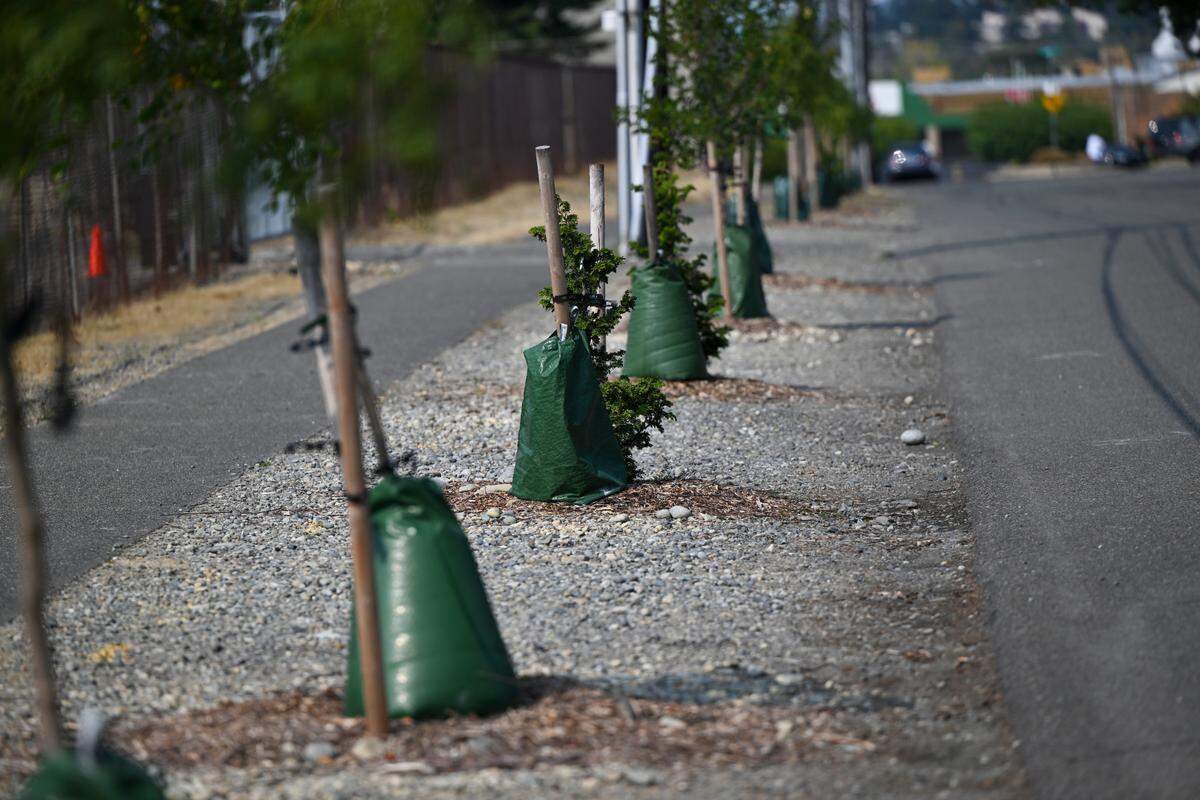
To help address the gap, the urban forestry team organizes tree giveaways and incentive programs aimed at giving community members free and discounted trees and equipping them with basic resources to care for them, like stakes, ties and compost. They also recently launched a hazardous tree assistance program.
Carey said the city prioritizes applications from neighborhoods that score very low, low, or moderate on the Equity Index for its free street tree program, Grit City Trees. Even so, some factors make it difficult for residents to say yes.
Le, a renter in the McKinley area, said he wanted to apply for a tree through Grit City Trees, but without the permission of his landlord, the property owner, he wasn’t able to. He fears the situation is the same for other renters on his neighborhood cul de sacs.
“Even if every single person in both cul de sacs – 50 people, 70 people – declared, ‘I want trees,’ it’s not our decision,” Le said.
The city’s community forestry map indicates that lower-opportunity neighborhoods also have significantly less available planting space to begin with. That combination, Carey said, can make it difficult to reach new people.
“When we do tree planting events, we can be assured that the same 20 people are probably going to show up to every single one,” he said. “It’s the frequent fliers that are already bought into the meaning and the intent of urban forestry in our cities.”
Because incentive programs rely on community participation, Carey said they’re more likely to produce trees that will survive and be cared for by the community. It also means it takes longer to see their impact, though.
“We try to actively engage community members to care for, nurture, take in trees to improve their own environment, which just is a slower model of getting trees in the ground,” Carey said. “It requires that partnership and those conversations and making sure that the right tree is going in the right place.”
City announces new community tree program
As the city urban forestry team continues outreach efforts, they’re seeking ways to add people to the conversation.
A new program could help accomplish that.
The city has a longstanding partnership with Tacoma Tree Foundation, but until recently it hasn’t provided formal funding for the nonprofit. Now for the first time, the Tree Foundation has been written into the city’s biennial budget for the Community Tree Program, a new initiative focused on community engagement through annual neighborhood-based planting projects and educational activities.
“By developing this really phenomenal partnership between the city and the Tree Foundation, they’re just able to access places and people that we wouldn’t otherwise be able to,” Carey said. “I think that’s a really fundamental partnership.”
Together, the urban forestry team and Tree Foundation recently kicked off Green Blocks: McKinley Hill, a program that will offer 250 trees to the McKinley Hill neighborhood. The city doesn’t have to look into the future to see what’s possible through a partnership, though. Back at the Madison School, dozens of new trees send a reminder of the work that’s already been done.
In late 2018, the city began the early stages of the Tacoma Mall Greening Project, a roughly $540,000 project that encompassed the Tree Foundation’s Tacoma Mall Green Blocks program, leveraged by a grant from the U.S. Forest Service.
The Tacoma Mall neighborhood is a high-priority neighborhood for tree planting, based on the city Equity Index, with just 10% urban canopy cover. It’s also a regional growth center, or an area with high potential for concentrated employment and housing growth.
“The question is, how can we add more people and add more trees at the same time? And it’s not easy to do,” said Wyse, the Tacoma Tree Foundation executive director.
In partnership with the Tree Foundation, the city sought guidance from a mall neighborhood advisory committee, doing door-to-door canvassing, hosting a tree giveaway at a local car shop, and even bringing a pop-up forest to the Tacoma Mall.
They also brought more than 50 trees to the Madison School.
As one of the few nearby outdoor spaces identified by Mall neighborhood residents, the school emerged as an obvious place to plant trees, Wyse said. In coordination with the Tacoma School District and local artist Teruko Nimura, the city and Tree Foundation hosted an initial planting party in October 2022. There, community members gathered to bring five new trees to a corner of the property, including a “wishing tree” in a colorful planter designed by Nimura.
Those five trees were only the beginning. Riding the momentum created by the initial planting event, the city and the Tree Foundation returned to Madison School in February 2023 to plant 58 additional trees, this time drawing 100 volunteers from across the city.
“It was incredibly powerful,” said iLeana Areiza, a South Tacoma resident who participated in the event. Areiza recalls seeing volunteers of all different backgrounds at the tree planting, as well as City Council members and legislators.
When Areiza began volunteering with the Tree Foundation a few years ago, she was simply looking for a way to give back.
Now, she’s on the nonprofit’s board of directors.
“I love it,” Areiza said. “The connection, the community, the challenges, and just dreaming [of] a better Tacoma with a group of people that are willing to do the work is something that I feel very grateful for.”
Through the Tree Foundation, Areiza learned how to plant two street trees in the right-of-way near her house. Understanding how to choose the right tree, navigate city resources and avoid interfering with pipes and gas lines was a game-changer, she said.
“Sometimes you’re afraid to break things, and people just don’t want to make a mess,” she said. “But I think that the educational part that I got from the Tacoma Tree Foundation was instrumental to say, ‘Oh, I actually can do something by myself.’”
Tamayo has seen the impact of community-level education in their neighborhood, too.
Through an annual tree steward training hosted by the Tacoma Tree Foundation, Tamayo learned how to properly plant, prune and care for trees. That training, they said, empowered them to share tree-planting resources with nearby neighbors who have since added three new magnolias to the right-of-way across the street.
“Even just being able to knock on a neighbor’s door and say, ‘Hey, your tree limb is in the walkway and it’s obstructing people’s path, can I help prune your tree for you?’ That helps immensely,” Tamayo said.
Wyse attributes the success of such programs to their hyperlocal focus.
While the Tacoma Mall Greening Project brought hundreds of new trees to the neighborhood, it also brought dozens of new faces into the fold of community greening efforts. To him, that’s a success in its own right.
“These are folks that were not participating in other programs, general programs,” Wyse said. “So it mattered that it was designed specifically for the neighborhood, and then it mattered that we were bringing a door-to-door approach and letting people know that this resource existed.”
Carey sees things similarly.
“The outcome wasn’t just trees in the ground,” he said. “It was a community being built around this concept of improving an environment in their own neighborhood.”
Tacoma Mall is just one neighborhood; as the city and Tacoma Tree Foundation step into new projects through the Community Tree Program, they have plenty of work cut out for themselves.
Wyse said he hopes residents will join them in that step forward.
“People tend to underestimate how much voice and power they have. So if you look around Tacoma and your neighborhood doesn’t have green space or doesn’t have trees, you can raise your voice and let your leaders know,” he said. “People have an opportunity to step up and say, ‘We care about this, this matters. We want our streets to be more beautiful, we want our air to be cleaner, our kids to be safer.’”
How to get involved
Upcoming opportunities with Tacoma Urban Forestry and Tacoma Tree Foundation:
- Sept. 16: Tacoma Tree Foundation tree stewards training
- Sept. 17: Deadline for McKinley residents to apply for free trees through Green Blocks: McKinley Hill
- Oct. 14: Green Tacoma Day
- Nov. 3-4: Branch Out community tree giveaway (pre-registration ends Oct. 15)
This story was originally published September 1, 2023 at 5:00 AM.