Pierce County tenants complained about moldy apartments. Weeks later, issues remain
The smell of mildew wafted through Cassie and Dennis Morrone’s ground-floor apartment in Lakewood on Nov. 8. These days the family spends a lot of their time outside their front door, bundled up, to avoid the coughing and headaches that have come as a result of what they say has been more than a month of mold exposure.
Their landlord has assured the Morrones there is no mold in their low-income apartment, several water leaks have been repaired and management is complying with city code. But the Morrones believe Legacy Park Apartments should have done more to address leaking water and the subsequent mold they’ve found as a result, which has impacted not only their lives but the lives of their neighbors.
Two families told The News Tribune they didn’t think management would have even addressed the issues had a news reporter not made an inquiry into living conditions at their units.
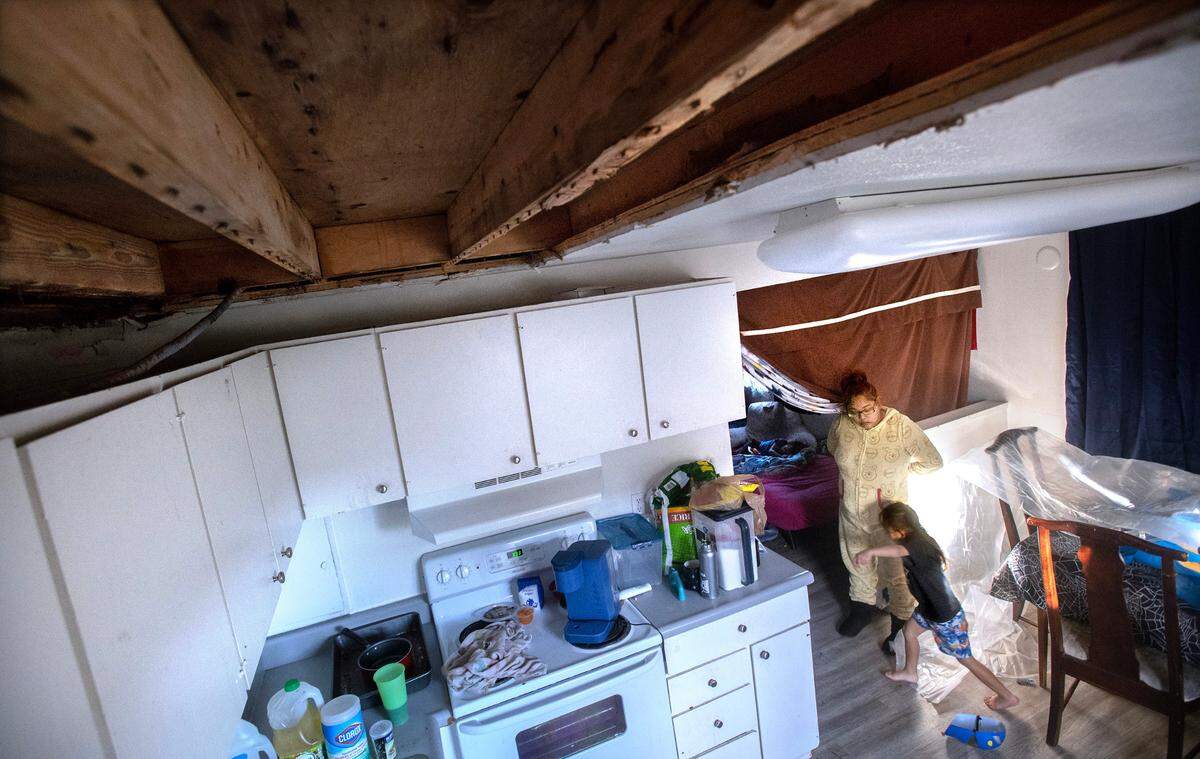
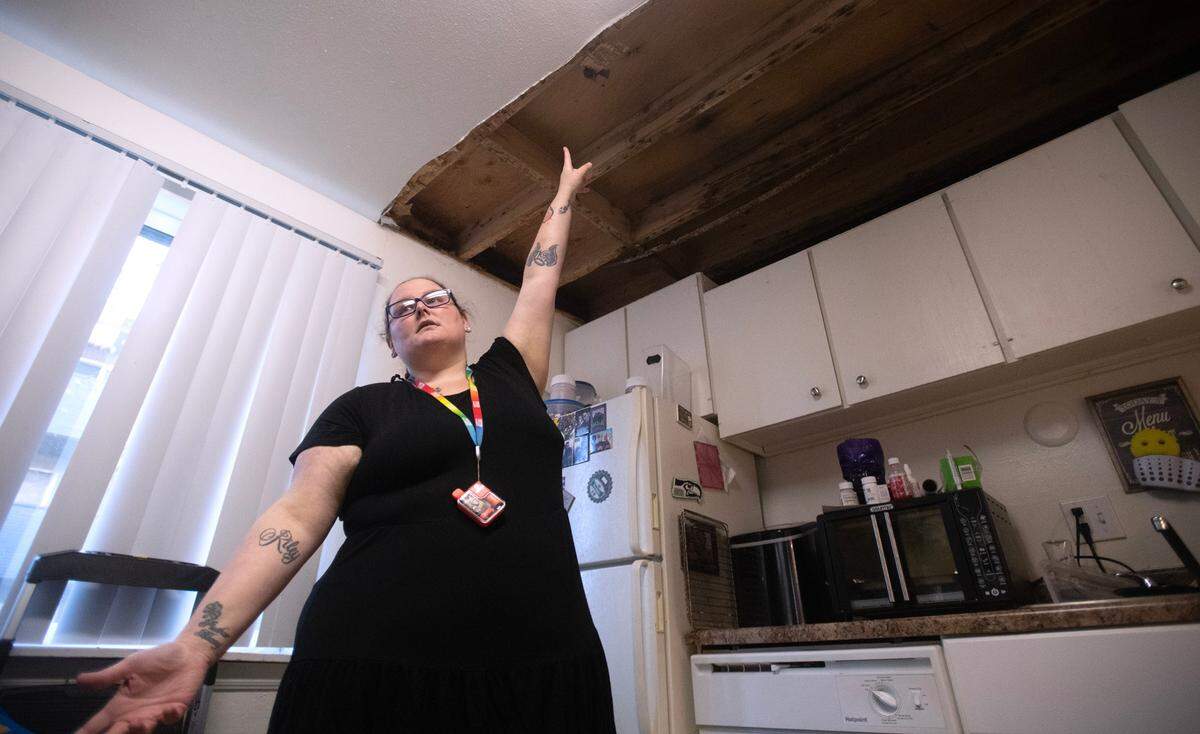
“The leak started here,” Dennis Morrone said Nov. 8, pointing to a gaping hole in the kitchen ceiling above the stove and refrigerator.
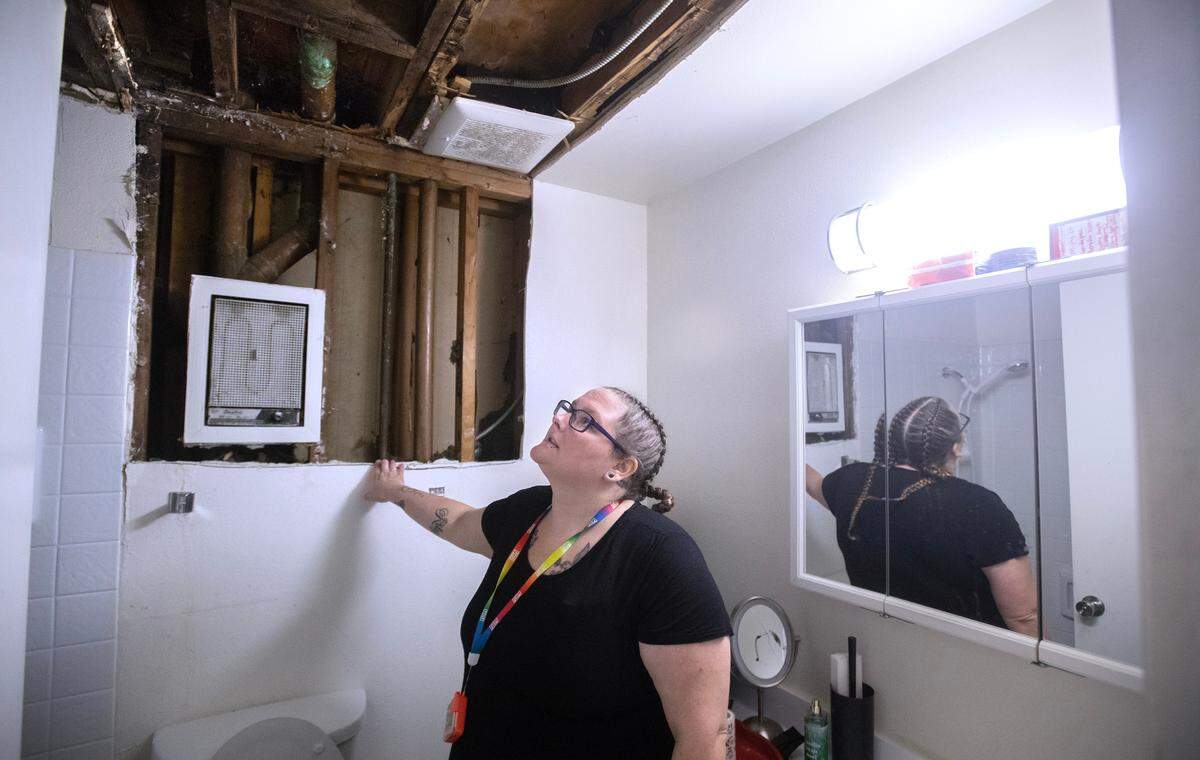
The hole revealed a crosshatch of wooden beams dotted with what appears to be white mold spores. A tour of the bathrooms revealed walls that caved with the slightest touch, and a hole in one bathroom ceiling showed wisps of once-pink insulation now turned black. The family would have lived in their apartment for two years in December.
Cassie Morrone said she called emergency maintenance at Legacy Park Apartments on Friday, Oct. 13, to report a burst pipe but said maintenance told her it wasn’t an emergency and would be dealt with Monday.
Over the weekend the family collected buckets of brown water dripping from the ceilings above their kitchen and bathrooms. In the kitchen, photos show the ceiling sagging under the weight of a water-clogged bubble. Morrone said when she called the fire department, someone there told her they couldn’t do anything unless the ceiling collapsed, which it eventually did on Monday, Oct. 16.
The family in the unit above the Morrones told The News Tribune a similar story. Upon a visit to their apartment, KayleenRose and Nathan Babauta pointed out holes in their kitchen ceiling and bathrooms, the wood above also spotted white and black. KayleenRose Babauta said they’ve blocked off the kitchen and dining room with a sheet for several weeks now because they’ve seen the impact of mold spores on their family of seven, one of whom has a serious medical condition. They have lived in the unit in the three-story apartment building for one year in November.
The Neiders Co. operates Legacy Park Apartments in addition to 30 other apartment complexes in the Tacoma area. In an email to the News Tribune on Nov. 13, Frank Hornung, vice president of operations for the company, said the health and safety of residents is its top priority.
“We are continuing to work with our maintenance staff, the city of Lakewood and licensed experts to mitigate the impact of this water leak for our residents. We know that living in an apartment that has on-going repair work in response to damage caused by a water leak can be difficult, which is why we have offered to help move the affected families and will not charge rent for the month of November for the affected families,” Hornung said. “Our company is founded on the mission of providing a comfortable, safe home for our residents and our team has discussed how our mission can be more effectively pursued.“
An advocate with the Northwest Justice Project said the nonprofit has heard many stories from tenants struggling to get their landlords to address issues like mold. A shortage of affordable housing has limited options for families to move and given landlords less incentive to fix issues, Scott Crain told The News Tribune. With standards of code enforcement varying from city to city, many tenants, especially those who are low-income often struggle to find justice, he said.
The Morrone and Babauta families have been talking with pro bono lawyers and keeping a paper trail in advance of possible legal action against The Neiders Company.
Property manager denies mold
In his email to The News Tribune, Hornung denied mold was present in the units.
“No mold has been visible during our repair work, and a mold-certified licensed building inspector reviewed the affected apartments this morning, confirming that no mold of any kind is present as verified through this repair work by city officials on their first visit, the OneWay Restoration workers and a certified inspection this morning,” Hornung said.
Lakewood communications manager Brynn Grimley said the city became aware of the issues Oct. 16 when the Morrones and Babautas called the city to report water leaks in their units. Two members of the city’s Rental Housing Safety Program team, the program coordinator and a code compliance/safety inspector visited the property, conducted an inspection on behalf of the tenants and later sent the leasing office directives to correct the leaks and obtain the appropriate permits, Grimley said.
“The property manager has been working toward compliance ever since. They are in contact with the residents and the City regularly and we are making sure the work is progressing,” Grimley said in an email Nov. 7. “Management has remained responsive to the city and is demonstrating the due diligence needed to correct the issue.”
The city of Lakewood said it does not test for mold “because that is outside the purview of expertise for our housing employees,” Grimley said. “In this instance it was clear the leak needed to be fixed and the damaged Sheetrock replaced.”
Hornung said the weekend of Oct. 13 maintenance staff replaced a hot-water valve they thought was the source of a water leak but did not discover an additional water leak, which is why the leak continued through the weekend despite multiple maintenance visits.
“Our team has discussed how the lengthy repair time for this type of water damage could have been better communicated and met our company standards of communication to our residents about the required course of action by our company and the city’s requirements,” Hornung said.
Hornung sent the News Tribune a log of repair work completed in the units from Oct. 13 through Nov. 3, which included a timeline of when a licensed plumber completed several leak repairs, assessments of the apartments, removal of drywall, when anti-bacterial and anti-fungal solutions were applied, as well as regular moisture readings that were taken.
“Our most recent reading suggests that we may be in the acceptable range, and we are working to confirm with city officials that repair work to the drywall may proceed,” Hornung said.
Cassie Morrone said on Nov. 14 she believes several areas of her apartment still have above-average moisture readings, based on watching maintenance staff conduct the inspections. Neiders shared a visual mold inspection report conducted on Nov. 13 with The News Tribune, which showed that “No evidence of active or previous mold or microbial growth was observed” within three apartments, including the Morrones’ and Babautas’.
“At the time of our review there was no active source of excessive moisture,” wrote Property Condition Services LLC on Nov. 14. “Moisture readings were taken within the three apartments of interest. All readings within a normal range, below 17%. ... The only moisture meter reading above 17% was on the exposed studs within the bathroom of [the Babauta’s unit], where readings of 20% were obtained.”
The source of that elevated moisture was determined to be from an upstairs neighbor “not containing shower water within the bathtub” and the water “draining through a small opening behind the toilet at the corner of the bathtub.” According to the report, wood starts to rot and is susceptible to mold when the moisture content reaches 35%-55%.
If Neiders was not actively correcting the issue or not being responsive to the city, under state law Lakewood could prevent Neiders from renting dwellings that the city deems condemned or unlawful to occupy. Neiders could also have been required to pay relocation assistance, prepaid rent or prepaid deposits to tenants affected by a governmental condemnation, Grimley said.
Lakewood Housing Program manager Jeff Gumm said the 2018 International Existing Building Code considers a residence unsafe or unhealthy to inhabit if the space “is a danger to the public … or it is an imminent danger of collapse or failure of the structure.” A Lakewood building official would ultimately determine if a unit should be closed, he said.
Buildings or structures are deemed “unsafe” by the IEBC if they are “unsanitary” or “deficient” in terms of lighting, ventilation or structure and meet the definition of “dangerous.” The IEBC defines “dangerous” as conditions that are dangerous to human life or the public welfare, and involve inadequate maintenance. According to the code, “dangerous” would be typically defined as buildings or structures that have collapsed, partially collapsed or are at significant risk of collapse within a specified period.
‘I’m starting to lose everything ...’
The Morrones have not been able to use their kitchen since mid-October and said Nov. 8 was the first day their children, ages 3 and 5, were able to return to school after two weeks off sick. Cassie Morrone said her family has suffered cold symptoms, nausea, fatigue, dryness, migraines, sore throat and phlegm. A doctor’s note Cassie Morrone shared with The News Tribune dated Nov. 1 said, “[The children] do have some signs and symptoms concerning for exposure to mold. I would recommend that [they] avoid exposure to the environment with mold or that the living area be sanitized from all signs of mold.”
On Oct. 30, KayleenRose Babauta conducted an at-home mold test. A photo she shared with The News Tribune showed a petri dish blooming with gray and white spores. On Nov. 9 she took her family, including five children ages 3, 4, 5, 8 and 10 to the emergency room. For weeks they have had body aches, coughing, migraines, swollen throats, shortness of breath and dizziness, which Babauta said her doctor also attributed to mold exposure.
Cassie Morrone said she reached out to The News Tribune on Nov. 3 after failing to get meaningful help from Neiders, the city of Lakewood, the Tacoma Pierce-County Health Department, the Washington State Department of Social and Health Services and a number of tenant advocacy groups, including Northwest Justice Project.
“I even called [Child Protective Services] on myself, hoping that they could do something with my kids,” she said. “It’s been a lot. I honestly feel like I’m starting to lose everything, lose myself.”
Shortage of affordable housing perpetuates issues
Complaints about mold or poor living conditions are “super common” in Western Washington, said Northwest Justice Project advocacy council Crain, who works assisting the nonprofits’ network of housing litigation lawyers throughout the state.
“It’s a pretty pervasive problem, particularly with low-income housing and aging housing stock,” Crain said. “And our laws are terrible. They just have not kept up with the times. I don’t think they’ve been significantly amended for decades in terms of renters’ remedies.”
Although Crain said he couldn’t comment specifically about the cases of the Morrones and Babautas, he said the families’ stories aren’t unique. If a landlord refuses to fix an issue, there’s not much tenants can do, especially if they can’t afford a lawyer and are at a disadvantage in court if they refuse to pay rent, he said. Different cities have different code enforcement, and some cities’ enforcement is more robust than others, Crain said.
“Tenants really, their best remedy is to move. Which is a terrible remedy, because it just lets the landlord get away with not fixing the problems,” Crain said. “There’s no real specific remedies in the Residential Landlord-Tenant Act that help a tenant in that situation if the landlord says there’s nothing wrong with the dwelling, it’s the tenant’s fault. And then you end up in this dispute that nobody can resolve until the tenant sues the landlord to try to get some money.”
Crain said the Northwest Justice Project receives more calls for help from tenants than it can address because there’s not enough lawyers to meet demand. The organization offers advice and explainers of tenant-landlord law on its website, “but a lot of those folks, we just can’t help,” he said.
A shortage of affordable housing in Pierce County and beyond, Crain said, leaves low-income tenants especially vulnerable.
“If you don’t have any money and there’s nowhere to go that you can afford, you’re going to be more likely to endure conditions that you otherwise would find intolerable,” he said. “There’s some percentage of landlords that don’t upkeep their property, and there always has been, but I think the problem now is there’s a lot of them and there’s a lot of renters that have nowhere else to go. Before, you could just move and find a landlord who is going to follow the law. That’s not as much of an option anymore.”
Issues with deferred maintenance, especially in older buildings, lead to additional issues like broken pipes, water intrusion and caved walls and ceilings, Crain said.
“That can be a big problem that causes really cascading effects and can really impact people’s health in an unpleasant way,” he said.
Cassie Morrone said the city of Lakewood acknowledged their problems and told Neiders what to repair, “And they’ll do it, but even then that’s a week in between with the mold just sitting above us.”
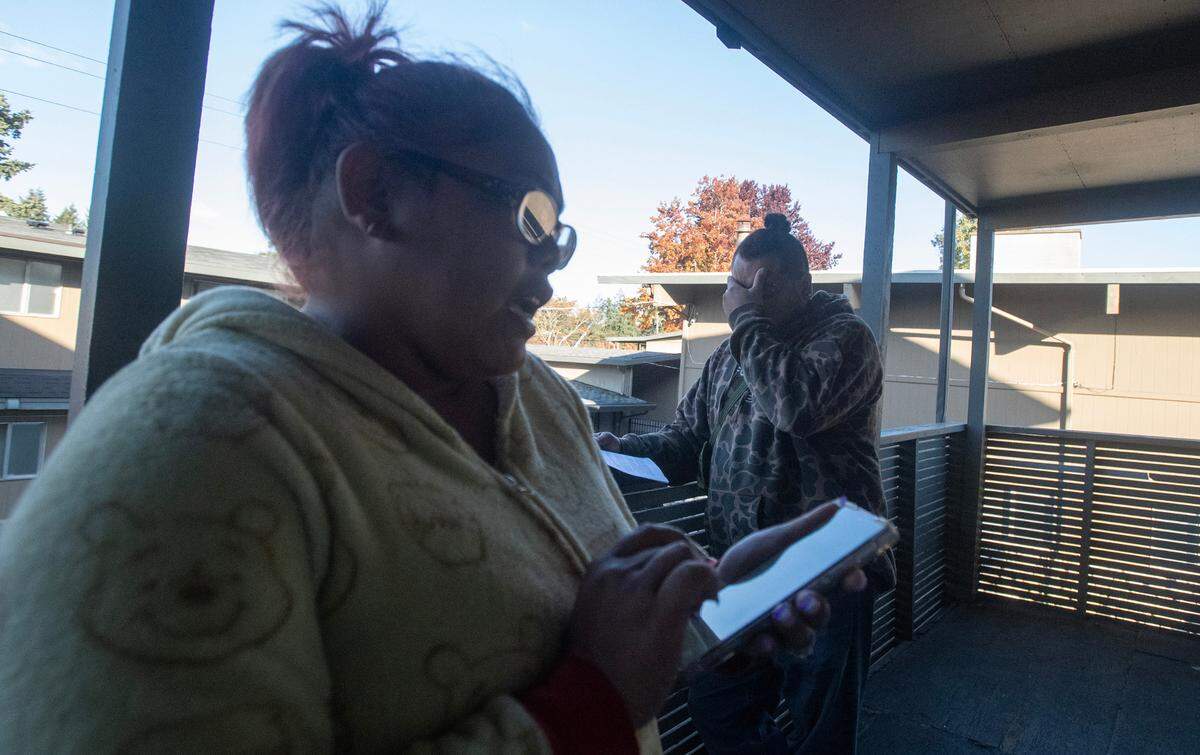
KayleenRose Babauta said on Nov. 13 there’s a hole in her bathroom ceiling that exposes the unit above hers, and water still drips down when her neighbor showers.
“When we’re sitting on the toilet or using the restroom, it’s still actively leaking,” she said. “Since this happened, we called every single day to talk to somebody from Neiders, the higher ups, to talk about what’s been done with our unit. Are they going to do anything for the health of my family? Do you guys not care for the health of my family? I mean, that’s how I feel.”
In the email to The News Tribune on Nov. 13, Hornung said a plumber was called to examine a potential leak on Nov. 3, and it was determined that water was being splashed from an upstairs tub/shower.
Moving on and moving out
On Nov. 10, both families were offered temporary relocation to a hotel, and both families have been offered relocation to other apartments on the Legacy Park campus, Hornung said in the Nov. 13 email.
Neiders said it would also waive the Morrones’ and Babautas’ rents for November and said a 30-day notice to vacate posted on the families’ doors on Nov. 8 for unpaid rent would be revoked following a discussion with company leadership.
“Given the extended nature of the repair work, our team has discussed how re-location offers could have been made available sooner to affected residents,” Hornung said in the email.
Both families said the financial impact of missing work due to illness, eating out because they cannot use their kitchens and the related expenses of moving last minute have put pressure on their already fixed incomes.
KayleenRose Babauta told The News Tribune on Nov. 14 that her family accepted Neiders’ offer to move into another unit on site, which she hopes will have fewer problems. She said they have already received their keys. In the future the Babautas will be looking to become first-time homeowners, she said.
Cassie Morrone said Nov. 14 that her family would consider Neiders’ offer to relocate to a new smaller unit as a last resort. She said it would take a lot of time to pack all their belongings only to move back to her current unit once repair work is done. A GoFundMe to help her family offset moving expenses hopes to raise $2,500.
KayleenRose Babauta said the stress and exhaustion of dealing with the trouble has exacerbated her depression and anxiety. Cassie Morrone said stress has triggered her chronic fibromyalgia and epilepsy.
“You should have done it before we contacted the news or the city. Why are you going to wait for some story to come out about your property for you to even acknowledge the severity for how you’re treating your tenants?” KayleenRose Babauta said. “[This is] what tenants have to deal with here.”
This story was originally published November 16, 2023 at 5:00 AM.