Are cameras tracking your vehicle? If you live in Pierce County, it is quite possible
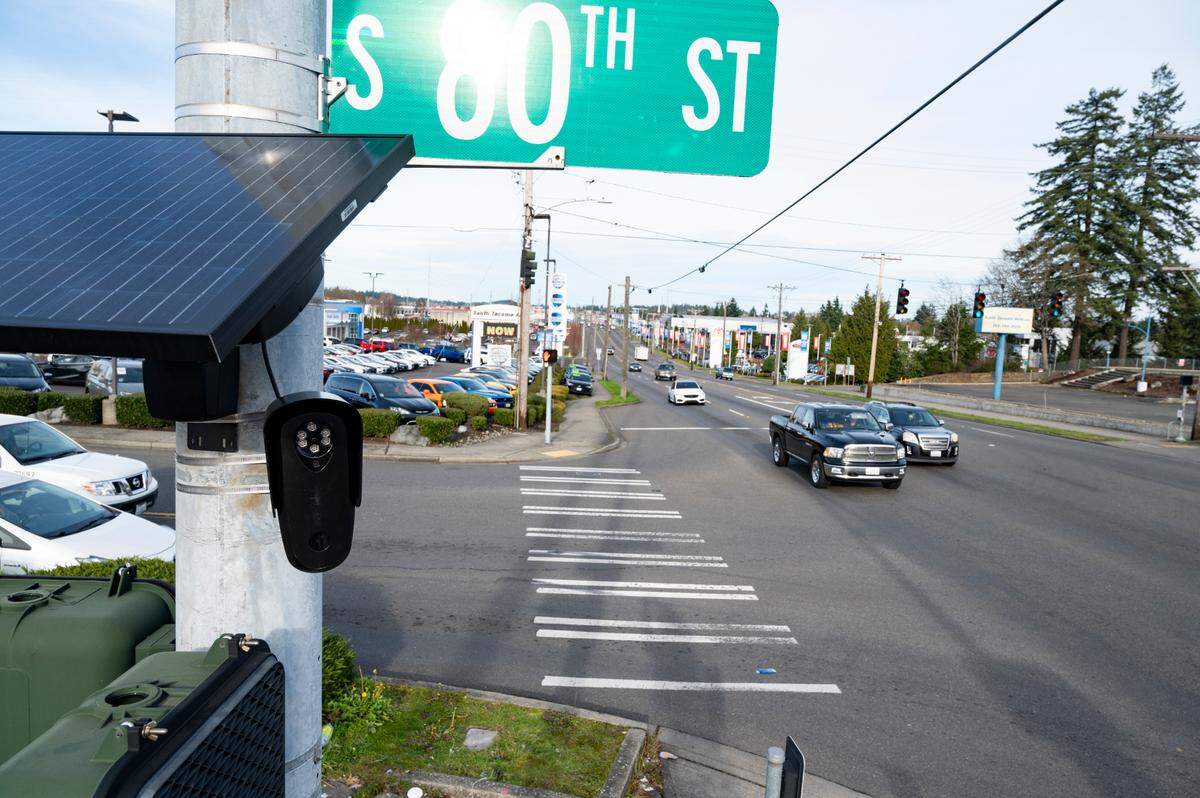
On an increasing number of streets in Pierce County, pole-mounted cameras capture the rear of every passing vehicle, storing photographs and automotive details such as license plate information for 30 days in a database accessible by law enforcement.
Authorities say the technology from Atlanta-based Flock Safety will aid efforts to catch vehicle thieves, prevent and solve other crimes and locate missing people while deterring those with criminal intentions from entering jurisdictions if they’re aware they’ll leave behind a visible trace.
The ACLU has raised concerns that the license plate-reading cameras will contribute to a “form of mass surveillance unlike any seen before in American life,” threaten personal privacy, potentially disproportionately affect communities of color and lead to deportations by immigration authorities. It’s also unclear if it’s widely known that local governments are adopting the cameras in part because they’ve been approved simultaneously with routine municipal items during recent meetings.
There are 40 agencies currently using Flock Safety’s technology in Washington, according to the city of Puyallup, which entered into a two-year contract with the company for $246,000 on Dec. 5, becoming the latest customer in Pierce County. At least two others — Lakewood and Eatonville — have deployed the cameras locally, publicly available data shows.
“The big goal is to reduce crime,” Puyallup Police Department Capt. Jason Visnaw said in an interview, adding that the city expected to install 37 cameras in strategic locations by the end of February.
Lakewood city lawmakers approved 36 cameras in July for $224,000 over two years. After a two-month trial period agreed to in February, the Eatonville Town Council is considering paying $75,000 to downsize from 11 to six cameras for an extended five-year run, public records show.
In its resolution on the proposed extension, Eatonville noted that the test period proved to be successful in helping police “on numerous occasions to solve and prevent crimes within the Town as well as assist neighboring agencies in cases.”
Lakewood has also seen positive results since 31 of its cameras were installed in early October, according to Lakewood Police Lt. Jeff Alwine. Approximately 23 stolen vehicles had been recovered and 11 people arrested as a result of the cameras, Alwine said.
“I’m confident that this system is going to help us solve some other crimes that we may otherwise not be able to solve,” he said.
Flock Safety says that license-plate recognition provides law enforcement with “actionable evidence.” It’s particularly important, the company’s website reads, because the vast majority of nonviolent crime across the country goes unsolved.
Automated license-plate readers, in general, are not new. In 2014, The News Tribune wrote about cameras affixed to three since-decommissioned Tacoma police vehicles, five years after the city received its first reader. In 2008, the Washington Association of Sheriffs and Police Chiefs authored guidelines for operating readers in the state.
But Flock Safety, specifically, has quickly grown since launching in 2017 and expanded into more than 3,000 communities in 40-plus states, according to its website. It offers not only automated license-plate readers but surveillance video and audio-detection technologies as well, although authorities in Pierce County said they weren’t using those additional product options.
During a July presentation to city lawmakers, Lakewood Police Chief Patrick Smith noted his experience with the company’s license-plate readers prior to arriving in the city in March. Puyallup began looking into the technology after seeing other agencies adopt it and learning of successful case studies, including in Yakima, whose law enforcement agency became the first in Washington to install Flock Safety cameras in spring 2022.
“We really believe we can balance public safety and protecting privacy,” company spokesperson Holly Beilin said in an interview.
How the technology works
Flock Safety’s license-plate readers run on solar panels and LTE — a cellular transmission technology — meaning users don’t need to worry about electricity or Wi-Fi, according to the company.
The cameras are motion-activated and designed to capture vehicles traveling in a single direction so that they’ll read the back of an automobile as soon as it passes by. The standard-version camera’s motion detection works for up to 75 feet and across one-and-a-half road lanes.
Flock Safety says its cameras aren’t equipped with facial recognition.
The company recommends customers aim cameras toward following traffic because not every state has front-facing license plates. Even if a user sought to track oncoming vehicles, occupants aren’t well seen in images due to the cameras being calibrated to pick up the detail of a license plate, according to Beilin. She also said it was rare that cameras were used in that way.
What the cameras do detect and log are vehicle image, license-plate number and type (standard or temporary), vehicle make and model, vehicle color and unique features such as a broken taillight, bumper sticker or after-market wheels. The cameras know what time a vehicle is captured, too.
The vehicle-identifying data, which Flock Safety says is encrypted and owned by the user, is stored by default for 30 days in a cloud database and can be shared among agencies.
The database is connected to the FBI’s National Crime Information Center that keeps tabs on fugitives, missing people and stolen property. Alerts automatically send to law enforcement when a wanted vehicle is detected by a camera. Local authorities are able to set up custom alerts for suspect vehicles.
Additionally, the cameras can assist with investigations, officials say, by providing detectives with an opportunity to search the database to chase leads following a crime if they know where and when it occurred and potentially some description of the involved vehicle.
“It’s like having additional police officers on the streets because the cameras are doing the work,” Alwine said.
Fears of surveillance
In March 2022, ACLU senior policy analyst Jay Stanley authored a paper titled, “Fast-Growing Company Flock is Building a New AI-Driven Mass-Surveillance System.”
The paper expressed a slew of concerns about the company’s technology and its use not only among law enforcement but private citizens, asserting that Flock Safety’s system’s records were intrusive and opened the door for abusive tracking.
Among customers that Flock Safety markets to are homeowner associations, school districts, businesses and residential property managers. If private users choose to sign a memorandum of understanding with local law enforcement agencies that also deploy the technology, authorities can directly access the private recordings to search for suspect vehicles and receive alerts whenever one is detected. Private users cannot receive those alerts, Beilin said.
Stanley wrote that the system effectively turned private camera owners into direct agents of law enforcement by, wittingly or not, expanding the surveillance network. As Flock Safety increases its private customer base, more cameras could become available for law enforcement use at no additional costs to the agencies.
Stanley also found fault with the company’s standard 30-day data retention period, saying there were no laws requiring Flock Safety to adhere to that time line. He wrote there is a lack of checks and balances in using the database and wrote that searches should require a warrant.
Beilin said there were safeguards in place and that Flock Safety met all that was being asked for by the ACLU.
The company does not sell the data to third parties, enables customers to determine who has footage access and requires authorities searching the database to enter a reason.
Alwine said that users leave a trail so that the police department could audit search behaviors. He also noted that the department limited use to supervisors or higher-ranking personnel to reduce any potential for abuse, although he added that he couldn’t think of a scenario in which an officer could inappropriately search the system.
The ACLU provided a hypothetical target: vehicles with a particular political bumper sticker, which Stanley worried could lead to people being singled out for exercising their freedom of expression.
Cameras are unregulated
The 30-day waiting period before automatically dumping collected data, Beilin said, was reasonable for investigative purposes and a good compromise to address concerns about privacy. Flock Safety’s retention standard would be preempted only in the event that any local legislative body decided to extend or shorten the minimum period, she said.
Eatonville might do just that. The town is mulling cutting data retention in half to 15 days after a City Council member requested it do so before entering into the five-year contract, Eatonville Police Chief Jason LaLiberte told The News Tribune.
In Wisconsin, police in the city of Waukesha were holding onto data for 121 days in the absence of any law governing retention, FOX6 Milwaukee reported in August.
Sixteen states regulate automated license-plate readers, according to the National Conference of State Legislatures. Washington is not among them. In 2019, Senate Bill 5529 tried to change that. It would have forced authorities to delete images after 12 hours if a vehicle’s license plate didn’t match a watch list. The bill died in committee. Critics argued there was no reasonable expectation of privacy for motorists on a public roadway and that the bill prohibited legitimate law enforcement uses of the technology.
“Our office is aware of the concerns some have raised about these readers,” Mike Faulk, a spokesperson for Gov. Jay Inslee, wrote in an email to The News Tribune. “The governor’s policy staff are engaged in discussions about potential legislative actions but have not made any decisions at this point on the various regulatory options.”
A December 2022 paper from the University of Washington’s Center for Human Rights, which raised concerns, in part, about the technology’s potential to out individuals from other states seeking abortions in Washington, noted the lack of local regulations.
“In Washington state, except for Seattle’s Surveillance Ordinance passed in 2017, there are no legal standards governing the use of ALPR systems or the management of the data they generate,” the paper wrote.
While some local authorities using the technology conditioned their support of any regulations on what those rules would do, Flock Safety said it welcomed local control.
“We definitely think that every community should be able to regulate it as they’d like to,” Beilin said.
In California, state police departments have been banned from sharing license-plate reader data with out-of-state or federal law enforcement agencies, including Immigration and Customs Enforcement, and any public agency that wishes to install the technology must first provide an opportunity for public comment at an agency’s regularly scheduled meeting.
“The decision-making process around whether to deploy surveillance technology should be transparent and open to public input and debate,” Stanley wrote.
Efforts for transparency
When Puyallup and Lakewood lawmakers approved contracts with Flock Safety, the agreements were part of the “consent agenda” — a section of the agenda typically reserved for routine and non-controversial items that can be passed in one fell swoop. Citizens can still comment on any one or more items and council members can pull an item for discussion.
During the City Council meeting Dec. 5, when Puyallup OKed installation of the cameras on the consent agenda, resident Bud Metzger addressed city leaders beforehand and suggested they take a different tack, saying that license-plate readers deserved “a bigger conversation.”
“I think that you need to have community meetings throughout the whole city discussing it and what people believe and don’t believe about it,” Metzger said. “It’s just a single line-item there without a lot of explanation, and I think it needs more conversation.”
The Puyallup Council’s broader agenda packet did offer additional information, although it didn’t detail the number of cameras being purchased.
“There’s really not a great understanding of what they are and what they’re about,” Visnaw acknowledged in an interview, adding that he could only assume the city planned to engage the community about the cameras.
Since the cameras are, in part, meant to deter bad actors from entering into Puyallup city limits, “we want people to know that they’re there,” he said.
In a statement, Puyallup city spokesperson Eric Johnson told The News Tribune that “these items are considered routine operational purchases that do not warrant additional public outreach,” adding that officials rely on law enforcement to determine what tools are needed to keep the community safe.
Prior to the Lakewood City Council’s adoption of the technology in July, Smith, the city’s police chief, presented information to city lawmakers during a public study session and also spoke about the cameras to community members at a meet-the-chief event, according to city spokesperson Brynn Grimley.
Grimley said it was the city’s common practice to place contracts on the consent agenda. She noted that the technology’s use was not unprecedented among law enforcement agencies.
“This, in no way, was trying to be, ‘Let’s slip this one under the radar or hide it’ or anything like that,” she said.
Alwine said that anyone who tracks council activity would be aware of the technology’s introduction in Lakewood. Still, he said the city was planning to raise public awareness in the future and inform residents about the potential to partner with law enforcement.
As Flock Safety’s profile has risen as more agencies interact with its products, so, too, has public awareness when the company’s system gets credited in news reports with helping to solve crimes, according to Beilin. She provided some prominent examples: a hospital shooting in Atlanta; a hate crime in Cathedral City, California; and the killing of three homeless men in Los Angeles.
The company has testified at hundreds of city council meetings and state legislative hearings across the country, Beilin said.
As part of adopting Flock Safety technology, public agencies can opt in to a transparency portal, which the company encourages, that provides use policies and data summaries online. Lakewood shares such information, and Puyallup and Eatonville said they intend to.
As of Dec. 12, Lakewood’s cameras in the past 30 days had detected more than 480,000 vehicles and had more than 1,400 “hotlist” or wanted license plate hits, the portal shows. Authorities had performed 330 searches.
The county’s two largest jurisdictions, Tacoma and Pierce County, have not signed on to use Flock Safety cameras, officials say. However, the Sheriff’s Department’s new Axon dashboard camera systems will be able to support license-plate reading beginning next year, Sheriff’s spokesperson Sgt. Darren Moss said.
Flock Safety presented in July 2022 to the county’s Public Safety Committee, where Nick Hausner, the sheriff’s chief of administrative services, said the department was “very interested” in the technology and would “likely” propose the County Council adopt it at some point.
“It creates some work, but good kind of work — it’s the kind of work that’s going to help us solve crimes,” Hausner said during the meeting, referring to the fact that personnel would still need to review footage.
Hausner added that his initial concerns — including whether the cameras used facial recognition — were fully addressed after earlier learning more about the company’s technology.
“It’s information that if I was standing on the street corner, watching cars drive by, I could take pictures and I could write information down,” he said. “The computers and the cameras just do it faster, and it’s always there 24/7, where we can’t have a police officer there 24/7.”
This story was originally published December 15, 2023 at 5:30 AM.
CORRECTION: A previous version of this story misstated the cost of the city of Puyallup’s contract with Flock Safety.