New medical clinic at this college campus might help Pierce County ‘health care desert’
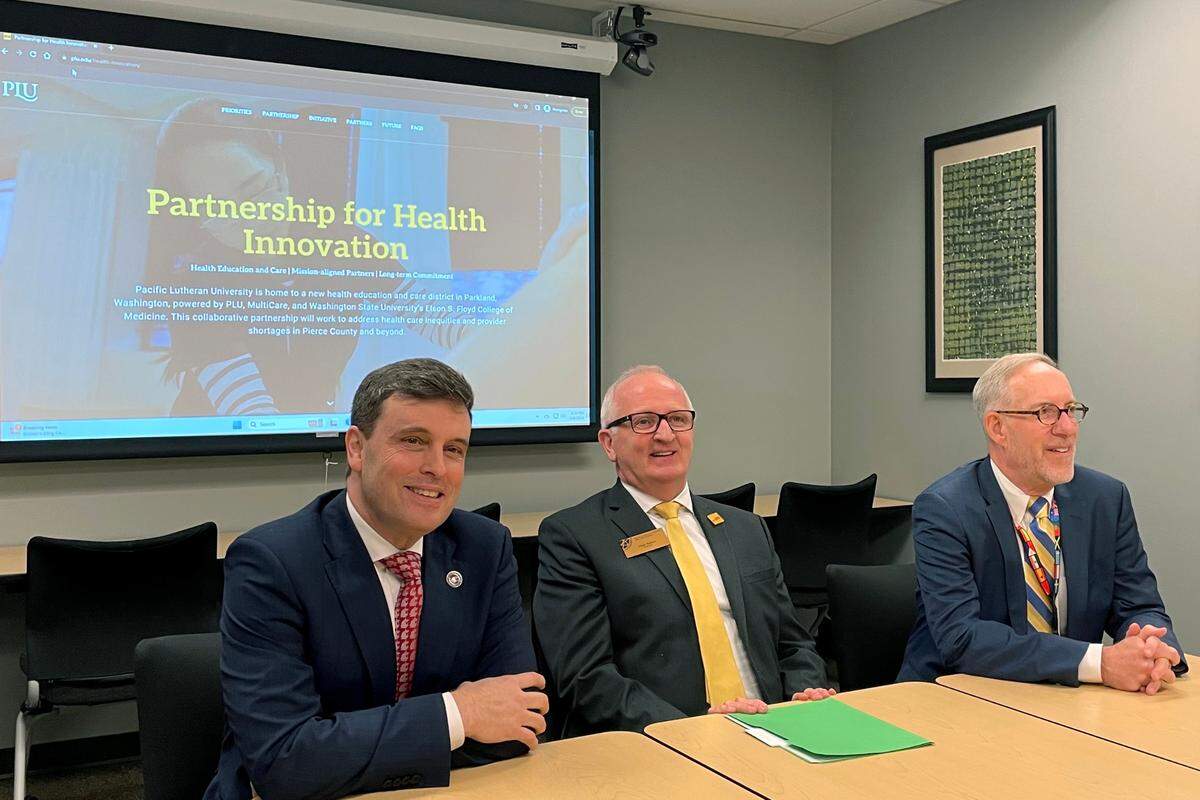
MultiCare, Washington State University and Pacific Lutheran University leaders on Tuesday announced a joint partnership to build a new medical center at PLU’s campus, bringing much-needed medical care to the Parkland-Spanaway area.
Although design details and the financial price tag are yet to be finalized, PLU president Allan Belton said at a news conference the MultiCare medical center could serve 200,000 people and might break ground on about 15 acres of PLU land on the southeast corner of campus in 2027, opening a year or two after that. Belton said PLU is also setting aside 10 acres of land to become a native plant conservation site in collaboration with local tribes, he said.
MultiCare will be leasing the land from PLU to operate the site and also be funding related construction costs, said Zach Power, PLU’s director of communications. MultiCare will be covering the cost of the building and will draw from its existing capital to do so, said MultiCare director of external communications Lori Meyers.
“It is too soon to put a price tag on the build as we have not entered into the design phase,” Meyers said in an email Wednesday. “Eventually the project will become self-sustaining.”
MultiCare CEO Bill Robertson said the center would include clinical outpatient services, as well as ambulatory surgeries, primary care, specialty activity and behavioral health services. The center would be an asset for students and faculty as well as the broader community, he said.
“Our goal is to grow with what the community needs and with the academic mission that is here,” Robertson said. “We’ll add to that as we learn and as we grow to meet the community’s needs.”
Belton said the partnership with MultiCare and WSU is the product two-and-a-half years of conversation as well as shared values and drive to support the health care system as well as bring needed medical resources to an underserved area of Pierce County. A Blue Zones Project initiative is underway to improve health outcomes for residents.
“When you think about Parkland, Midland, Spanaway, you’re talking about the largest by population unincorporated area in the state of Washington,” Belton said. “There currently is no primary care. There currently is no outpatient services. None of this exists in the community today.”
PLU and MultiCare have had a close relationship for decades, with partnerships in nursing and other programs, Belton said. PLU was brought into conversation with MultiCare as related to the Blue Zones initiative, and WSU’s Elson S. Floyd College of Medicine was actively pursuing serving Pierce County as well, he said.
“It wasn’t one of us saying, ‘Hey, we have this great idea.’ We sat in a room, we talked about the need and I believe there was an aha moment where we said, ‘Wow, Pierce County needs this, we have a campus, why not? Let’s break down the barriers and do something different,” Belton said.
Addressing community need
Belton said there’s currently “an incredible shortage” of health care providers in the state, particularly in the South Sound region.
WSU medical students would be able to live on PLU’s campus and have residencies at MultiCare facilities in Pierce County with the goal to produce more local doctors, nurses, pharmacists, therapists and behavioral health specialists, he said.
With this partnership PLU will also be expanding health care education opportunities for both its students and WSU students, as well expand opportunities for clinical experience, Belton said.
“You are sitting today in one of the largest health care deserts, frankly, in the state of Washington,” Belton said. “I think there’s no three partners who could do a better job.”
Robertson said the health care system is seeing shortages for all jobs, including primary care physicians, specialty physicians, nurses, respiratory therapists, lab technicians, “the whole gamut of the progressions that make health care possible in the United States.”
Part of that is driven by an aging population of clinicians “who as they leave their profession are now consumers in a big way of health care services,” in addition to changing societal roles and career interest, including among young adults, he said.
In the next decade Central Pierce County is expected to see a 20% increase in demand for outpatient services, an 11% increase in demand for acute care and 5% increase in demand for emergency services, according to a 2020 Comprehensive Hospital Abstract Reporting System baseline report.
Belton said the partnership between the three organizations will help “utilize unused resources” to provide the land, programming and technology to address community needs in an equitable way.
“We wanted to set this land aside and basically into perpetuity so that we will have access to health care in Parkland for a long time,” Belton said.
“And then MultiCare will bring resources to invest in building up the ambulatory medical center and other things that are developed over time,” Robertson added. “We will use our capital capacity to build that out and start those programs, but then they’ll become self-sustaining. And so they will ultimately create the future capacity to continue developing needed services here.”
WSU Medical School Dean Jim Record said WSU is looking forward to research opportunities, both public and private, at the location, as well as a number of programming elements for undergraduate medical school and graduate school residency education.
“Along with a lot of the human resources to create the programming, to make sure that we are delivering what the needs of the community are, and making sure that we’re tying in that innovation component with research that really creates and discovers new knowledge that translates into better care,” he said.