Sacred to tribes, document that set stage for Indian fishing rights on display in Tacoma
For the U.S. government, the Treaty of Medicine Creek is an important historical document with ongoing legal authority. It’s carefully stored within feet of the U.S. Constitution at the National Archives in Washington D.C.
For Washington tribes, the treaty is a sacred artifact so important that a blessing ceremony was conducted upon its temporary return to Tacoma this month for an exhibit at the Washington State History Museum.
The treaty, signed during a three-day encampment under a towering tree at the Nisqually River Delta in 1854, guaranteed fishing rights to tribal signees. It, in turn, set the stage for a landmark judicial ruling 120 years later that recognized tribal sovereignty and guaranteed half of the state’s salmon catch to tribes.
The treaty is on loan to the museum through July 8. A companion show on that 1974 ruling, “Usual and Accustomed Grounds: The Boldt Decision at 50,” illustrates the 170-year history of native fishing rights in Washington. For the tribes, those rights go back to the beginning of time.
“It was a turning point in the sense that it was validation of our rights that have always been, that have never been given up,” said the museum’s tribal liaison, Pam James.
Medicine Creek
Only one page of the treaty is in Tacoma, but it’s the most important, said museum curator Gwen Whiting. The page contains Article III, which was the basis for Judge George Hugo Boldt’s 1974 ruling.
“The right of taking fish, at all usual and accustomed grounds and stations, is further secured to said Indians in common with all citizens of the Territory,” it reads in part.
In order for the history museum to display the treaty, the National Archives required a special case to be built to control humidity and lighting. They also require constant human supervision when the treaty is on display. Tribal representatives asked for the treaty to be covered in a red blanket when the exhibit is not open to the public.
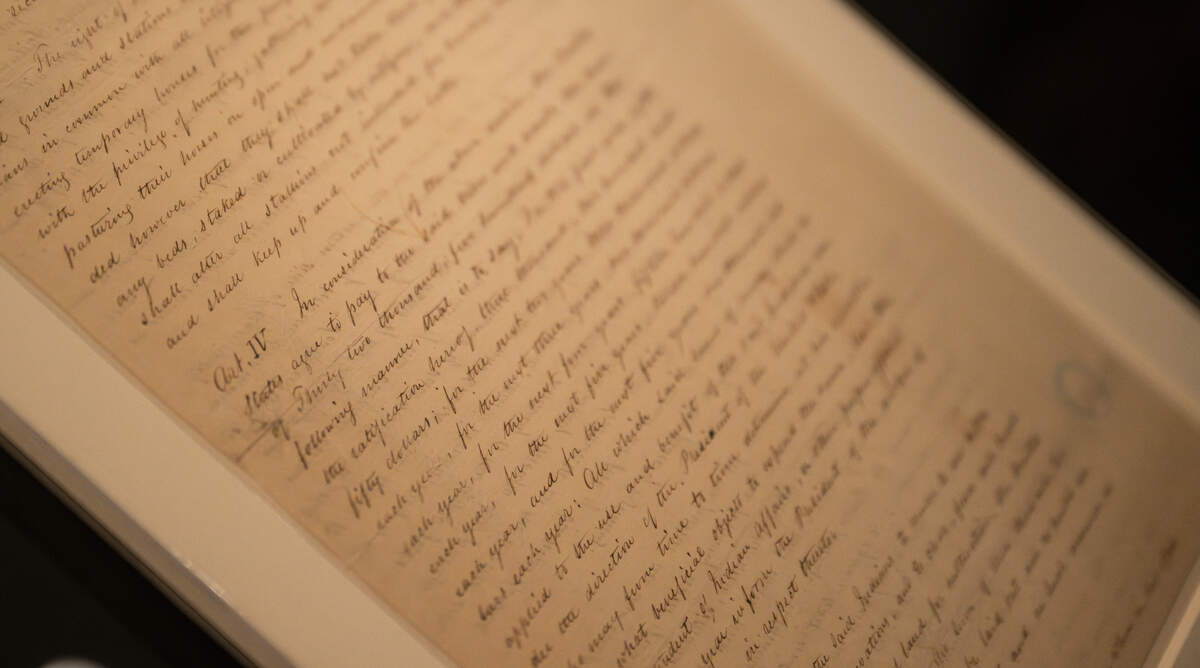
Museum director Jennifer Kilmer said the motivations behind the Medicine Creek Treaty, like other treaties, are complex.
“Treaties paved the way for Native people to be removed from their land, removed from access to food sources,” she said. “They were the beginning of many detrimental actions by the government. But they have also been used by the tribes to assert their rights. And looking at the Boldt Decision is a great example of that.”
James acknowledged the importance the treaty had in preserving native rights but also the accompanying sense of loss. A document codifying what a tribe would be given and taken from them is still a bitter pill to swallow.
“There’s a painful side to the treaties,” she said Friday, Feb. 9, while preparing for a reception at the museum for local tribal leaders. “But there’s also the recognition that we are sovereign nations. And that our sovereignty still stands today as we continue to fight for it.”
Boldt at 50
The first object a visitor sees walking into the Boldt exhibit is the judge’s black robe. It sets the tone for the show, which walks the visitor from the Medicine Creek Treaty through the Boldt Decision and into 2024.
“We take a look back at how tribes have advocated for their rights in the court system, how activists took to the waters, rivers, streams, to assert their treaty, guaranteed rights, and then forward today to look at how different entities are co-managing waters together and the impact that that’s had on Washingtonians,” Whiting said.

An inkwell once used by Washington Territory Gov. Isaac Stevens is on display although it’s unknown if it was used to sign the treaty.
Decade by decade panels list the court cases that preceded and followed Boldt as Indians sought to affirm their rights and others challenged them.
Fish wars
As sport fishing increased in the 1940s, Indians found themselves the victims of harassment from game wardens and non-Native fishermen. In 1945, a 14-year-old Nisqually tribal member was arrested for fishing on his family’s land on the Nisqually River. That boy, Billy Frank Jr., would go on to become one of the central figures in the fight for treaty rights and responsible environmental stewardship.
Frank died in 2014, but his legacy lives on today within his tribe and the national wildlife refuge and U.S. Navy ship named in his honor. A statue of Frank is being made for display in the U.S. Capitol building.
Native activism increased in the 1960s and 1970s in an era that became known as “Fish Wars” with some Indian fishermen provoking arrest. A News Tribune photo from March 11, 1964, shows the wives of tribal fishermen hauling in steelhead from a net on the Nisqually River after their husbands had been arrested for contempt of court after fishing on the river.
In 1970, tribal activists set up a fishing camp on the bank of the Puyallup River on federal land. On Sept. 9, Tacoma police invaded the camp and arrested more than 60 people. The U.S. attorney filed a lawsuit against Washington state for violating tribal treaty rights. That case, U.S. v. Washington, would go on to be known as the Boldt Decision.
The decision, a victory for Native rights, did not sit well with many. A photo in the exhibit shows a fishing boat covered in anti-Indian slogans.
A constant battle
The Boldt Decision affected only those tribes who were signees of the Medicine Creek Treaty. Tribes like the Chinook Tribe of Willapa Bay which are not recognized by the federal government didn’t benefit nor did tribes in eastern Washington.
Although the exhibit spans 170 years, it’s far from ancient history, James said. Challenges to Native rights continue to this day.
“We’re always at risk,” she said. “Although we have sovereignty, it’s never guaranteed.”
Once outsiders to a legal system imposed upon them, today’s tribal members hold law degrees and positions of power in government.
Tribal fish hatcheries are a major contributor to the state’s human-raised salmon populations. Tribes fight for the health of the land and waterways. Environmentalism comes naturally to Washington tribes, James said.
“We didn’t emigrate here,” she said. “This has always been our land. Our teachings, our elders, our wisdom keepers have always taught us that we are responsible for the care of the land and the waters. That is our responsibility to this world.”
If you go
What: “The Treaty of Medicine Creek” and “Usual and Accustomed Grounds”
Where: Washington State History Museum, 1911 Pacific Ave., Tacoma.
When: Medicine Creek Treaty through July 8, Boldt Decision through Sept. 1
Information: washingtonhistory.org/exhibit/medicine-creek/, washingtonhistory.org/exhibit/boldt-decision/
Boldt Decision Symposium: Features guest speakers. 10 a.m-5 p.m. March 30. Free with admission.
This story was originally published February 13, 2024 at 5:00 AM.