Some Tacomans are being pushed out of their neighborhoods. The city wants to intervene

As the city of Tacoma seeks to produce more affordable housing to contend with a crisis shortage, it has laid the groundwork for addressing another lingering housing issue: People getting squeezed out of their communities.
City lawmakers earlier this month adopted an anti-displacement strategy to serve as a guide to prevent longtime locals from being pushed out of their desired neighborhoods either by physical changes, such as building sales, or by market forces, including rising housing costs.
The plan consists of 21 actions for the city to consider, such as buying property to build affordable units in areas at high risk for displacement and requiring owners of subsidized properties to issue notices whenever they intend to sell, opt-out or refinance.
The strategy, approved on Feb. 6, will act as a separate addition to a broader housing plan adopted in 2018 — a plan that city officials acknowledged didn’t directly address displacement nor directly focus on people already living in Tacoma.
More than five years ago, the city passed the Affordable Housing Action Strategy (AHAS) to create new affordable housing and preserve existing stock, among other objectives. Through June, Tacoma has produced roughly 1,100 units toward its goal of 6,000 by 2028 and preserved 10% of its target of 2,300 units, also by 2028, according to the city.
Jacques Colon, the city’s chief strategy officer, said during a Jan. 23 study session that AHAS had yielded “really incredible results” but noted that development can often change the economics of a region, which can lead to displacement.
“So what we’re trying to do is to accomplish the balance of threading the needle to get the best of both worlds and ultimately have development without displacement,” Colon told Council members.
BIPOC, seniors most at risk
A report on the new strategy indicated there were high levels of displacement in Hilltop and parts of Eastside and South Tacoma and suggested those areas should be included in any geographically targeted policies that might stem from the plan.
In two Hilltop census tracts, the share of Black population significantly decreased between 1970 and 2020, the report said. One tract’s Black population, in south Hilltop, dropped from 60.6% to 21.5% over the period. Another tract, in the center of the neighborhood north to Division Street, saw a similar decline: from 33.9% to 17.9%. Meanwhile, the two tracts grew a combined 14% in total population during the same span.
The report warned that the demographic shift couldn’t be entirely tied to residents being forced out due to housing changes but noted that community members had expressed that sentiment during outreach efforts.
Seniors, communities of color and renters — a disproportionate number of the latter who are Black, indigenous or people of color (BIPOC) — are at a higher risk for future displacement, the report said. The at-risk population includes those residing in parts of the city where BIPOC residents had been historically forced to live due to racist and restrictive housing policies.
The city uses five mapping tools to gauge risk from sources that range from its own equity index to the Urban Displacement Project at University of California, Berkeley. The maps rely on indicators such as shares of BIPOC and renter population, median household income, eviction risk, home affordability and segregation, among others.
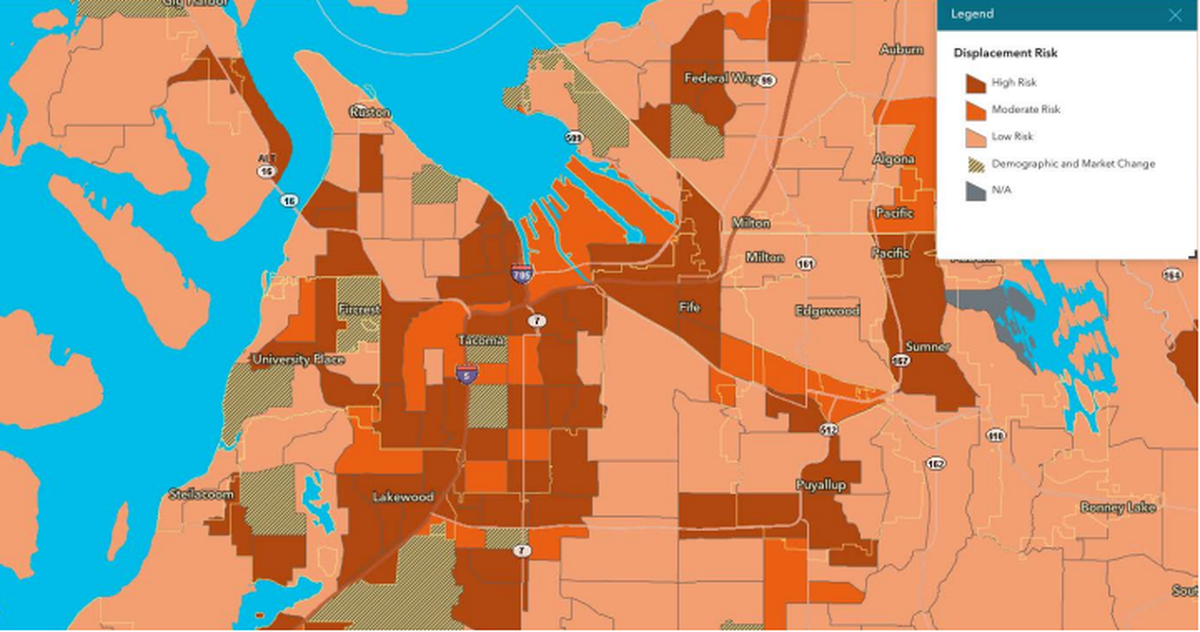
“Our city was built by those who live in our neighborhoods — the character, the feel — and it’s so sad when those people who started that feeling in a neighborhood can no longer afford to live in it,” Mayor Victoria Woodards said during the Council meeting where the strategy was adopted.
“This might be an anti-displacement strategy, but this is also an opportunity to create and hold onto wealth for our community members,” she added.
The strategy suggested a slew of actions that the city could take, including expanding one-time cash assistance to keep families housed; offering incentives for developers to build affordable housing in at-risk areas; prioritizing new units to be rented or sold to at-risk or displaced residents; focusing down-payment home-buyer assistance in high-risk neighborhoods; or reducing the cost to build accessory dwelling units.
Other possible actions included launching a proactive rental inspection program or community land trust, with the intention of preserving affordable housing; increasing funds to the city’s tenant-protection program and housing assistance contracts or creating a property tax-relief program.
The strategy also called for the city to consider establishing a reparations committee that would research the possibility of reparations for historical racist policies, the report showed.
The plan’s passage came several months after the Council enacted stronger renter protections that some argued didn’t go far enough. In November, Tacoma voters narrowly approved a sweeping renters’ rights initiative that the city said it wouldn’t enforce because it lacked authority.
Displacement adversely affects families, safety, cultural continuity, historical knowledge and the strength of a collective, according to the report and city officials. Colon said that perceptions of safety were strongly interwoven with feelings of belonging and community ties.
“We know that stable housing is vital for our community’s health, well-being and resiliency and we know that displacement all too often splits apart families and degrades trusted social networks and community institutions that vulnerable members of our community rely on for assistance,” Council member Kristina Walker said at the Feb. 6 Council meeting.
The strategy is not meant to be a short-term spending plan but instead a policy guide for the next five to 10 years, according to Ted Richardson, from the city’s Office of Strategy. As such, the report noted that each proposed action isn’t assured to be implemented, given funding and staff time constraints. As city lawmakers prepared to adopt the strategy earlier this month, Council member Kiara Daniels hinted from the dais that results may take time to show.
“I think that this is a plan and a strategy that we won’t really get to see right now but it’s going to be one of the things that our grandkids and our grandkids’ kids will thank us for,” she said.
This story was originally published February 14, 2024 at 11:00 AM.