Is Pierce County at high risk for earthquakes? Volcanoes? Yes, according to FEMA report
Have you ever wondered what natural disasters pose the most significant risk to Pierce County?
Washington isn’t a stranger to heavy precipitation events and the natural hazards it creates, such as landslides or blizzards. Although those weather-related events should be taken seriously, what about other natural threats like earthquakes or volcanoes?
Pierce County is one of three Washington counties with a “relatively high” risk assessment on the National Risk Index, the second-highest category assigned.
The National Risk Index is a data set designed and built by the Federal Emergency Management Agency that illustrates the most at-risk communities in every county nationwide for 18 natural hazards.
The index estimated that Pierce County is expected to lose over $265 million annually due to natural hazards, with its overall risk calculated to be higher than 99% of all counties within the United States and 97% of counties in Washington.
Here is why Pierce County has a “relatively high” risk assessment, the second-highest risk category.
Pierce County’s risk assessment
In order to determine risk, FEMA uses a risk equation that looks at three components:
- Expected annual loss: the average economic loss in dollars resulting from natural hazards each year.
- Social vulnerability: the susceptibility of social groups to the adverse impacts of natural hazards
- Community resilience: the ability of a community to prepare, adapt and recover from a natural hazard
The calculation multiplies the expected annual loss in dollars by the county’s social vulnerability score. The total is then divided by the county’s resilience score, and the resulting number is the county’s risk index rating.
The following natural hazards pose the highest risk to Pierce County, according to FEMA:
Avalanche: Very high
It might not seem that Pierce County is at major risk for avalanches, but according to the Pierce County website, avalanches can happen in the county’s mountainous areas, such as Mount Rainier National Park and Crystal Mountain. FEMA gave the county a score of 96.2 and expects the annual loss to be $1.8 million.
Earthquake: Relatively high
Although the chances of earthquakes in Pierce County are very low, with only a 0.735% chance every year, FEMA gave the county a score of 99.5. A 3.0 earthquake detected near Mount Rainier was felt throughout Pierce County in early February. The News Tribune previously reported that there are about three to four earthquakes on average every month within four miles of the Mount Rainier summit.
Landslide: Relatively high
Landslides in Washington are not uncommon, but in Pierce County specifically, the landslide hazard areas include the walls of the major river valleys, the more mountainous regions, the coastal areas and parts of the peninsula. FEMA predicts annual losses of $510,000, with the county averaging a landslide every five years.
Volcanic activity: Very high
It might be easy to forget that Mount Rainier, the mountain that serves as a beautiful backdrop for Puget Sound, can cause severe damage to nearby cities if it ever erupts again.
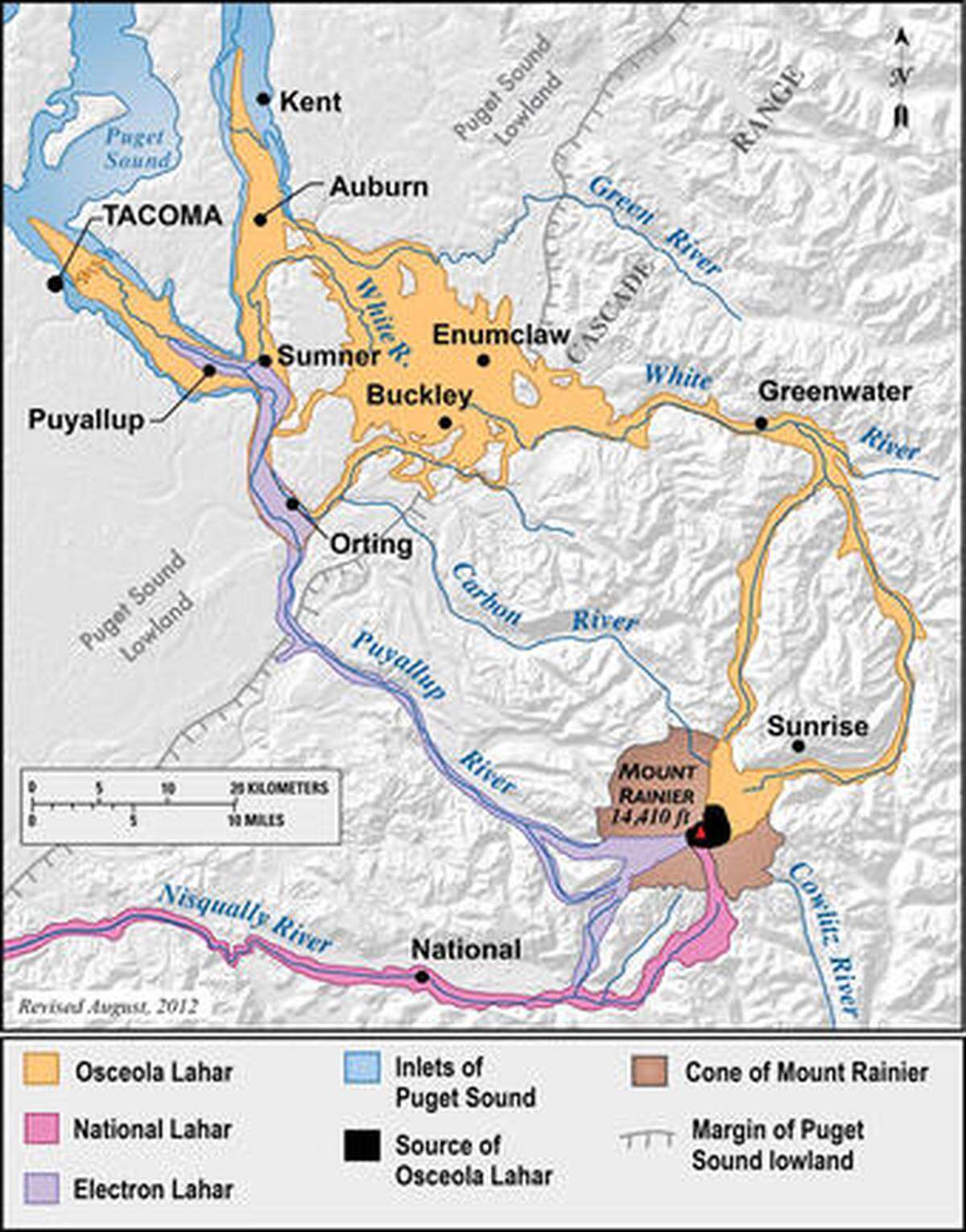
Almost all of Pierce County is within the lahar hazard zone since each of the major river valleys comprises a portion of the lahar runout zone, according to the county website.
Lahars, also known as volcanic mudflows or debris flows, pose the biggest threat to communities in lowlands. Although the county hasn’t experienced any volcanic activity in over a century, FEMA still calculated that the county has an index score of 98.9. It has been over 500 years since Mount Rainier produced a significant eruption, according to the U.S. Geological Survey.