This park might become Tacoma’s only free food forest. Its funding is at risk
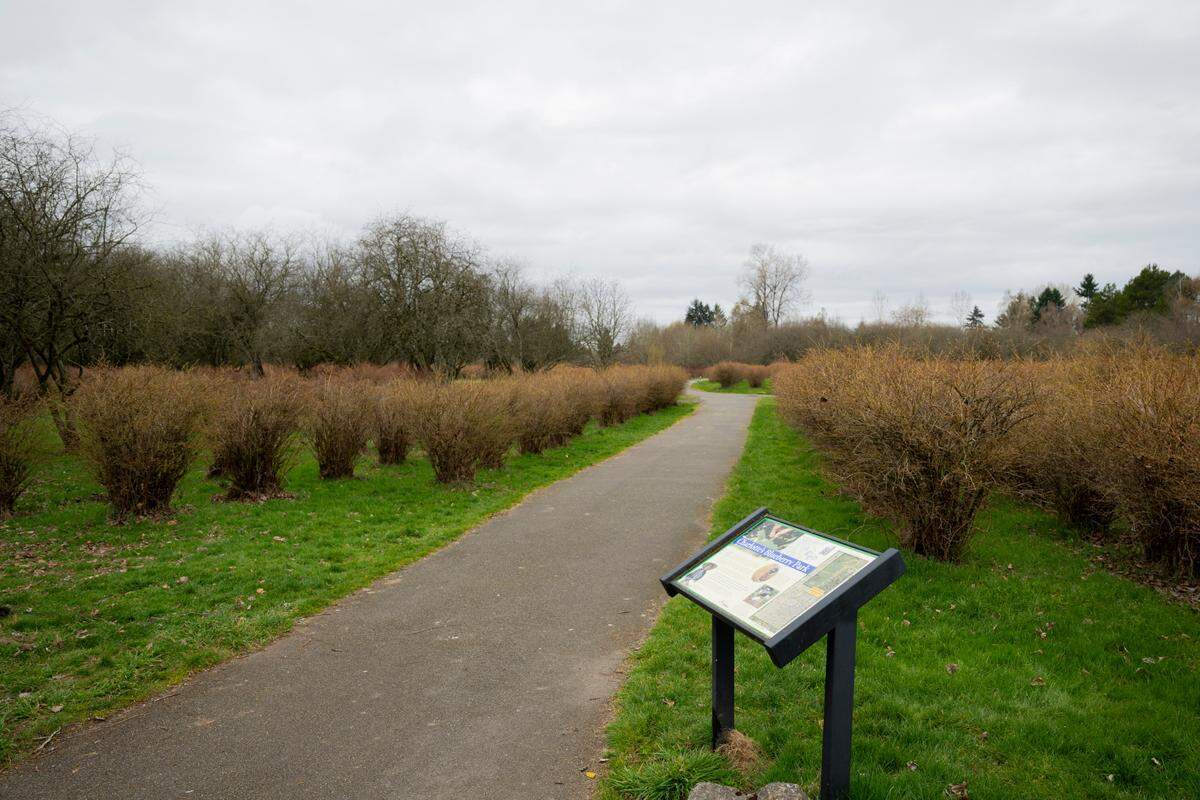
Strolling through thousands of blueberry shrubs Wednesday, Kevin Johnson pointed out open patches of grass where he wants to plant a variety of fruit and nut trees later this year in Charlotte’s Blueberry Park.
After recently receiving a $171,000 urban forestry grant from the Washington Department of Natural Resources, the Metro Parks community and special projects coordinator has a plan to make the South Tacoma park a free food forest, where anyone can come and forage not only blueberries but things like plums, persimmons, herbs, hazelnuts, figs and walnuts.
Neighbors are familiar with Charlotte’s Blueberry Park, located at 7402 E. D St., but many Tacoma residents aren’t, Johnson said. The city wants to change that, making this park the only active food forest in Tacoma.
The 20-acre park is home to more than 4,000 blueberry shrubs, as well as a community garden, a playground, paved trails and 10 acres of wetlands.
Blueberries become ripe in July and August, but the addition of other fruit and nut trees would extend the park’s harvesting season year round, Johnson said. Work to install the trees and remove some existing Hawthorn trees is expected to begin as early as this fall, and the project is expected to be complete in June 2025, he said.
The park is in an area of town that’s effectively a food desert, Johnson said, where many South Tacoma residents don’t have access to a grocery store within walking distance. In offering free food that residents can forage on their own, he hopes the project will address food insecurity as well.
“The South End experiences food insecurity almost across the entire South End. And not all the food that’s available is necessarily culturally appropriate,” said Rachel Wilkie, vice chair of the South End Neighborhood Council, who also has stakes in the project. “We just wanted to create a space where all our neighbors can come in and find things that they enjoy. It’s also about the experience. It’s very exciting for families to come year after year and … [watch] things as they bloom and grow and start to ripen.”
Metro Parks will be talking with people about what kinds of fruit and nut trees they’d like to see planted in Charlotte’s Blueberry Park, Johnson said.
A community garden group already donates leftover produce to food banks or other local organizations, he said. The South End Neighborhood Council is working to expand food giveaways to other under-served areas of Tacoma as well, Wilkie said.
From farm to park
The park was operated as a family-owned blueberry farm from 1952 until 1968 when the Tacoma School District purchased the property for the future site of a new high school, according to Metro Parks. After community outrage, that plan was abandoned and in 1994 the district traded 23 acres of the north end of the property to Metro Parks for a portion of Manitou Park, which later became the site of Manitou Elementary School.
Volunteers are active at the park, meeting monthly to weed, prune and care for more than five varieties of blueberry. In 2010 the park was named Charlotte’s Blueberry Park in honor of long-time park advocate and founder of Friends of Blueberry Park, Charlotte Valbert.
Johnson said Valbert’s decades of volunteer work were instrumental in saving the park from disrepair.
With the South End experiencing a boom of new housing developments, including along the Pacific Avenue corridor, Wilkie said it’s more important than ever to preserve and invest in parks like these.
“Only half of us are within walking distance of a green space and less than 25% of us have walkable access to green spaces,” Wilkie said, who lives a quarter mile away from Charlotte’s Blueberry Park. “It’s very important to preserve what we have and look for opportunities to find more because these green spaces are the health and the lifeblood of our community.”
Funding uncertainty threatens project timeline
On Wednesday Wilkie said she was informed the project’s grant funding might be at risk. State funding for the project is tied to the Climate Commitment Act that is being appealed in Olympia right now with Washington Initiative 2117, she said. That choice will be before voters Nov. 5.
If this grant funding falls through, the food forest will still happen one day, but it might take five to 10 years, Johnson said.
“The grant just allowed us to expedite it and get it in sooner,” he said. “Things are always changing. Even if we do lose the funding, there’s a collective consciousness about this food forest. You can stop the dollars, but you can’t stop the momentum from the community. So if there’s enough push and want from the community, then we also may find ways to put more dollars behind that on our end.”
This story was originally published March 22, 2024 at 5:00 AM.