Remember the BRAT? History of Japanese cars is focus of new car museum show
They’re small, they’re fast and they’re dazzling to behold: Japanese cars. Nearly 50 of the finest examples of automobiles from the Land of the Rising Sun are on display in “Shinka,” a show that opened in March at Lemay — America’s Car Museum in Tacoma.
We’re not talking about the latest Toyota RAV4 here. The show, which runs through March 2025, displays some of the best Japanese classics, hot rods and quirky vehicles that established the island nation as an automobile powerhouse. Think The Fast and the Funky.
There’s a 2023 Nissan Z Proto Spec that looks so fast one almost expects it to fly through the museum’s glass wall overlooking downtown Tacoma. Meanwhile, a ladybug-like 1970 Subaru 360 micro car seems like a character from Japanese anime.
The entire showcase gallery — the top floor through which visitors enter the museum — is filled with the Shinka exhibit. It’s the first show in ACM’s history that’s used the entire floor, according to executive director Gary Yamamoto.
“As we started embarking on the concept of having a Japanese car auto exhibit, the interest just exploded,” he said.
Loaners
There are 46 cars on display, all of them loaned to the museum. Those cars will be periodically swapped out during the year-long run of the show, Yamamoto said.
Although both LeMay car museums have vast collections, they are dwarfed by the number of museum-quality cars owned by enthusiasts and collectors across the country. ACM is making greater use of those loaned vehicles in its showcase exhibits, Yamamoto said.
In another change for the museum, the cars are displayed among exhibits that highlight Japanese culture and aesthetics — from ancient to anime. Previous shows mostly had just automobiles and placards. In “Shinka,” a giant origami crane gazes across the museum’s floor at a rendering of Mount Fuji and blooming sakura (cherry) trees. A set of yoroi, or samurai armor, holds court amid the automobiles.
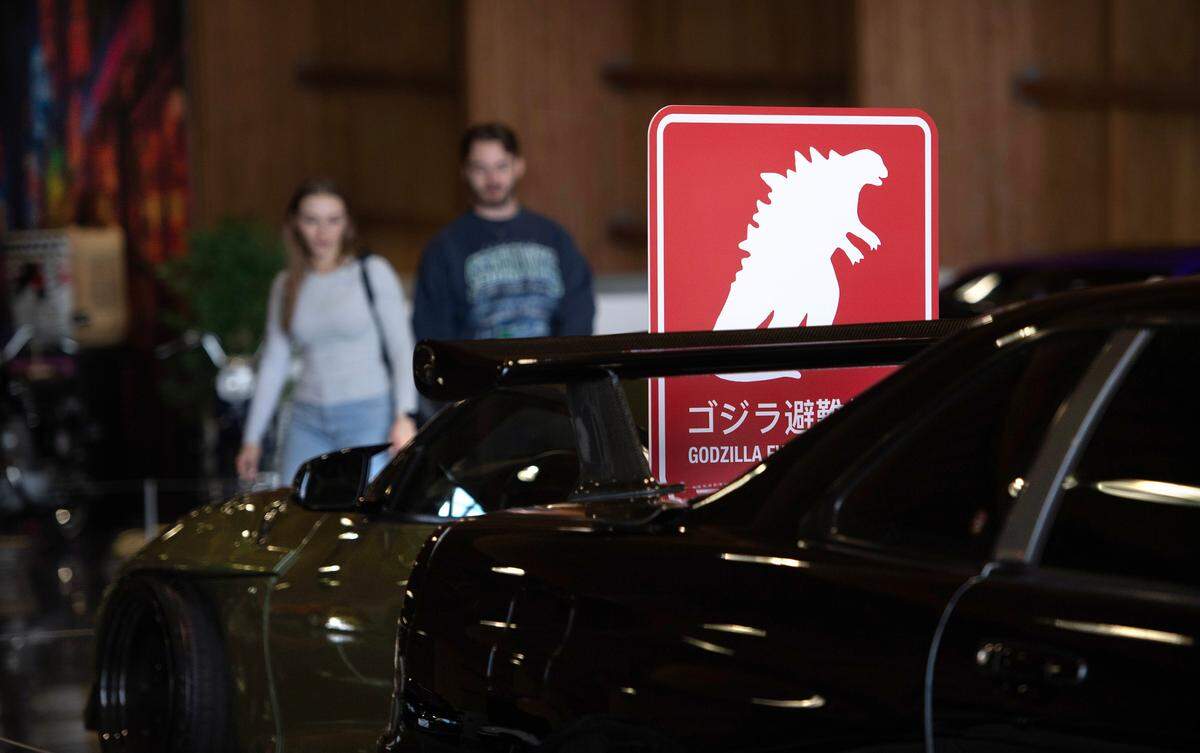
“It’s to have people come in and see the car in a similar environment in which it operated and also to expose people a little bit to the Japanese culture,” Yamamoto said.
Small is big
When Detroit was still putting out cars as big as a whale in the 1970s, Japan’s cars were more akin to goldfish.
“Why are cars small like this? Well, because in Japan, there’s very limited road space,” Yamamoto said. They were also economical with gas.
The 1970s oil embargo that led to gasoline rationing across the United States was a wake-up call for Americans. It’s also when Japanese cars really gained a foothold in the U.S. They were affordable, reliable and fun to drive.

“In the ‘70s and ‘80s, Japanese car manufacturers really figured out a way to make a small, efficient, durable car that lasts,” said Jake Welk, ACM’s spokesperson.
That doesn’t mean Japanese cars were all about practicality. A 1971 Datsun 240Z and a 1970 Nissan Fairlady Z JDM on display exemplify some of the classic sports cars from that era.
Fast, and yes, a little furious
A 1999 Nissan Skyline GT-R R34 V-SPEC looks straight out of “The Fast and the Furious” movie franchise. Equipped with hydraulics, the car’s skirting has only one inch of clearing from the museum’s floor.
Many of the cars have been customized by their owners for a wow factor. A purple 2018 Honda Civic SI Tuner bears the license plate “HNDAGRL” and has several decals, one of which reads, “Ladydriven.” It has matching lighting underneath its chassis and its wheels light up in a variety of patterns and colors. It’s won 45 awards for its design.
Not all of the vehicles in the show are flashy. There are motorcycles and delivery trucks.
A 1979 Subaru BRAT (Bi-drive, Recreational, All Terrain, Transporter) looks like a truck but isn’t, according to Yamamoto. Two rear-facing jump seats classified it as a car, allowing it to get around a 25 percent tariff on light duty trucks. As a placard explains, Ronald Reagan used one on his California ranch before becoming president.
This story was originally published April 2, 2024 at 6:00 AM.