Have a look inside luxury home that replaced Steamer’s restaurant in Tacoma’s West End
A new Tacoma waterfront home is not some kind of luxury residence displaying the whims of its owner. Every detail is both functional and intentional — by law.
For just under $2.6 million, it can be yours.
The story begins with the demise of a beloved fish-and-chips restaurant at Titlow Beach and ends with a site transformed into a 4,215-square-foot home under the watchful eyes of local and state regulators.
The property’s owners are Mike and Marsha Ebert. Mike is probably best known for co-developing Katie Downs Waterfront Tavern, (named after his grandmother) also in Tacoma.
In 1984 he purchased the Titlow Beach area property at 8802 Sixth Ave., where at the time sat a derelict building.
Instead of building the couple’s waterfront dream home, the property became a restaurant. Steamer’s Seafood Cafe was at the site from 1991 until it closed in early 2021.
Keeping any restaurant going amid the COVID-19 pandemic on that property was further complicated after a call from BNSF Railway in Fort Worth involving property next to the rail line at the site.
According to Ebert, BNSF had been leasing the property for Steamer’s use.
BNSF was taking back the parking property, and putting a lock on gates at the site to prevent future use.
“The key to the whole thing to me was if there’s no parking, there is no restaurant, because there’s no place to reclaim it,” he said.
With no viable option for alternative parking close to maintain it as a restaurant site, something else had to happen.
From blaring horns to quiet zone
As The News Tribune reported in February 2023, the Sixth Avenue rail crossing is one of two planned pedestrian improvement projects funded by city and state money and a Federal Highway Safety and Improvement Grant. The other is South 19th Street rail crossing at the Narrows Marina.
Improvements are geared toward submitting an application to federal regulators for a “Quiet Zone.” The city describes the zone as “a section of a rail line at least one-half mile in length that contains one or more consecutive public roadway-rail grade crossings at which locomotive horns are not routinely sounded when trains are approaching the crossings.”
According to the city’s project page, “Select improvements include upgraded railroad signals, relocated vehicle railroad gates, the installation of new pedestrian railroad gates, sidewalks, curb ramps, pavement replacement, pavement markings/crosswalks, landscaping, signage and fencing.”
Maria Lee, a spokesperson for the city, told The News Tribune on Wednesday, “We’re currently collaborating with (Washington Department of Transportation) to obtain authorization for re-advertising both projects” for a city contractor.
“Our next steps entail awaiting WSDOT’s review of specification documents and WSDOT’s approval to proceed with advertising.”
Lee added, “If all goes as planned, we aim to advertise these projects by June 2024 and begin construction by fall 2024.”
In the meantime, the horns keep blowing at the crossing until the application is approved.
After learning about the “Quiet Zone” project, Ebert didn’t feel there was any logic in arguing against it.
“The horn is a big deal,” Ebert said. “So for me to argue against that and say, ‘No, you can’t do that. ... It was futile.’”
He described the situation to a reporter in a recent visit to the house. As if on cue, a train rolled by — complete with blaring horn.
“We have friends on Fox Island who can hear it,” he responded when asked how loud the horns were during the day.
From restaurant site to waterfront home
Ebert met with city and state Department of Ecology representatives, who worked through the complex permitting process to create a new home at the site.
“And if it hadn’t been for the city and the state Department of Ecology, we would never have been able to do it,” he said.
Shirley Schultz is a supervisor in the city’s land-use and zoning department. In a phone interview this week, Schultz offered further details on the project’s complexity under the shoreline master program and shoreline code.
“The building that was there pre-existed a lot of our shoreline regulations and was, to use the official planning term, ‘nonconforming’ to a lot of our regulations,” she said.
Schultz added that “by changing the use, we were able to work with the owner to bring it more into conformance because of its location and because of the way that it was built.”
Working through a shoreline exemption, she said, they looked at “how to get rid of some of the pavement and the hardscape, which we don’t want in the shoreline, and add some native plantings and convert it to a use that may be more viable in that location.”
“They were super cooperative and great landowners to work with and a great designer to work with. So that’s how we got to where we are today,” she said.
Despite the city and Ecology’s help, construction was in no way simple, starting with keeping the exact same footprint of the restaurant to prevent any impacts to the shoreline’s buffer area.
“If you’re building a house, which is allowed, you have to make sure that you’re protecting the ecology,” Schultz explained. “And that has to do with things like pavement and roof line and making sure you’ve got room for plantings. So because their building already was in that protected area, they couldn’t make it any bigger without going through a whole bunch more hoops that they might not have been able to make it through.”
“We were forbidden to change the footprint of the building — that was required by the state,” Ebert said. “You could not change anything on the footprint, from looking at it via satellite.”
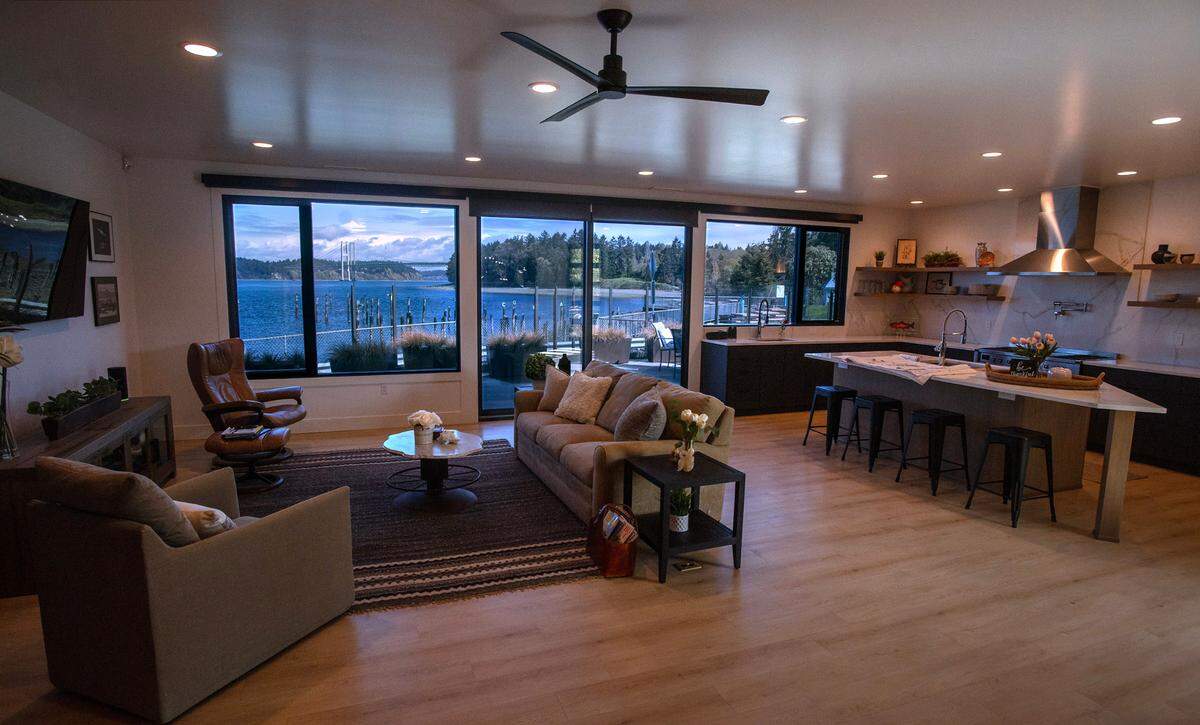
The house includes three built-in fireplaces, all electric, which, Ebert noted, came from Germany, and offers energy-efficiency features such as tinted, triple-pane windows, heat pump, solar panels and more.
“This is max efficient,” he said.
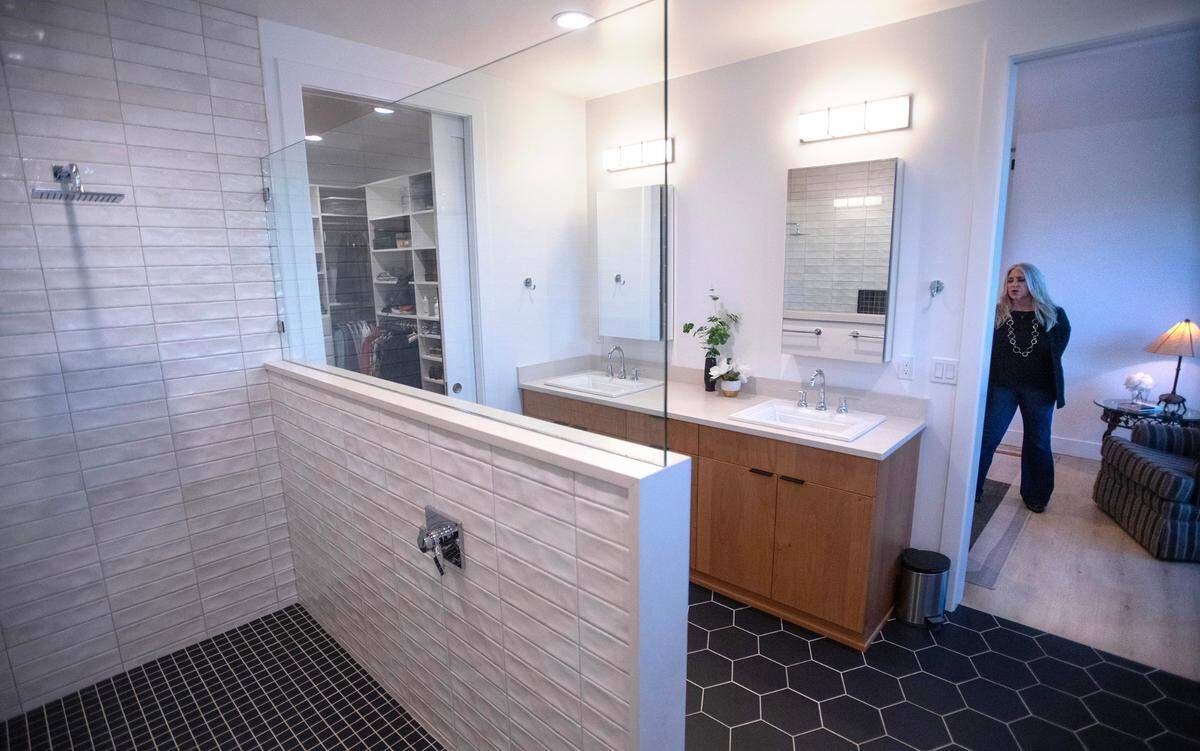
The home features quartz countertops and an island with a prep sink and bar seating as well as gas cooktop. The main bedroom comes with expansive adjacent bath and a walk-in closet.
Views of the Olympics and the bridge are plentiful from inside.
A landscape architect was brought in, and the site includes 300 native marine plants, as per code, as well as permeable pavers and permeable surfaces around the structure.
Inspectors were particular about every detail, Ebert said, including the variety of snowberry plant that is part of the landscaping.
“There’s three or four different varieties, but only one of them is native,” he said. “For the inspection, when they showed up from the state and the city, they checked every single one of those varieties ... they got down to where they could tell by the color of this berry whether it was the correct variety.”
“Our biologists are really good,” Schultz said. “They know.”
The end result is a home that features one-of-a-kind views of Tacoma Narrows Bridge, waterfront sunsets, an open floor plan that manages also to include a lower level, plus three bedrooms/baths and a half-bath also tucked inside, storage nooks and more.
“It will be a unique buyer, for sure,” said Anne Watkins, the home’s listing broker with Morrison House Sotheby’s International Realty.
Ebert and his wife were on the property to oversee the entire construction process, and live there now. For the couple, the time seemed right to let new owners take on the site.
When asked what he’d miss most when the home sells, it was simple.
“The people and the bridge,” Ebert responded, followed by descriptions of how the crowds changed through the day from dog walkers to those enjoying lunch by the water to whale watchers.
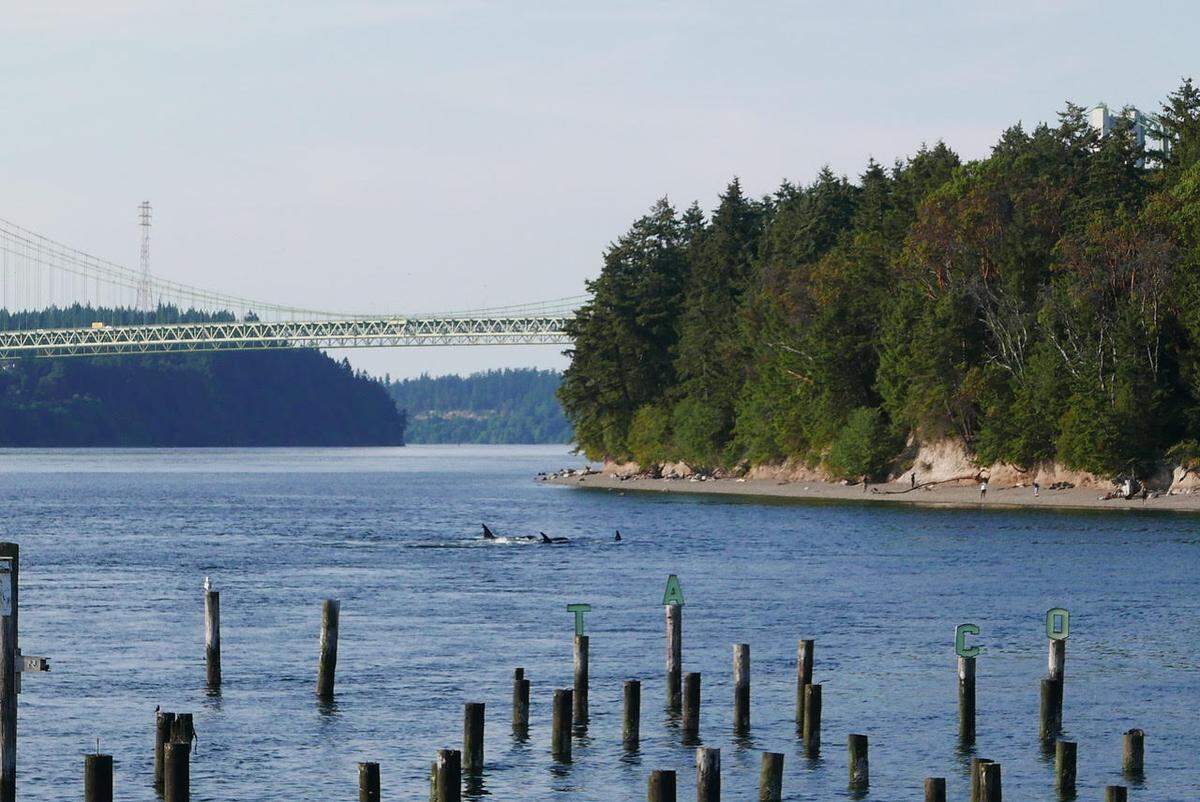
“I don’t know how many people that have gotten engaged out here. I can’t tell you how many weddings we’ve seen out there on the beach ... baptisms ...,” he said.
“People spend tons of money to go to Paris to the Champs-Élysées, to sit there and have a coffee and and watch people go by,” he said. “We get to sit here, and I kid you not, it is mesmerizing.”
News Tribune archives contributed to this report.
This story was originally published April 11, 2024 at 11:00 AM.